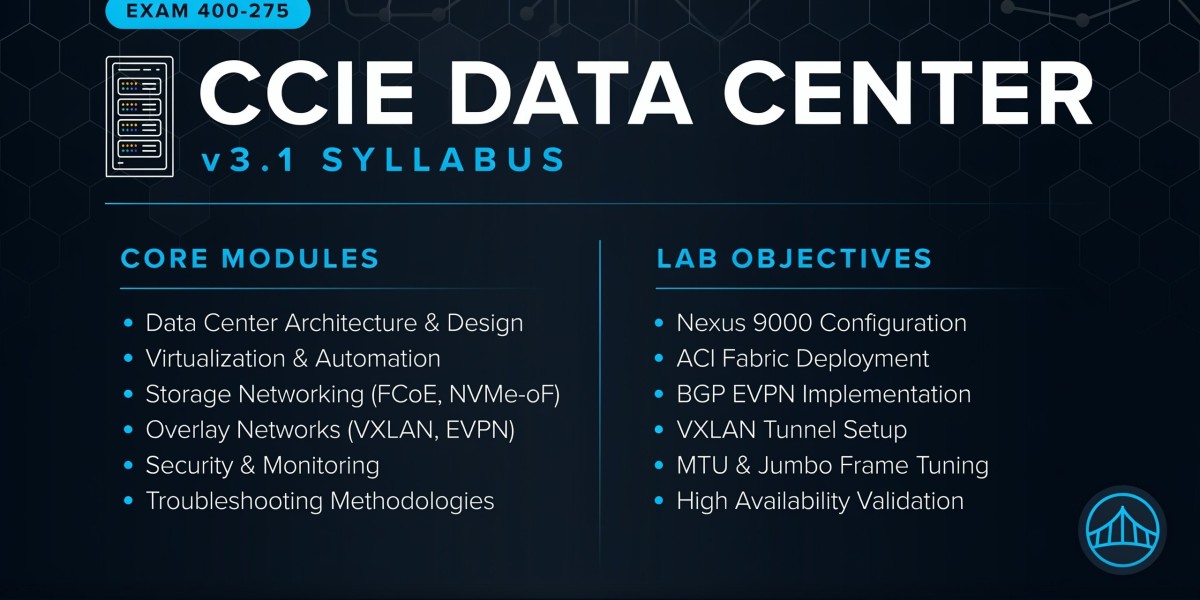

CCIE Data Center v3.1 Syllabus
If you're planning to become an expert in enterprise data center technologies, understanding the latest certification blueprint is the first step toward success. The CCIE Data Center v3.1 Syllabus introduces updated technologies, practical lab topics, and modern networking concepts that align with today's industry requirements. CCIE Data Center Training helps candidates gain the hands-on expertise required to master these advanced technologies and confidently prepare for the certification exam.
Understanding the CCIE Data Center v3.1 Syllabus
The CCIE Data Center v3.1 syllabus is designed to validate advanced knowledge and practical skills in planning, implementing, operating, and troubleshooting complex data center infrastructures. Cisco regularly updates the blueprint to reflect evolving technologies, ensuring certified professionals remain relevant in modern IT environments.
The certification consists of two exams:
CCIE Data Center Written Exam (Qualifying Exam)
CCIE Data Center Lab Exam
While the written exam focuses on theoretical understanding, the lab exam evaluates your ability to configure, troubleshoot, and optimize enterprise-grade data center environments.
Why Cisco Updated the v3.1 Blueprint
Cisco revised the syllabus to include technologies that organizations actively use today. Modern enterprises increasingly rely on virtualization, automation, software-defined infrastructure, and cloud integration.
The updated syllabus emphasizes:
Infrastructure automation
Network programmability
Enhanced storage technologies
Modern security practices
Advanced troubleshooting methodologies
Cloud-ready architectures
Who Should Learn the CCIE Data Center v3.1 Syllabus?
The certification is ideal for professionals who already possess networking experience and want to specialize in enterprise data center technologies.
Suitable candidates include:
Network Engineers
Data Center Engineers
Infrastructure Engineers
Network Architects
System Administrators
Technical Consultants
Cloud Infrastructure Engineers
Professionals working with Cisco Nexus switches, UCS servers, SAN technologies, or enterprise virtualization platforms benefit significantly from mastering this syllabus.
Overview of the CCIE Data Center v3.1 Topics
The updated blueprint is divided into multiple technical domains. Each section tests advanced implementation and troubleshooting skills.
Network Infrastructure
Network infrastructure forms the backbone of every enterprise data center.
Topics include:
Cisco Nexus architecture
Layer 2 switching
Layer 3 routing
VXLAN EVPN
FabricPath
Cisco ACI fundamentals
Multicast technologies
High availability
Virtual Port Channels (vPC)
Overlay networking
Candidates must understand how to build scalable and resilient network infrastructures.
Compute Infrastructure
Compute technologies are another major portion of the exam.
Key topics include:
Cisco Unified Computing System (UCS)
UCS Manager
Service Profiles
UCS Fabric Interconnects
UCS Domain configuration
Server virtualization
BIOS policies
Firmware management
Server deployment
Hardware troubleshooting
Hands-on practice is essential because the lab exam includes real-world server administration scenarios.
Storage Networking
Storage remains a core component of enterprise data centers.
Important syllabus topics include:
Fibre Channel fundamentals
Fibre Channel over Ethernet (FCoE)
VSAN configuration
SAN switching
Zoning
NPIV
Storage security
Performance optimization
Troubleshooting SAN connectivity
Understanding storage protocols helps engineers maintain high-performance enterprise applications.
Network Services
Candidates must configure and troubleshoot enterprise services that support business applications.
These include:
DHCP
DNS
NTP
QoS
First Hop Redundancy Protocols
Multicast
Load balancing concepts
Network optimization
High availability features
These services improve reliability and application performance.
Infrastructure Security
Security plays a larger role in the v3.1 syllabus than previous versions.
Security Concepts Covered
Topics include:
AAA
TACACS+
RADIUS
Role-Based Access Control
Secure device management
Management plane security
Control plane protection
Network segmentation
Device hardening
Secure protocols
Organizations increasingly expect infrastructure engineers to secure critical data center resources.
Infrastructure Automation and Programmability
Automation is one of the biggest additions to the updated syllabus.
Automation Technologies
Candidates should understand:
Python basics
JSON
YAML
REST APIs
Cisco NX-API
Ansible fundamentals
Infrastructure automation
Configuration management
Network programmability
API integration
Automation reduces manual configuration errors while improving deployment efficiency.
Why Automation Matters
Modern enterprise data centers can contain thousands of devices. Manual configuration becomes inefficient and error-prone.
Automation enables:
Faster deployment
Consistent configurations
Reduced operational costs
Improved scalability
Better compliance
Simplified troubleshooting
Automation knowledge is becoming a valuable skill for infrastructure professionals.
Virtualization Technologies
Virtualization remains an essential component of enterprise infrastructure.
Topics include:
Virtual machines
Hypervisors
VMware integration
Virtual networking
Resource allocation
UCS virtualization support
Virtual storage
High availability
Virtual machine mobility
Candidates should understand how networking integrates with virtualized environments.
Cloud Integration
Although CCIE Data Center focuses primarily on on-premises infrastructure, modern enterprises often operate hybrid environments.
The syllabus introduces cloud-related concepts such as:
Hybrid cloud architecture
Cloud connectivity
Automation workflows
Infrastructure scalability
Resource provisioning
Policy-based management
Understanding cloud integration helps engineers design future-ready infrastructures.
Troubleshooting Skills Required
Troubleshooting is one of the most important parts of the certification.
Candidates should practice identifying and resolving issues involving:
Network connectivity
Routing
Switching
Storage
Compute infrastructure
UCS configuration
Nexus switching
Automation failures
Performance bottlenecks
High availability failures
The lab exam measures both technical knowledge and structured troubleshooting methodology.
Hands-On Lab Practice
Reading documentation alone is not enough.
Candidates should spend significant time practicing:
Nexus switch configuration
UCS Manager administration
Fibre Channel setup
VXLAN deployment
Cisco ACI fundamentals
Automation scripts
API testing
Troubleshooting labs
Consistent lab practice improves confidence and prepares candidates for real-world scenarios.
Recommended Study Resources
Preparing for the CCIE Data Center v3.1 syllabus requires multiple learning resources.
Useful study materials include:
Cisco Official Certification Guides
Cisco Documentation
Cisco Learning Network
Cisco DevNet
Virtual Labs
Practice Labs
Whitepapers
Technical Videos
Community Forums
Mock Lab Exams
Using diverse learning resources strengthens conceptual understanding.
Common Preparation Strategy
A structured study plan helps candidates cover every syllabus section effectively.
Step 1: Learn the Fundamentals
Build a strong understanding of:
Networking
Switching
Routing
Storage
Virtualization
Step 2: Master Cisco Technologies
Focus on:
Cisco Nexus
Cisco UCS
Fibre Channel
VXLAN
Automation
Step 3: Build Hands-On Experience
Practice daily using:
Virtual labs
Physical lab environments
Simulation software
Step 4: Practice Troubleshooting
Troubleshooting should become a daily habit rather than a final preparation activity.
Step 5: Attempt Mock Labs
Full-length lab simulations improve speed, accuracy, and confidence before the actual examination.
Career Opportunities After CCIE Data Center Certification
Professionals who earn this certification become qualified for senior infrastructure roles.
Popular job positions include:
Senior Network Engineer
Data Center Engineer
Infrastructure Architect
Network Consultant
Cloud Infrastructure Engineer
Technical Solutions Architect
Systems Integration Engineer
Enterprise Network Architect
Many organizations value the certification because it demonstrates advanced technical expertise.
Benefits of CCIE Data Center Training
Enrolling in structured CCIE Data Center Training provides several advantages beyond self-study.
Key benefits include:
Access to experienced instructors
Real-world lab environments
Updated curriculum aligned with v3.1
Practical troubleshooting sessions
Mock lab examinations
Automation practice
Personalized guidance
Better exam preparation
Industry-relevant projects
Increased confidence before certification
Training also helps candidates understand complex topics more efficiently through guided instruction and hands-on exercises.
Tips for Successfully Completing the Syllabus
Stay Consistent
Allocate dedicated study time every day rather than cramming before the exam.
Focus on Practical Learning
Configuration and troubleshooting experience are more valuable than memorizing theory.
Learn Automation Early
Automation is becoming increasingly important in enterprise networking and should not be postponed until the end of your preparation.
Review Cisco Documentation
Official Cisco documentation provides the most accurate explanations for advanced technologies.
Practice Full Lab Scenarios
Combining multiple technologies into complete deployment scenarios prepares you for real exam conditions.
Conclusion
The CCIE Data Center v3.1 Syllabus reflects the latest advancements in enterprise networking, storage, virtualization, automation, and security. Its comprehensive structure prepares professionals to design, deploy, manage, and troubleshoot modern data center infrastructures with confidence. While the certification is challenging, a disciplined study plan, regular hands-on lab practice, and quality CCIE Data Center Training can significantly improve your chances of success. By mastering every domain of the updated syllabus, you not only prepare for the certification exam but also build practical skills that are highly valued across enterprise IT environments.