
That divide is closing fast, and organizations that don't adapt are already falling behind. The shift happening right now in platforms like Microsoft Fabric is not just a technical upgrade. It is a fundamental change in how data work gets done, reviewed, and delivered at enterprise scale.
The Hidden Cost of Unstructured Data Development
Most data teams have a story like this one: a critical dashboard breaks hours before a board meeting. Someone made an update the previous evening. No one knows exactly what changed, there is no record of the previous version, and rebuilding from memory takes the entire team the rest of the day.
This isn't a dramatic edge case. It's a weekly reality for analytics teams working without version control. The cost isn't just hours lost. It's stakeholder trust, delayed decisions, and in regulated industries like banking or healthcare, potential compliance exposure that can carry serious consequences.
The root issue is that modern data platforms were originally built to be powerful analytics environments, not structured development ecosystems. Collaboration happened at the workspace level, not the code level. That architecture made the platform easy to start with but genuinely difficult to scale responsibly once teams grew in size or complexity.
When multiple engineers are working on the same pipelines and reports simultaneously, the absence of version control turns everyday development into a coordination risk. The last person to save their changes wins, and there is no system to question that outcome.
What DevOps Actually Means for Data Teams
When developers talk about DevOps, they mean a set of practices that bring structure, traceability, and automation to how software gets built and deployed. If you're new to terms like CI/CD pipelines, Git branching, or version control, understanding the fundamentals of Cloud Data Management will give you the right foundation before going deeper into how these practices apply to your data platform.
The essential pillars are:
Version control means every change is tracked, timestamped, and attributed to the person who made it. You can always see what changed, when it happened, and who made the call.
Branch-based development means engineers work in isolated environments, so no one overwrites anyone else's changes while work is still in progress.
Code review before deployment means changes go through an approval process before they reach production, catching errors early and improving the overall quality of what gets released.
Automated pipelines mean that instead of manually moving assets from development to test to production, deployments happen automatically once changes are reviewed and approved by the right people.
These aren't new ideas. Software engineering teams have relied on them for over a decade. The question for data teams has always been the same: when do we get the same tools and the same standards?
The Platform Gap Is Now Officially Closed
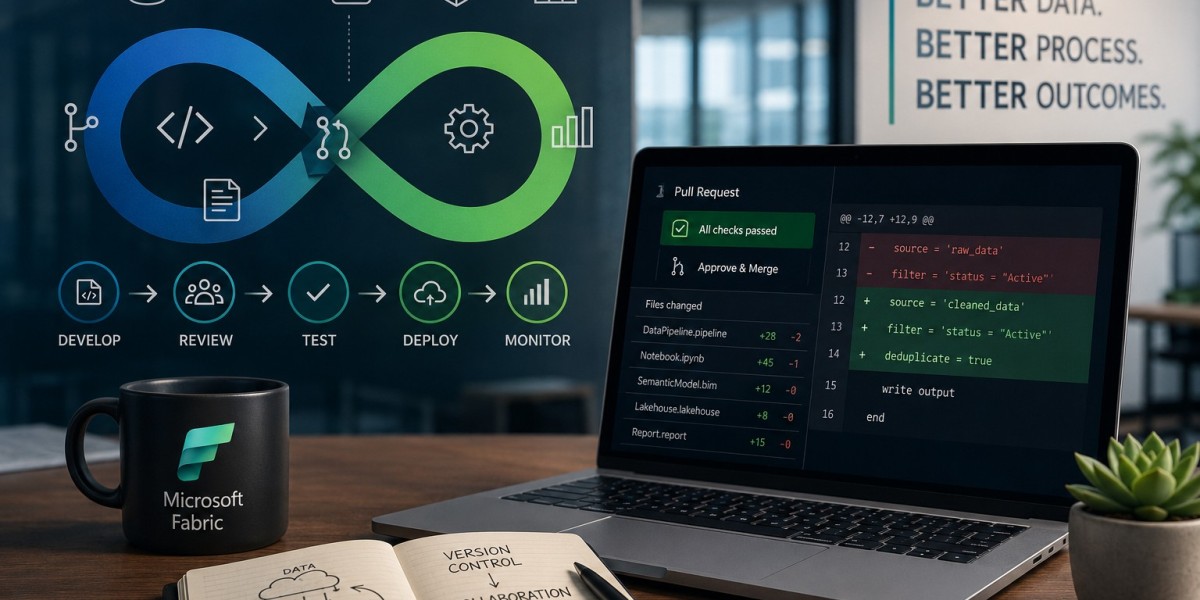
Microsoft's April 2026 update to Microsoft Fabric is the most significant answer to that question yet. Native Git integration now covers every Fabric asset type, including data pipelines, notebooks, semantic models, lakehouses, and reports. Developers can build and test locally through VS Code extensions using the same tools and shortcuts they already rely on. Automated CI/CD pipelines replace manual deployment steps entirely, removing the human error that creeps into repetitive release processes.
What this means in practice is that a data engineering team can now work with the same discipline and structure as a software team. Feature branches, pull requests, automated tests, and clean promotion paths from development to production are all now native to the platform.
For a detailed breakdown of exactly what shipped in this update and how enterprise teams across financial services, retail, and distributed global organizations are already applying it, Microsoft Fabric DevOps: What Changed and Why Your Data Team Should Care is the most thorough analysis available and covers real-world scenarios in depth.
Three Shifts That Follow When Data Teams Adopt DevOps
1. Accountability becomes built-in, not optional
When every change is committed to Git with an author, timestamp, and message, governance stops being a quarterly audit exercise and becomes a natural output of how the team works day to day. Compliance teams can answer questions like "who changed this report and why" simply by searching through commit history, without needing to interview engineers who may not clearly remember.
For regulated industries, this shift from reactive to proactive compliance carries real dollar value. Audit preparation becomes a matter of pulling records rather than reconstructing events from memory.
2. Parallel development stops being chaotic
Branch-based development removes the single biggest friction point for distributed data teams, which is the shared workspace conflict. Engineers across different time zones can work independently on their own branches and merge their changes through a defined review process. The chaos of "last save wins" is replaced by a workflow where nothing reaches production without proper oversight and sign-off.
This also has a cultural benefit. Teams that once operated in silos around shared workspaces begin to develop a common, consistent workflow that makes collaboration cleaner and onboarding new engineers far more straightforward.
3. Deployment cycles shorten without quality dropping
Automated pipelines remove the dependency on people following the same checklist correctly every single time. Once set up, the same sequence of validate, review, merge, and deploy runs consistently for every change, whether it is a minor label fix or a major pipeline overhaul. Release cycles that used to take days can now happen on a reliable weekly cadence.
Early Adopters of Fabric DevOps Will Pull Ahead
DevOps maturity in data engineering is still relatively low across the industry. Most teams are still working in ways that software development teams moved away from years ago. Teams that build this capability now, establishing the workflows, the branching conventions, and the pipeline templates, are accumulating a real operational advantage. Those that wait will find themselves catching up to a standard that early movers helped define.
Organizations already standardized on Azure DevOps or GitHub are particularly well-positioned to make this transition without significant disruption. Dream IT's Cloud Data Management services are built specifically around helping teams extend these existing platforms into their data engineering practice, reducing the number of tools to manage and shortening the learning curve for engineers who are new to Git-based workflows.
The tools exist. The platform update has shipped. The only remaining question is whether your organization's processes and engineering culture will follow before your competitors' do.
Dream IT is a Microsoft Solutions Partner specializing in data analytics, cloud data management, and enterprise Microsoft platform implementations. If your team is ready to modernize how it builds and deploys data assets, our team can help you design a workflow built for scale.