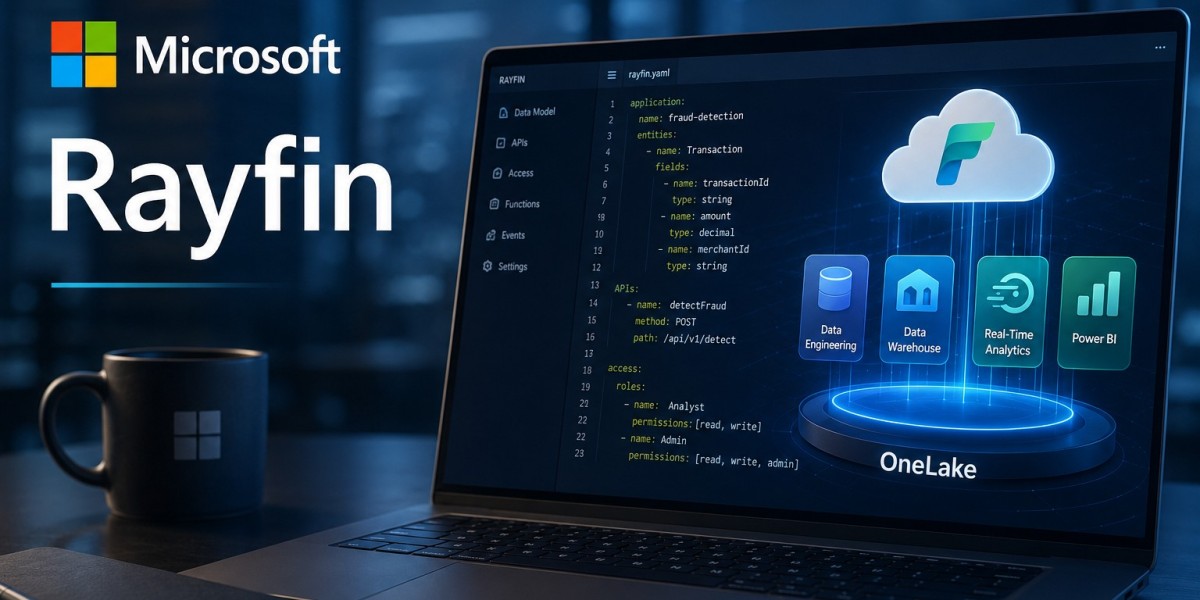

For most of the last two decades, enterprise applications and enterprise analytics have lived in separate worlds. Apps ran on their own databases, spoke to their own APIs, and shipped data off to a warehouse or lake only after the fact, usually through a maze of ETL jobs nobody enjoyed maintaining. Microsoft's new Rayfin platform is a direct challenge to that separation, and it's worth understanding why the company thinks the timing is finally right.
The Problem Rayfin Is Trying to Solve
AI coding tools have made the easy part of app building even easier. A frontend, a UI flow, a bit of business logic: an agent can scaffold all of that in minutes. What hasn't gotten easier is everything underneath the surface. Someone still has to stand up a database, wire authentication, write and secure APIs, configure hosting, and make sure the whole thing meets whatever compliance bar the organization has set. That backend layer has quietly become the real bottleneck standing between an AI-generated prototype and something a business can actually run in production.
Rayfin is Microsoft's answer to that bottleneck. It's a code-first backend platform built directly into Microsoft Fabric, designed so that developers, and increasingly AI agents working on their behalf, can describe an application's data model, logic, and access rules in code and have Fabric provision everything else automatically.
A Code-First Platform, Not a Low-Code One
It's worth being precise about what Rayfin is not. It isn't a drag-and-drop app builder, and it isn't trying to compete with low-code tools aimed at citizen developers. Rayfin is built for professional engineering teams, and it leans into standard software practices rather than replacing them: version control, CI/CD pipelines, GitOps-style workflows, and an open SDK and CLI that fit into the tooling teams already use.
That distinction matters because it shapes who Rayfin is for. It's aimed at organizations that already have engineering discipline and want to extend it into a new layer, not organizations looking to bypass engineering altogether. Define your backend the same way you'd define anything else in a repository, and let the platform handle provisioning, deployment, and governance from there.
Why Fabric, Specifically
The choice to build Rayfin on top of Microsoft Fabric, rather than as a standalone service, is the most consequential design decision in the whole product. Fabric already unifies data engineering, data warehousing, real-time analytics, data science, and Power BI reporting on a single data foundation called OneLake. By deploying application backends directly into that environment, Rayfin means an app's operational data isn't a separate island waiting to be piped into analytics later. It's already there.
That has a practical effect most engineering teams will recognize instantly: fewer synchronization jobs, less duplicated data, fewer reconciliation headaches between what the app thinks is true and what the reporting layer shows. Instead of building a pipeline to move data toward the tools that need it, Rayfin's premise is to build the application where the data already lives.
Governance as a Starting Point, Not an Afterthought
Enterprise IT teams have heard "move fast" promises before, and the reasonable reaction is usually skepticism about what gets sacrificed to get there. Rayfin's pitch tries to head that off by baking governance into the platform from day one rather than treating it as a compliance pass bolted on before launch.
Because every application backend deployed through Rayfin becomes a governed artifact inside Fabric, it inherits the platform's existing security policies, access controls, and audit capabilities automatically. For regulated industries such as banking, insurance, healthcare, and government, where an application's data handling can be as scrutinized as its functionality, that built-in governance is arguably a bigger selling point than the development speed itself.
What This Looks Like in Practice
Consider a few scenarios that map well to Rayfin's design:
A financial services firm wants a fraud-detection tool that reacts to transactions as they happen, drawing on data that's already tightly access-controlled. Building that tool outside the governed data estate would mean either duplicating sensitive data into a new system or building a slow, brittle integration back into it. With Rayfin, the application lives inside the same governed environment as the data it needs.
A retailer wants an internal app that blends live sales figures with a predictive demand model. Normally that means stitching together an operational database, an analytics pipeline, and a reporting layer maintained by three different teams. On Rayfin, the app's backend and the analytics layer share the same data foundation from the start.
A manufacturer wants a lightweight internal dashboard connecting shop-floor data to a predictive maintenance model. Rather than commissioning a separate application platform, the dashboard's backend is defined in code and deployed straight into the same Fabric workspace already running the manufacturer's analytics.
None of these are exotic use cases. They're the kind of internal tools most enterprises already build, just usually with far more friction than Rayfin is designed to require.
The Bigger Strategic Play
Rayfin is best understood as part of a larger repositioning Microsoft is attempting with Fabric. Fabric launched as a unified analytics platform, competing for the attention of data engineers and BI teams. Rayfin pushes it toward something broader: a platform where application development and data analytics aren't just adjacent, but structurally the same thing.
Replit CEO Amjad Masad, whose company partnered with Microsoft at Rayfin's launch, described the intended outcome as compressing the distance between an idea and enterprise-grade production down to hours rather than months. Whether Rayfin delivers on that timeline at scale remains to be seen, but the architectural bet behind it is clear enough: as AI agents take on more of the actual coding, the organizations that win will be the ones whose data platforms make it safe and fast to put that code into production, not just easy to generate it in the first place.
For enterprises already invested in Microsoft Fabric, Rayfin is a natural next step worth watching closely, but getting the architecture, governance, and rollout right takes more than reading the release notes. Dream IT Consulting Services works with organizations navigating exactly this kind of shift, helping teams plan their Fabric adoption, tighten data governance, and build a rollout strategy that matches Rayfin's capabilities to real business needs instead of chasing the hype. If you want a deeper technical breakdown of the platform before you commit resources, Dream IT's detailed look at how Rayfin is transforming data application development in Microsoft Fabric is a good next stop, and their team is ready to help you turn that research into an actual implementation plan.