
Key Takeaways:
- Multimodal, hybrid-reasoning models read text, images, audio, and video together, and the systems built for text alone cannot absorb them without rework.
- Gartner expects multimodal software to jump from under a tenth of enterprise applications to roughly four-fifths by 2030, so the integration decision is arriving fast.
- Text-era data pipelines, storage, latency budgets, orchestration, and governance each break in a specific, predictable way when video and audio enter the flow.
- The projects that stick treat AI integration solutions as an architecture problem first, pairing model access with retrieval, evaluation, and access controls built for mixed media.
- Cost, evaluation, and security are the three failure points that abandon most pilots after a promising demo.
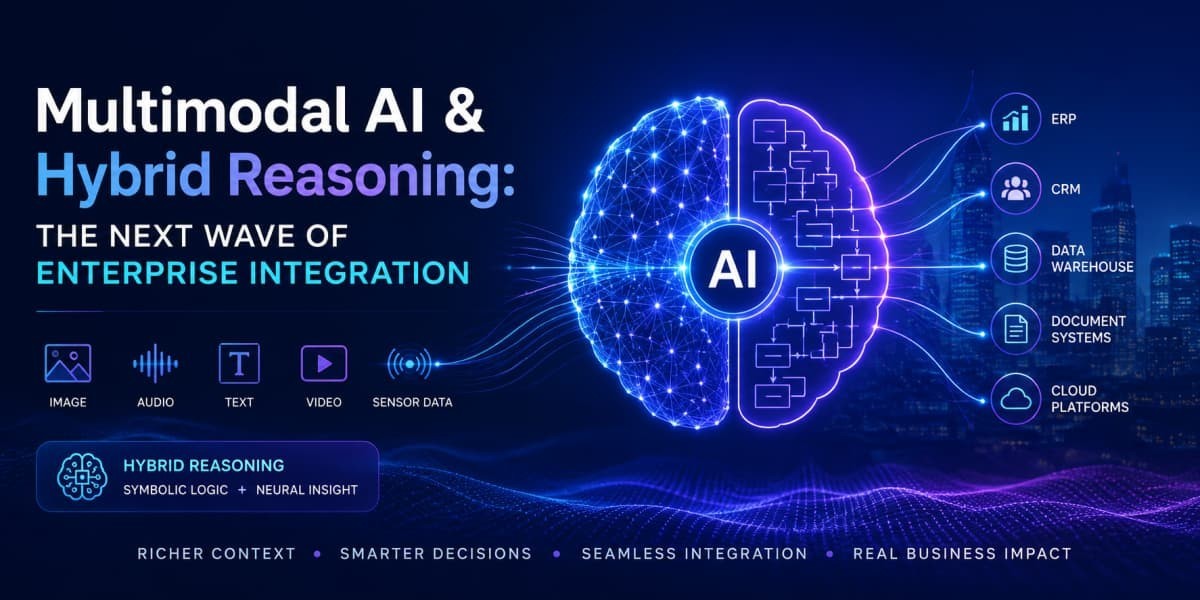
An enterprise that wired its stack for text is about to meet a class of model that reasons over pictures, sound, and full-motion video in one pass. That gap is the story of the next 18 months. Multimodal, hybrid-reasoning AI does not slot into a text pipeline the way a new chatbot did, and the teams treating it as a drop-in upgrade are quietly setting up their next migration. AI integration services now have to account for data that arrives as claims photos, call recordings, inspection footage, and scanned contracts, not tidy rows of strings.
The scale of the shift is documented. Gartner projects that 80% of enterprise software will be multimodal by 2030, up from less than 10 percent in 2024. When a capability moves that far that quickly, the question stops being whether to adopt it. The question becomes whether the underlying architecture can carry it, and most were never designed to. Sound AI integration solutions start by admitting that a text-era foundation is the constraint, not the model.
Why Text-Era Architectures Cannot Absorb the New Models
The last generation of enterprise AI was built around one assumption: input is text, output is text, and both are small. That assumption is baked into the plumbing. Retrieval indexes store token embeddings, message queues cap payloads at a few kilobytes, and audit logs record strings. A model that ingests a two-minute video and a spoken query violates every one of those defaults at once.
Data pipelines feel it first. A text record moves in milliseconds; a batch of inspection images or a recorded call is orders of magnitude larger and needs preprocessing, frame sampling, transcription, and format normalization before a model ever sees it. Storage costs and egress fees climb with it. Latency budgets that were comfortable for a text completion collapse when a single request now carries media, and orchestration layers built to route one prompt to one model must now coordinate transcription, vision, retrieval, and a reasoning step in sequence.
Governance is the quiet failure. A frame of video can contain a face, a license plate, or a patient chart, and a text-era data catalog has no idea that sensitive content now lives inside a binary blob. Gartner warns that through 2026, organizations will abandon 60% of AI projects that are not supported by AI-ready data. Multimodal data is the least ready of all, because most enterprises have never governed their images and recordings the way they govern their databases. Retention rules, redaction, and consent tracking all have to be rebuilt for content that no scanner reads by default, and the compliance obligation attaches the moment the media enters the pipeline, not when a person happens to review it.
What AI Integration Services Actually Involve
Adoption is nearly universal; readiness is not. McKinsey's latest survey found that 88% of organizations now use AI in at least one function, while only about 7 percent have scaled it across the enterprise. That gap is where the integration work lives, and for multimodal systems it widens rather than closes. The distance between a working demo and a production system that a regulator, a finance team, and an on-call engineer all trust is measured in the plumbing nobody sees.
The work breaks into a defined sequence. Skipping a step is what turns a strong demo into a stalled pilot:
- Ingestion and normalization: build a layer that accepts images, audio, and video, extracts frames or transcripts, strips or tags sensitive content, and hands the model a consistent format.
- Multimodal retrieval: index media alongside text so the model can pull the right diagram, clip, or recording, rather than reasoning from the prompt alone.
- Reasoning orchestration: route each request through the correct mix of fast response and deliberate, tool-using steps, and set budgets so a hybrid model does not over-think a simple query.
- Evaluation harness: score outputs against graded examples for each modality, because a system that reads charts well may still misread a doctor's handwriting.
- Access and audit controls: apply the same identity, permission, and logging discipline to media that the enterprise already applies to structured records.
Handled well, artificial intelligence integration services become the connective tissue between a capable model and the systems of record it has to respect. The model is rarely the hard part. The pipelines, the retrieval layer, and the guardrails around them are.
Each step also changes who owns the work. Ingestion pulls in data engineers who once never touched AI. Multimodal retrieval forces a conversation with the teams that own image archives and call recordings, many of which sit outside the data warehouse entirely. Reasoning orchestration lands on platform engineering, because deciding when a model should think longer is a runtime concern, not a prompt. Evaluation belongs to the domain experts who know what a correct answer looks like, and access controls belong to security and compliance. A multimodal rollout that assigns all of this to a single team stalls, because no single team holds the media, the models, and the rules at once.
Where Multimodal Reasoning Earns Its Keep
Abstract capability means little until it lands on a workflow. Four patterns are already returning measurable value.
Document and image workflows are the clearest. An insurer receives a claim as a scanned form, a set of damage photos, and a voicemail; a multimodal system reads all three together, cross-checks the policy, and flags the mismatch a text-only tool would miss. Field inspection follows the same logic: a technician records equipment on video, and the model compares it against maintenance manuals and prior footage to spot wear a checklist would skip.
Contact centers gain a second sense. A hybrid-reasoning agent listens to a live call, reads the customer's account history, watches a shared screenshot of the error, and drafts a resolution while the conversation continues. Analytics extends the reach further, letting teams query a mixed archive of reports, dashboards, and recorded meetings in one natural-language question. The benefits compound: fewer handoffs between tools, faster cycle times on media-heavy tasks, and decisions grounded in the full record rather than the transcribed slice of it. AI integration services for enterprises turn these patterns from isolated experiments into standard operating procedure.
The common thread across all four is that value tracks how much of the original signal survives. A text-only pipeline throws away the tone in a caller's voice, the dent in a fender, the smudge on a form. Multimodal reasoning keeps that signal in play, so the decision at the end reflects what actually happened rather than a lossy summary of it. That is why the strongest early results cluster in workflows that were previously bottlenecked on human review of media: adjusters studying photos, technicians walking a site, agents parsing a frustrated call. The technology does not replace those people. It reads the same evidence they do and hands them a head start.
AI Integration Solutions That Survive the First Year
A pilot that impresses in a demo and dies in production usually fails on one of three fronts, and durable AI integration solutions plan for all three from the start.
Cost is the first. Multimodal inference is expensive per request, and a system that sends every frame of a video to a frontier model will burn its budget before it proves value. The fix is architectural: sample intelligently, cache aggressively, and reserve the most capable models for the requests that need deliberate reasoning while routing routine ones to smaller, cheaper models.
Data is the second. Media is messy, unlabeled, and often locked in formats no one has touched in years. Teams that invest early in cleaning, tagging, and governing that media move faster later, and the ones that skip it hit the AI-ready-data wall Gartner describes.
Evaluation and security close the list. A multimodal model can be confidently wrong across any of its inputs, so a graded evaluation harness is not optional. A model that summarizes a call accurately may still misread the chart attached to it, and without per-modality scoring that error ships silently. Security widens too, because a face in a frame or a name in a recording carries the same obligations as a field in a database. Deloitte's 2025 research found that only 21% of companies have mature governance for the autonomous, tool-using agents now entering production, a gap that grows sharper once those agents can also see and hear.
Trends Shaping 2026, and What Comes Next
Two shifts define the current wave. Reasoning is being priced and controlled as a dial rather than a fixed trait, so a single model handles a quick lookup and a multi-step investigation at different cost and latency. And multimodal capability is moving from a premium feature to a default expectation, which is what the Gartner trajectory toward broad adoption really signals.
A third shift is organizational. Multimodal systems blur the line between the AI team and the data platform team, and the enterprises moving fastest have stopped treating them as separate projects. The retrieval layer that serves a chatbot is the same layer that serves an inspection model; the governance catalog that tracks a customer record is the one that must now track a customer's photo. Consolidating that substrate once, rather than rebuilding it per use case, is what separates a program from a pile of pilots.
The near future rewards enterprises that build the integration substrate now. As models grow more capable, the differentiator shifts from model access, which everyone will have, to the quality of the pipelines, retrieval, and governance feeding them. Teams that treated multimodal integration as an architecture decision will extend it to new use cases in weeks. Teams that bolted it onto a text stack will be re-platforming while their competitors ship. The next wave rewards the foundation, not the demo.
Multimodal, hybrid-reasoning AI is an integration challenge before it is a model choice, and the enterprises treating it that way are the ones that will avoid a second round of rework. Text-era pipelines, storage, latency budgets, and governance each need rebuilding for media that arrives as pictures, sound, and video. The organizations that pair capable models with disciplined AI integration services, from ingestion through evaluation, turn a demanding technology into dependable operations. Damco helps enterprises architect this foundation through its AI integration services for complex workflows, built for mixed-media data rather than retrofitted onto it. The models will keep improving; the advantage will belong to whoever built the pipes to carry them.