
Looking back at the progress in the field of vaccine R&D over the past three decades, in addition to antigen design, adjuvants—often referred to as the "chips" of vaccines—play a critical role in determining the efficacy of novel vaccines, especially recombinant protein vaccines. These vaccines have demonstrated strong performance in populations with compromised immune systems and against complex diseases where traditional approaches have failed.
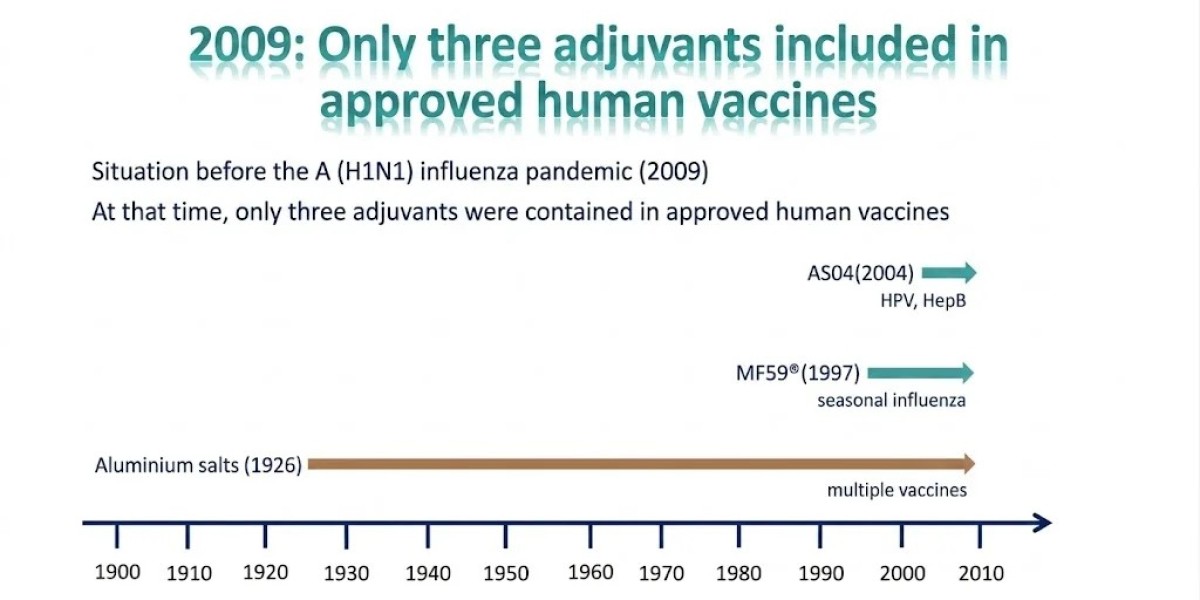
Taking the 2009 H1N1 pandemic as a milestone: prior to that, only three adjuvants had been approved for use in human vaccines worldwide: aluminum salts (first used in 1926), MF59 (launched in 1997), and AS04 (launched in 2004) (Figure 1).
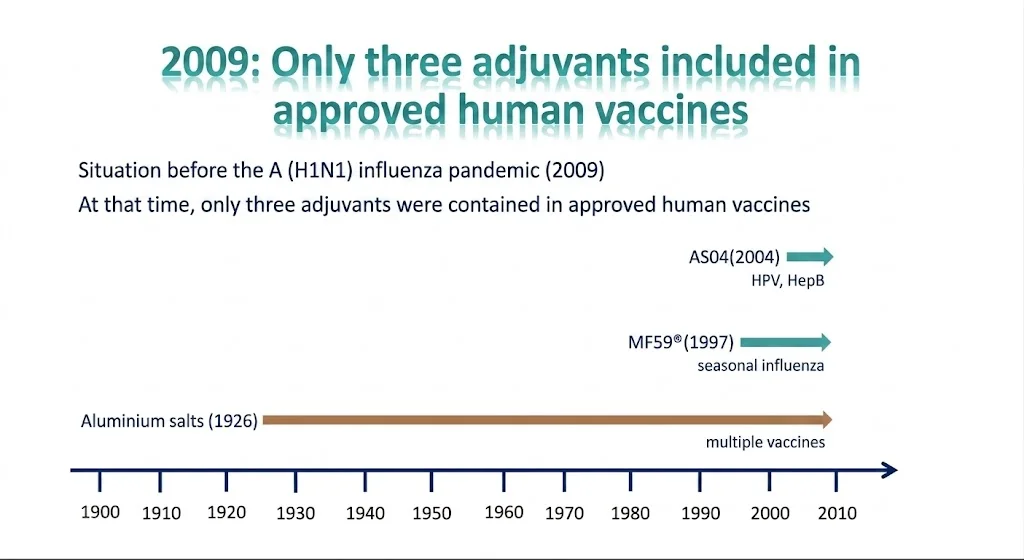
Figure 1
2009: Only three adjuvants included in approved human vaccines
This was the landscape before the 2009 influenza A (H1N1) pandemic, when only three adjuvants were included in globally approved human vaccines.
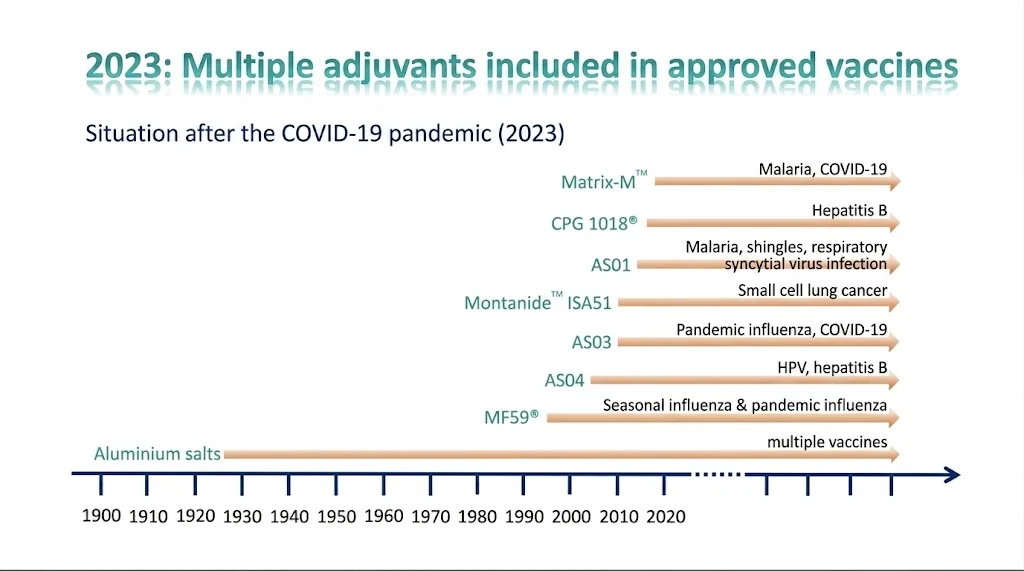
Figure 2
2023: Multiple adjuvants included in approved vaccines
Post-COVID-19 pandemic landscape (as of 2023)
Experience over the past century has shown that developing a new adjuvant or adjuvant system and bringing it to market requires an extremely long cycle with very low success rates. Rough estimates indicate that from raw material development, formulation process optimization, and clinical trials to final regulatory approval, at least 30 years are needed, with a success rate only one-tenth that of conventional vaccine products. For R&D personnel at domestic vaccine enterprises, how should they select novel adjuvants to align with their own R&D timelines? We believe the optimal choice is adjuvants or adjuvant systems that already have marketed products, no intellectual property disputes, and proven multi-antigen compatibility in clinical trials.
Based on these principles, we identify the following two adjuvant systems as having the potential to become platform-type adjuvants:
---
01 Matrix-M Adjuvant: An Innovative Nanocage Platform
Immune-stimulating complexes (ISCOMs) were originally developed by Morein and colleagues, combining these proteins with adjuvant-active saponins to enhance the immunogenicity of membrane-derived viral glycoproteins (the saponins used are also extracted from the bark of the Quillaja saponaria tree). The unique structure of ISCOMs relies on the strong affinity between saponins and cholesterol. They are stable particles composed of saponins, cholesterol, and phospholipids, and many antigens bind to them physically to form complexes. These complexes are 40 nm in diameter and have a precise cage-like structure. ISCOMs induce strong, durable antigen-specific immune responses covering both humoral immunity and cellular immunity (CD4+ and CD8+ T cells). This class of complexes, later named Matrix, exhibits potent adjuvant activity and can be used simply by mixing with various types of antigens. Although antigens are not physically bound to the adjuvant particles, this formulation retains the full function of ISCOMs—inducing both humoral and cellular immunity—and since compatible antigens are no longer limited to hydrophobic membrane proteins, this adjuvant has broader application scenarios.
ISCOMs were further developed by Novavax into the Matrix-M formulation. This adjuvant consists of two distinct but physically stable nanoparticle types mixed at a fixed ratio (85% Matrix-A + 15% Matrix-C). Matrix-A and Matrix-C contain different but functionally complementary saponin components: Matrix-C contains saponin component C (mainly QS-21), which has strong adjuvant activity but high reactogenicity in mice (measured by lethargy and mortality); Matrix-A contains saponin component A, which has lower adjuvant activity at equivalent doses but better tolerability. Testing of the combination in animal models found that the specific ratio could retain adjuvant activity while reducing reactogenicity. In addition, Matrix-M remains stable for several years when stored in aqueous solution at 2–8°C. Matrix-M has currently been used in two approved vaccines (COVID-19 and malaria vaccines), and several other vaccine candidates using this adjuvant are in clinical development.
Table 3 Approved or Clinical-Stage Vaccines Containing Matrix-M Adjuvant
Disease | Vaccine Type | Adjuvant Dose | Target Population | Clinical Stage | Clinical Trial ID |
SARS-CoV-2 | Recombinant spike protein nanoparticle vaccine | 50ug 50ug 50ug | Healthy adults aged 18–84; healthy adolescents aged 12–18; HIV-positive adults aged 18–64 receiving antiviral therapy | Phase III; Phase III; Phase II | NCT04583995; NCT04611802; NCT04533399 |
Seasonal influenza virus | Trivalent/quadrivalent recombinant hemagglutinin nanoparticle influenza vaccine; trivalent inactivated hemagglutinin influenza vaccine | 75ug 50ug 50ug | Healthy adults aged ≥65; healthy adults aged 18–90; older adults aged 65–75 | Phase III; Phase I; Phase I | NCT04120194; NCT01444482 |
SARS-CoV-2 and seasonal influenza virus | Recombinant spike protein nanoparticle vaccine + quadrivalent nanoparticle influenza vaccine | 50 μg | Clinically stable adults aged 50–80 | Phase I/II | NCT04961541 |
Pandemic influenza virus | Virus-like particle H5N1 vaccine; H7N9 virus-like particle influenza vaccine | 50 μg; 25/50 μg | Healthy adults aged 20–49; healthy adults aged 18–64 | Phase I; Phase I/II | NCT00868218; NCT02078674 |
Respiratory syncytial virus (RSV) | RSV fusion protein vaccine | 50 μg | Clinically stable older adults aged 60–80 | Phase II | NCT03026348 |
Plasmodium falciparum | Viral vector malaria vaccine; pre-erythrocytic malaria vaccine, R21; malaria transmission-blocking vaccine, Pfs25-IMX313 | 25/50 μg; 50 μg; 50 μg; 25/50 μg; 50 μg | Healthy adults aged 18–49; children aged 5–36 months; healthy adults aged 18–45; children aged 5–17 months; healthy adults aged 18–45 | Phase I; Phase III; Phase II; Phase I/II; Phase I | NCT01669512; NCT04704830; NCT03947190; NCT03896724; NCT04130282 |
Plasmodium vivax | Blood-stage malaria vaccine, PvDBP | 50 μg | Healthy volunteers aged 18–45 | Phase I/II | NCT04201431 |
Ebola virus | Ebola glycoprotein nanoparticle vaccine | 50 μg | Healthy adults aged 18–49 | Phase I | NCT02370589 |
Herpes simplex virus type 2 (HSV-2) | Recombinant HSV-2 protein vaccine | 25/50/75 μg; 50 μg | Healthy adults aged 18–50 (with recurrent genital HSV-2 lesions); adults aged 18–50 (who had received three doses of recombinant HSV-2 protein vaccine) | Phase II; Phase II | NCT02114060; NCT03146403 |
Matrix-M-adjuvanted influenza vaccines can induce broad neutralizing antibodies and cross-reactive T cells, and are particularly effective in older adults.
---
02 AS01 Adjuvant: An Excellent Representative of Liposome Systems
Safety and Efficacy
In clinical trials, AS01-adjuvanted vaccines have demonstrated efficacy and acceptable safety against tuberculosis, malaria, shingles, and respiratory syncytial virus across multiple age groups. For approved AS01-containing vaccines, post-marketing surveillance has confirmed consistent safety and efficacy profiles.
Synergy of Two Immunostimulants
The adjuvant effect of AS01 relies on the spatiotemporal co-localization of AS01 and the antigen. Shortly after injection, AS01 drains from the muscle to proximal lymph nodes, where it rapidly induces cytokine production and recruitment of innate effector cells.
3-O-desacyl-4'-monophosphoryl lipid A (MPL) and the saponin QS-21 act synergistically via interacting downstream signaling pathways to drive the adjuvant effect of AS01. MPL and QS-21 share signaling pathways that promote complex signal integration, and together activate diverse cell types, creating a network of innate effector functions.
A hallmark of AS01's innate immune profile is the rapid production of interferon (IFN)-γ in draining lymph nodes. Within 24 hours of vaccination, AS01 also induces a core innate gene signature in the blood of vaccinees, including genes related to IFN pathways and natural killer (NK) cell functions. In experimental studies, this core innate gene signature correlates with the strength of adaptive responses and predicts the durability of humoral immunity.
Applicability Across Populations
Importantly, AS01 induces this core gene signature in most subjects regardless of their underlying immune status. Thus, AS01 can overcome individual immune heterogeneity, and even in older adults and immunocompromised individuals, it reduces the impact of poor baseline immune health on vaccine responses.
AS01 promotes the generation of T follicular helper cells, broadly reactive antibody responses with optimized functional properties, and immune memory, and can sustainably induce multifunctional T cell responses in infants, older adults, and immunocompromised populations.
Table 4 Approved or Clinical-Stage Vaccines Containing AS01 Adjuvant
Disease | Vaccine Type | Adjuvant Type | Target Population | Clinical Stage | Clinical Trial ID |
Shingles | Recombinant glycoprotein E (gE) vaccine | AS01B | Adults aged ≥50; adults aged ≥18 at high risk of immunodeficiency or immunosuppression | Approved/Marketed | NCT01165177 |
RSV | Recombinant protein vaccine (containing prefusion-stabilized F protein) | AS01E | Older adults aged ≥60 | Phase III | NCT04732871 |
Seasonal malaria | Recombinant protein vaccine: RTS,S fusion protein | AS01E | Children aged 5–17 months | Approved/Marketed | NCT04319380 |
Seasonal influenza virus | Pan-seasonal universal influenza vaccine (inactivated, SUIV) | AS01; AS03 | Healthy adults aged 18–39 | Phase I | NCT03275389 |
Human immunodeficiency virus (HIV) | ALVAC-HIV (vCP2438) clade C Env protein | MF59; AS01B | HIV-uninfected healthy adults | Phase I; Phase II | NCT03122223 |
Mycobacterium tuberculosis | Recombinant fusion protein vaccine (M72) | AS01E | Adults aged 18–50 with latent tuberculosis infection | Phase III | NCT01755598 |
---
03 Beyond Infection Prevention: Unexpected Brain Protection Effect
Recent studies have found that AS01-adjuvanted vaccines may also confer additional benefits in reducing dementia risk.
A large retrospective cohort study analyzing electronic health record data from more than 430,000 adults aged over 60 from the US federal tertiary care database showed that:
- Individuals who received the AS01-adjuvanted RSV vaccine alone had a 29% lower risk of dementia;
- Individuals who received the AS01-adjuvanted shingles vaccine alone had an 18% lower risk of dementia;
- Those who received both vaccines had a 37% lower risk of dementia.
This protective effect emerged within 3 months of vaccination and was not affected by sex. Notably, there was no statistically significant difference in the magnitude of protection between the two AS01 vaccines, and combined vaccination did not show an additive effect, suggesting that the AS01 adjuvant itself (rather than antigen-specific immunity) may be the primary mechanism of action.
The potential mechanism may involve MPL in AS01 activating microglia via TLR4 to reduce β-amyloid deposition; its synergistic induction of the IFN-γ cascade with QS-21 has been confirmed in human cohorts to be negatively correlated with cognitive decline.
---
04 Platform Potential: Becoming a "Universal Engine" for Vaccine R&D
Both AS01 and Matrix-M possess the core features required to become platformized adjuvants: broad antigen compatibility (can be paired with proteins, polysaccharides, nucleic acids, and other antigen types), tunable immune responses (the balance of Th1/Th2 responses or the bias toward cellular/humoral immunity can be optimized by adjusting adjuvant component ratios), and clinically validated safety and efficacy (already applied in approved vaccines with sufficient real-world data). These properties enable them to rapidly adapt to diverse vaccine R&D needs, shorten development cycles, and provide powerful immune enhancement tools for complex diseases such as infectious diseases (malaria, shingles, COVID-19) and cancers (melanoma, lung cancer).
In terms of performance and specifications, Jicang Biotech's GA101 is benchmarked against AS01, and GA102 is benchmarked against Matrix-M. We offer both human-grade and veterinary-grade formulations in diverse specifications to meet varied R&D and production demands.
We invite you to apply for free samples to experience the superior performance of Jicang Biotech's adjuvant products.
https://en.jicangbio.com/breaking-through-the-chip-bottleneck-of-vaccine-r-d.html