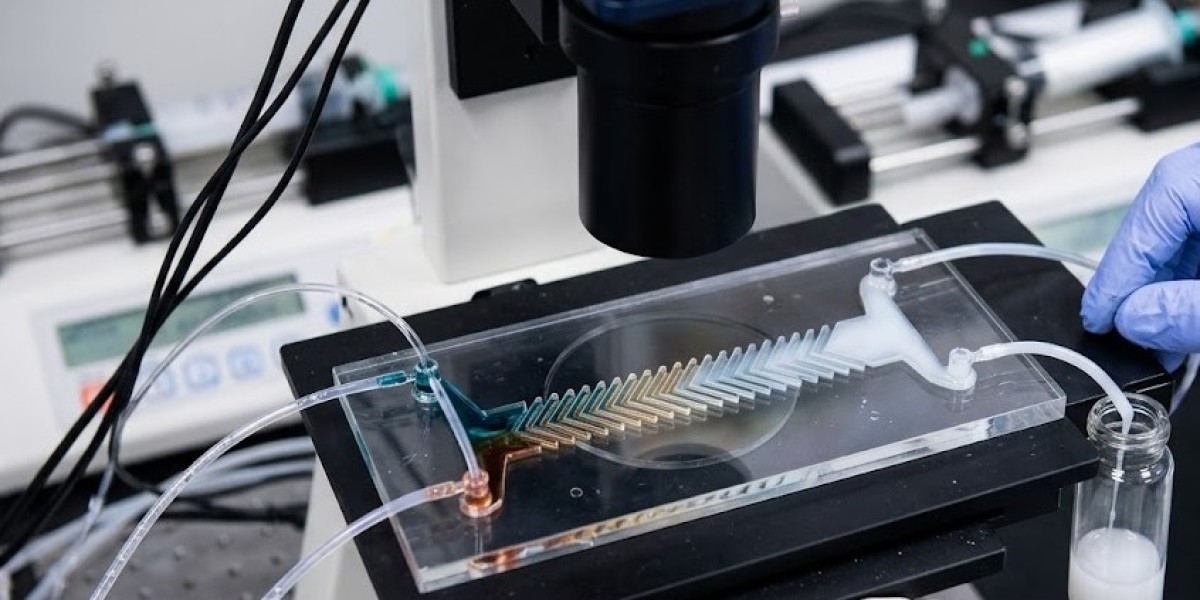

The development of nanotechnology has significantly transformed modern pharmaceutical research, creating new possibilities for targeted drug delivery, gene therapy, RNA-based medicines, and personalized treatments. Among these innovations, nanoparticle-based delivery systems have become one of the most promising platforms for improving therapeutic effectiveness.
From lipid nanoparticles (LNPs) used in mRNA vaccines to polymeric nanoparticles designed for controlled drug release and cancer therapy, the success of these advanced formulations depends greatly on manufacturing precision. One of the most critical technologies behind high-quality nanoparticle production is microfluidic mixing for nanoparticle formulation.
Unlike traditional batch preparation methods, microfluidic technology provides accurate control over fluid behavior at the microscale. By precisely regulating mixing conditions, microfluidic systems can produce nanoparticles with highly consistent size distribution, improved encapsulation efficiency, and excellent batch-to-batch reproducibility.
As pharmaceutical companies, biotechnology organizations, and research institutions continue to accelerate the development of RNA therapeutics, gene-editing technologies, vaccines, and precision medicine platforms, the demand for advanced microfluidic nanoparticle formulation solutions is rapidly increasing.
As an experienced microfluidic technology developer, XGen Bio provides innovative microfluidic solutions designed to help researchers and manufacturers achieve reliable nanoparticle production, optimize formulation performance, and support the transition from laboratory research to scalable manufacturing.
Why Traditional Nanoparticle Formulation Methods Have Limitations
For decades, nanoparticle preparation has relied on conventional techniques such as mechanical stirring, vortex mixing, sonication, and batch processing. While these approaches remain useful for early-stage research, they often face significant challenges when higher consistency and industrial scalability are required.
Common limitations include:
- Broad nanoparticle size distribution
- Variable encapsulation efficiency
- Poor batch reproducibility
- Difficult process control
- High consumption of valuable materials
- Challenges during manufacturing scale-up
Nanoparticle characteristics can be strongly influenced by small variations in:
- Mixing speed
- Addition rate of solvents
- Temperature conditions
- Operator handling
- Processing time
These variations may directly affect important product characteristics, including stability, biodistribution, cellular uptake, and therapeutic performance.
For pharmaceutical development, especially in regulated environments, achieving consistent nanoparticle quality is essential. This has driven increasing adoption of microfluidic mixing technology for nanoparticle formulation.
What Is Microfluidic Mixing for Nanoparticle Formulation?
Microfluidic mixing is an advanced manufacturing technology that uses precisely engineered microchannels to control fluid interactions at the micrometer scale.
Instead of relying on uncontrolled bulk turbulence, microfluidic systems create a highly controlled environment where different fluid streams interact through:
- Hydrodynamic focusing
- Controlled laminar flow
- Rapid molecular diffusion
- Precise solvent exchange
During nanoparticle formation, the process typically occurs as follows:
- Lipid or polymer solutions are introduced into microchannels.
- The organic and aqueous phases meet under controlled flow conditions.
- Rapid solvent exchange triggers nanoparticle self-assembly.
- Particle growth is precisely regulated.
- Uniform nanoparticles are continuously produced.
This controlled environment enables manufacturers to achieve much higher consistency compared with traditional batch mixing approaches.
Major Advantages of Microfluidic Nanoparticle Formulation Technology
1. Superior Nanoparticle Size Control
Particle size plays a crucial role in drug delivery performance.
The size of nanoparticles affects:
- Biological distribution
- Cellular uptake efficiency
- Circulation time
- Drug release behavior
- Overall therapeutic effectiveness
Microfluidic nanoparticle formulation enables:
- Narrow particle size distribution
- Lower polydispersity index (PDI)
- Improved formulation stability
- Reduced aggregation risk
This level of control is especially important for lipid nanoparticles used in mRNA delivery and gene therapy applications.
2. Higher Encapsulation Efficiency
For advanced therapeutics, maximizing drug loading efficiency is essential because many active ingredients are expensive and sensitive.
Optimized microfluidic mixing improves the encapsulation of:
- mRNA molecules
- siRNA therapeutics
- DNA materials
- Proteins
- Peptides
- Small-molecule drugs
Higher encapsulation efficiency helps reduce material waste while improving therapeutic delivery performance.
3. Excellent Batch-to-Batch Consistency
Consistency is one of the biggest challenges in pharmaceutical manufacturing.
Microfluidic systems provide accurate control over critical process parameters, including:
- Flow rate ratio (FRR)
- Total flow rate (TFR)
- Mixing time
- Solvent exchange rate
- Temperature conditions
Because these parameters can be precisely controlled, manufacturers can achieve highly reproducible nanoparticle characteristics across multiple production cycles.
This is particularly valuable for clinical development and GMP pharmaceutical manufacturing.
Applications of Microfluidic Mixing in Pharmaceutical Development
Lipid Nanoparticle (LNP) Production
The rapid expansion of mRNA vaccines and nucleic acid-based therapies has created strong demand for reliable LNP manufacturing technologies.
Microfluidic systems support the development of:
- mRNA vaccines
- siRNA delivery systems
- CRISPR gene-editing platforms
- DNA vaccines
- Circular RNA (circRNA) therapeutics
Precise microfluidic mixing improves nanoparticle uniformity while protecting sensitive genetic materials during delivery.
Polymeric Nanoparticle Manufacturing
Polymeric nanoparticles are widely investigated for controlled drug release and targeted therapy applications.
Microfluidic production provides advantages such as:
- Controlled particle morphology
- Improved drug loading
- Adjustable release profiles
- Reduced solvent consumption
- Enhanced formulation stability
These benefits make polymeric nanoparticles attractive for oncology, chronic disease treatment, and targeted medicine.
Liposome Formulation
Liposomes remain an important drug delivery platform due to their biocompatibility and versatility.
Compared with traditional preparation methods, microfluidic liposome production offers:
- Better size control
- Higher reproducibility
- Improved stability
- Easier process scaling
Continuous-flow manufacturing provides a more predictable alternative for modern pharmaceutical development.
Critical Parameters Affecting Nanoparticle Quality
Successful nanoparticle formulation requires careful optimization of several technical factors.
Flow Rate Ratio (FRR)
The ratio between organic and aqueous phases directly influences nanoparticle formation.
Optimizing FRR helps control:
- Particle size
- Surface properties
- Encapsulation efficiency
- Stability performance
Total Flow Rate (TFR)
Total flow rate affects both mixing speed and production capacity.
Higher flow rates may increase manufacturing throughput, but must be carefully balanced with nanoparticle quality requirements.
Microchannel Design
The internal structure of microfluidic chips directly affects mixing performance.
Advanced designs may include:
- Hydrodynamic focusing channels
- Serpentine mixers
- Chaotic mixing structures
- Multi-inlet channel configurations
Optimized channel geometry improves mixing efficiency and enables consistent nanoparticle formation.
From Laboratory Research to Commercial Manufacturing
A major advantage of microfluidic technology is its ability to support scalable production.
Traditional batch methods often require larger reactors as production increases, which may introduce additional variability.
Microfluidic manufacturing uses continuous-flow processing and parallelization strategies, allowing companies to scale production while maintaining formulation quality.
Key benefits include:
- Faster process development
- Easier technology transfer
- Consistent product quality
- Improved manufacturing efficiency
- Reduced production risks
For pharmaceutical companies moving from discovery stages toward clinical trials and commercial production, scalable microfluidic nanoparticle manufacturing provides significant advantages.
Supporting Quality by Design and Regulatory Requirements
Modern pharmaceutical manufacturing increasingly emphasizes Quality by Design (QbD) principles and Process Analytical Technology (PAT).
Microfluidic nanoparticle systems naturally support these requirements through:
- Precise process control
- Real-time parameter monitoring
- Improved traceability
- Reduced operator influence
- Simplified validation procedures
These advantages make microfluidic mixing an ideal technology for future GMP pharmaceutical manufacturing environments.
Why Choose XGen Bio for Microfluidic Nanoparticle Solutions?
Successful nanoparticle development requires more than advanced equipment. It requires expertise in microfluidics, pharmaceutical formulation, and process optimization.
XGen Bio provides advanced microfluidic mixing solutions designed for researchers, biotechnology companies, and pharmaceutical manufacturers seeking higher formulation precision.
Key capabilities include:
- Advanced microfluidic chip engineering
- Stable microscale mixing performance
- Highly reproducible nanoparticle production
- Flexible formulation compatibility
- Support for LNPs, liposomes, polymer nanoparticles, and other nanocarriers
- Scalable solutions from laboratory research to production development
- Professional technical support for pharmaceutical applications
By combining engineering innovation with pharmaceutical application expertise, XGen Bio helps customers improve development efficiency and accelerate next-generation medicine research.
Conclusion
As nanomedicine continues to expand, pharmaceutical developers require manufacturing technologies that deliver precision, reliability, and scalability.
Microfluidic mixing for nanoparticle formulation provides a powerful solution by improving control over particle size, encapsulation efficiency, stability, and production consistency. These advantages make it a key technology for RNA therapeutics, vaccines, gene delivery systems, and advanced drug development.
With innovative microfluidic platforms and a commitment to pharmaceutical advancement, XGen Bio supports researchers and manufacturers in optimizing nanoparticle production processes and moving closer to the future of precision medicine.
For organizations seeking improved formulation control, reduced development risks, and scalable nanoparticle manufacturing capabilities, advanced microfluidic mixing technology represents a strategic investment in the next generation of pharmaceutical innovation.