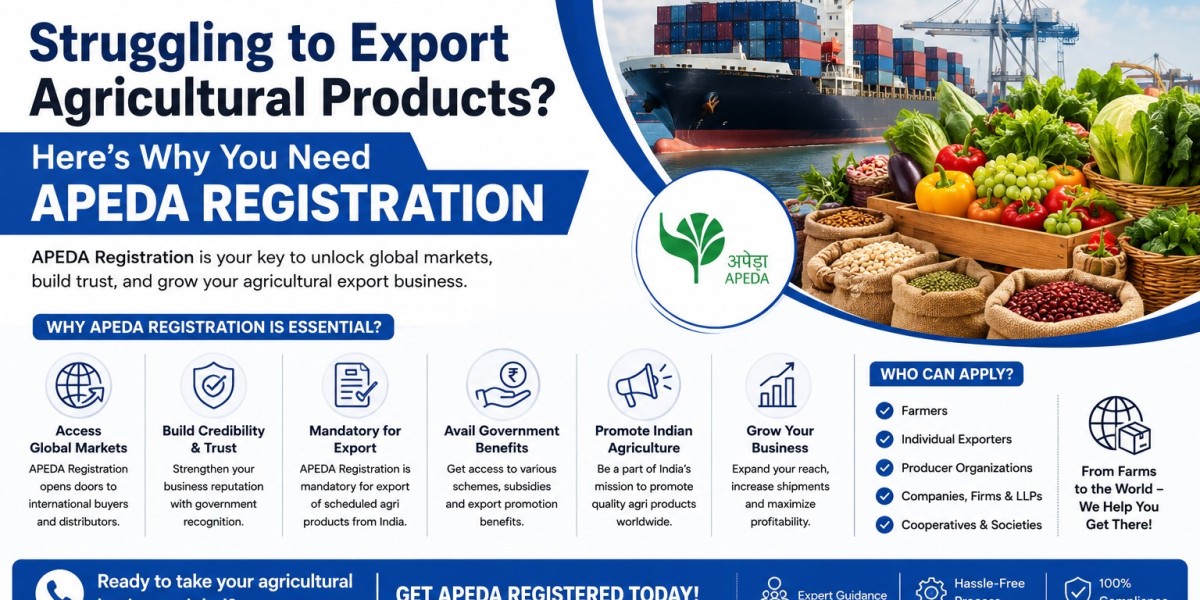

India has become one of the world's leading exporters of agricultural and processed food products. From fresh fruits and vegetables to cereals, spices, meat products, dairy items, and organic foods, Indian exporters are expanding their presence in international markets every year. However, entering the global marketplace requires more than quality products—it demands regulatory compliance and recognition from the appropriate export authorities. One of the most important requirements for eligible exporters is APEDA Registration.
The Agricultural and Processed Food Products Export Development Authority (APEDA) plays a vital role in promoting India's agricultural exports while ensuring quality standards and export facilitation. Businesses involved in exporting scheduled products can significantly improve their credibility and access to government benefits by obtaining an APEDA registration. With expert guidance from Agile Regulatory, exporters can complete the registration process efficiently and focus on growing their international business.
What is APEDA Registration?
APEDA Registration is the process through which eligible exporters obtain authorization from the Agricultural and Processed Food Products Export Development Authority under the APEDA Act, 1985.
Businesses exporting products covered under APEDA's scheduled product list are generally required to register with the authority. After successful registration, the exporter receives an APEDA Certificate along with a Registration-Cum-Membership Certificate (RCMC), enabling access to various export promotion schemes and services.
Obtaining APEDA Registration is an important milestone for businesses planning to expand into international markets while complying with India's export regulations.
What is APEDA?
The Agricultural and Processed Food Products Export Development Authority (APEDA) is a statutory organization established by the Government of India under the Ministry of Commerce and Industry.
Its key objectives include:
- Promoting agricultural exports.
- Improving product quality.
- Supporting exporters through financial assistance.
- Encouraging infrastructure development.
- Promoting value-added agricultural products.
- Facilitating international market access.
- Enhancing India's export competitiveness.
APEDA works closely with exporters to strengthen India's position in global agricultural trade.
Why APEDA Registration is Important
International buyers often prefer dealing with exporters who comply with recognized government standards. APEDA Registration demonstrates that a business follows established export procedures and maintains regulatory compliance.
Major benefits include:
- Improved export credibility.
- Recognition by government authorities.
- Access to export promotion schemes.
- Eligibility for financial assistance.
- Better international market acceptance.
- Enhanced buyer confidence.
- Support for export documentation and compliance.
Professional registration creates a strong foundation for sustainable export growth.
Who Needs APEDA Registration?
APEDA Registration is generally required for businesses exporting scheduled agricultural and processed food products.
Eligible businesses may include:
- Fresh fruit exporters
- Vegetable exporters
- Processed food manufacturers
- Organic product exporters
- Dairy product exporters
- Meat and poultry exporters
- Floriculture exporters
- Cereal exporters
- Honey exporters
- Food processing companies
Exporters should verify whether their products fall under APEDA's scheduled product categories before initiating registration.
Understanding the APEDA Certificate
An APEDA Certificate serves as official proof that the exporter has successfully completed registration with APEDA.
The certificate enhances business credibility by demonstrating compliance with export regulations. It also enables exporters to participate in government-supported export development initiatives and international trade promotion activities.
Many overseas buyers and business partners consider the APEDA Certificate an indicator of regulatory compliance and professionalism.
Benefits of APEDA Registration
Obtaining APEDA Registration offers several commercial and strategic advantages.
Improves Export Credibility
Registration demonstrates that your business operates under recognized export regulations, increasing confidence among overseas buyers.
Access to Government Schemes
Registered exporters may become eligible for various APEDA initiatives designed to improve export competitiveness, subject to applicable guidelines.
International Market Recognition
The APEDA Certificate strengthens your company's image while expanding opportunities in international markets.
Better Business Opportunities
Many importers and distributors prefer working with registered exporters who comply with government requirements.
Export Promotion Support
APEDA provides guidance, training programs, quality initiatives, and market development support that help exporters compete globally.
What is APEDA RCMC?
APEDA RCMC stands for Registration-Cum-Membership Certificate.
The APEDA RCMC confirms that the exporter is registered with APEDA and is recognized under the applicable export promotion framework. This certificate is often required to avail export-related benefits and participate in government-supported export initiatives.
Obtaining APEDA RCMC helps businesses establish credibility while facilitating smoother export operations.
APEDA Registration Process
The APEDA Registration process involves several important steps.
Business Eligibility Verification
The applicant first confirms whether the products intended for export fall within APEDA's scheduled product categories.
Documentation Preparation
Required documents such as Import Export Code (IEC), GST registration, PAN card, business registration documents, bank details, and supporting information are collected.
APEDA Application Submission
The completed APEDA Application is submitted through the prescribed registration process along with the necessary supporting documents.
Verification
APEDA reviews the submitted application and verifies the applicant's eligibility and documentation.
Certificate Issuance
Upon successful verification, the applicant receives the APEDA Certificate along with APEDA RCMC.
APEDA Application
The APEDA Application is one of the most important stages of the registration process. Applicants should ensure that all information provided is complete, accurate, and supported by valid documentation.
Incorrect or incomplete applications may lead to unnecessary delays during processing.
Professional guidance helps businesses prepare accurate applications while minimizing approval risks.
APEDA Application Form
The APEDA Application Form requires applicants to provide important business information, including:
- Business name
- IEC details
- GST registration
- PAN details
- Business address
- Bank account information
- Export product details
- Authorized signatory information
Applicants should carefully review every section before submission to avoid mistakes.
Documents Commonly Required
Although documentation requirements may vary depending on business activities, applicants generally prepare:
- Import Export Code (IEC)
- PAN Card
- GST Registration
- Business Registration Certificate
- Bank Certificate
- Cancelled Cheque
- Address Proof
- Identity Proof
- Digital Signature (if applicable)
- Product Information
Maintaining organized documentation contributes to faster registration.
Common Challenges During Registration
Many exporters encounter avoidable issues during the registration process.
Some common challenges include:
- Incorrect business information.
- Missing supporting documents.
- Errors in the APEDA Application Form.
- Incomplete product details.
- Delayed submissions.
- Lack of awareness regarding documentation requirements.
Professional consultancy significantly reduces these challenges while improving approval efficiency.
Why Hire an APEDA Consultant?
Although the registration process appears straightforward, exporters often benefit from working with an experienced APEDA Consultant.
A consultant assists with:
- Eligibility assessment.
- Documentation preparation.
- APEDA Application filing.
- Application review.
- Regulatory consultation.
- Query management.
- Compliance guidance.
- Post-registration assistance.
Professional consultancy saves time while reducing the likelihood of application errors.
How Agile Regulatory Helps Exporters
Agile Regulatory provides comprehensive consultancy services for businesses seeking APEDA Registration across India. Our experienced professionals help exporters navigate every stage of the registration process with confidence.
Our services include:
- Eligibility assessment
- Documentation preparation
- APEDA Registration
- APEDA Application filing
- APEDA Application Form assistance
- APEDA RCMC support
- Regulatory consultation
- Compliance management
- End-to-end registration services
We work with exporters from multiple industries and provide customized guidance based on their specific products and export objectives.
Why Choose Agile Regulatory?
Businesses across India trust Agile Regulatory because of our transparent approach, regulatory expertise, and customer-focused services. Our consultants stay updated with the latest export compliance requirements and provide practical solutions that simplify complex registration procedures.
Whether you are exporting agricultural products for the first time or expanding into new international markets, our team helps ensure a smooth registration experience while minimizing compliance challenges.
Best Practices After Obtaining APEDA Registration
Receiving your APEDA Certificate is only the beginning. Businesses should continue maintaining compliance by following best practices such as:
- Keep export records updated.
- Maintain valid Import Export Code (IEC).
- Monitor APEDA notifications.
- Renew registrations where applicable.
- Participate in APEDA awareness programs.
- Maintain product quality standards.
- Stay informed about export policy changes.
Consistent compliance strengthens long-term export success.
Conclusion
APEDA Registration is a valuable investment for businesses engaged in exporting agricultural and processed food products from India. It enhances export credibility, supports international market access, enables participation in government export promotion initiatives, and strengthens business reputation. Rather than viewing registration as a regulatory formality, exporters should recognize it as an important step toward building a successful global business.
Whether you require APEDA Registration, an APEDA Certificate, assistance with APEDA License requirements, support for APEDA RCMC, guidance from an experienced APEDA Consultant, help preparing an APEDA Application, or assistance in completing the APEDA Application Form, Agile Regulatory provides complete end-to-end consultancy services. Our experienced professionals ensure a smooth registration process, helping exporters remain compliant while focusing on expanding their international business.
Frequently Asked Questions (FAQs)
1. What is APEDA Registration?
APEDA Registration is the process through which eligible exporters register with the Agricultural and Processed Food Products Export Development Authority to export scheduled agricultural and processed food products.
2. What is an APEDA Certificate?
An APEDA Certificate is the official document issued after successful registration, confirming that the exporter is recognized by APEDA.
3. What is APEDA RCMC?
APEDA RCMC (Registration-Cum-Membership Certificate) is issued to registered exporters and serves as proof of membership under APEDA for eligible export activities.
4. Is APEDA Registration mandatory?
Businesses exporting products covered under APEDA's scheduled product categories are generally required to obtain APEDA Registration before undertaking export activities.
5. What documents are required for APEDA Registration?
Common documents include Import Export Code (IEC), GST registration, PAN card, business registration certificate, bank details, address proof, and supporting business documents.
6. Why should I hire an APEDA Consultant?
An experienced APEDA Consultant helps with eligibility assessment, documentation preparation, APEDA Application filing, compliance guidance, and regulatory support, ensuring a smoother registration process.
7. What information is required in the APEDA Application Form?
The APEDA Application Form generally requires business details, IEC information, GST registration, PAN, bank details, address, product information, and authorized signatory details.
8. How can Agile Regulatory help with APEDA Registration?
Agile Regulatory provides complete assistance with APEDA Registration, including documentation preparation, APEDA Application filing, APEDA RCMC support, regulatory consultation, compliance management, and end-to-end registration services for exporters across India.