
Ask most practice owners to describe their billing process, and they’ll usually describe a single task: send the claim, wait for payment. But behind every successful medical billing outcome is something bigger than revenue cycle management (RCM). Understanding how RCM connects to medical billing services is often the missing piece that explains why some practices get paid quickly and consistently, while others are stuck chasing claims month after month.
Medical Billing Is One Piece; RCM Is the Whole Picture
Medical billing services typically involve coding, submitting, and following up on insurance claims. It’s an essential function, but on its own, it only covers part of the financial journey.
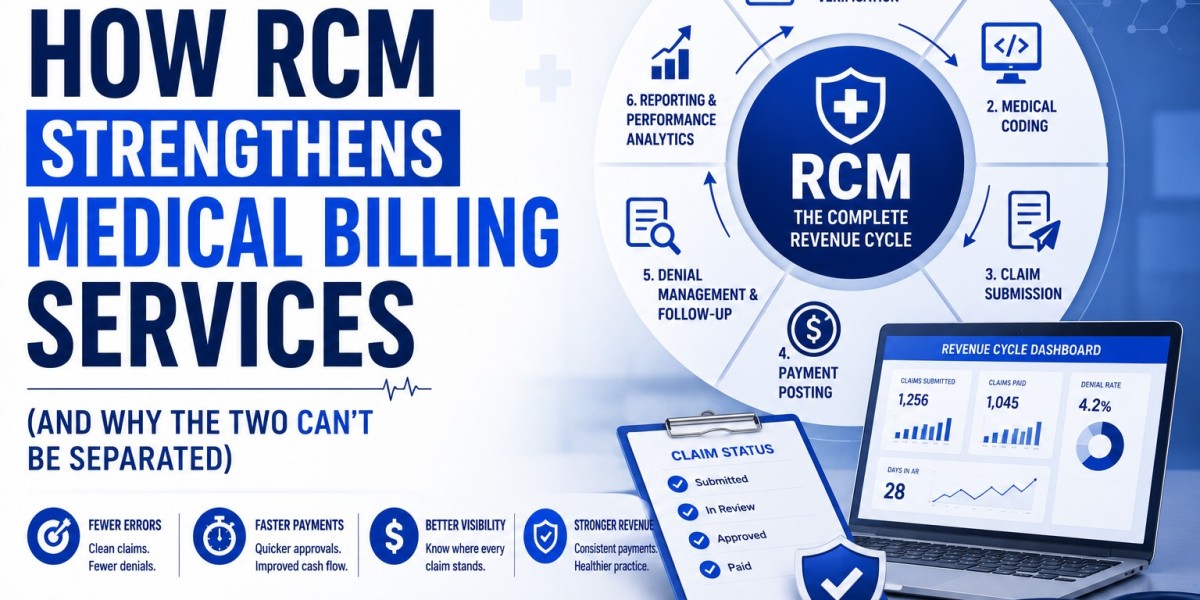
RCM, or revenue cycle management, is the broader system that billing sits inside. It covers everything from the moment a patient schedules an appointment to the moment their bill is fully paid, including insurance verification, coding accuracy, claim submission, payment posting, and denial follow-up.
In other words, medical billing is a critical stage within RCM, but RCM is what makes that stage actually work well. Without a strong revenue cycle framework behind it, even accurate billing can get delayed or lost in the gaps between stages.
Why RCM Matters So Much for Billing Accuracy and Speed
When medical billing services operate as part of a well-managed revenue cycle, claims move through the system with far fewer interruptions. Here’s why that connection matters:
1. Fewer Errors Before Claims Are Even Submitted
RCM starts before billing does with accurate patient registration and insurance verification. When this step is handled properly, claims go out clean the first time, which means fewer denials for your billing team to deal with later.
2. Coding That Aligns with the Full Patient Record
Because RCM tracks the entire patient journey, coding teams working within an RCM framework have better visibility into documentation and history, reducing coding mismatches that commonly trigger denials.
3. Faster Denial Resolution
In a standalone billing process, denied claims can sit unnoticed for weeks. Within a proper RCM system, denials are flagged and followed up immediately since tracking claims through to final payment is part of the process by design, not an afterthought.
4. Clear Visibility into Cash Flow
RCM provides ongoing insight into where every claim stands: submitted, pending, denied, or paid, giving practices a real-time picture of revenue instead of guessing based on bank deposits.
The Cost of Treating Billing and RCM Separately
Many practices still treat billing as an isolated task, disconnected from the rest of the revenue cycle. This usually leads to a familiar pattern: claims get submitted, some come back denied, and by the time anyone follows up, the timely filing window has already closed. Revenue that should have been collected simply disappears, not because of one big failure, but because billing wasn’t supported by a properly managed cycle around it.
This is one of the most common and most avoidable sources of lost revenue in healthcare practices.
What RCM-Driven Medical Billing Looks Like in Practice
When medical billing operates within a structured RCM approach, the process looks noticeably different:
- Insurance and patient details are verified before a claim is ever created
- Coding is checked against documentation for accuracy before submission
- Claims are submitted promptly, reducing avoidable delays
- Denials are caught and resolved quickly, not left to expire
- Payments are posted and reconciled consistently, so nothing is missed
At Go Source MD, medical billing services are delivered with this RCM-driven approach built in. Rather than treating billing as a disconnected task, every claim is managed as part of the full revenue cycle from the first patient interaction to final payment which is exactly why fewer claims fall through the cracks.
Why This Matters for Practices of Every Size
Smaller practices often assume RCM is only relevant for large hospital systems, but the opposite is usually true. Smaller practices feel the impact of a broken revenue cycle even more, since they typically don’t have the staffing to absorb delayed payments or chase denials manually. A well-managed RCM process gives smaller practices the same level of billing reliability that larger organizations rely on, without needing to build an internal team from scratch.
The Bigger Payoff: Predictable, Healthier Cash Flow
When RCM and medical billing work together properly, the results show clearly: fewer denied claims, faster reimbursement timelines, and revenue that arrives predictably instead of in unpredictable waves. That stability makes it easier to plan staffing, manage expenses, and grow the practice with confidence, instead of constantly reacting to cash flow surprises.
Final Thoughts
Medical billing and revenue cycle management aren’t two separate processes; one supports the other. Billing done in isolation will always be vulnerable to the small errors and missed follow-ups that quietly drain revenue. Billing done within a strong RCM framework is far more resilient, catching problems early and keeping payments flowing consistently.
Go Source MD combines both delivering medical billing services backed by complete revenue cycle management, so practices get paid faster, more accurately, and with far fewer administrative headaches. Want billing that’s backed by a properly managed revenue cycle? Connect with GoSource MD to see how RCM-driven billing can improve your practice’s cash flow.