
Introduction
Central heating residential districts commercial air conditioning complexes and factory heat circulation stations rely on thermal energy meter to realize fair energy billing and equipment operation efficiency analysis, yet many project engineers cannot fully understand the three core functional modules of thermal energy meter leading to improper parameter configuration after installation. Ordinary flow meters only record fluid volume without capturing temperature difference data required for heat energy calculation, unable to replace dedicated thermal energy meter for heating and cooling consumption statistics. Thermal energy meter integrates ultrasonic flow sensor paired dual precision temperature probes and digital energy computing chip into one compact measuring device, automatically accumulating total heat or cold energy consumed by terminal equipment. This article disassembles each functional component working principle of thermal energy meter and summarizes targeted model matching rules for residential commercial and industrial thermal circulation system projects.
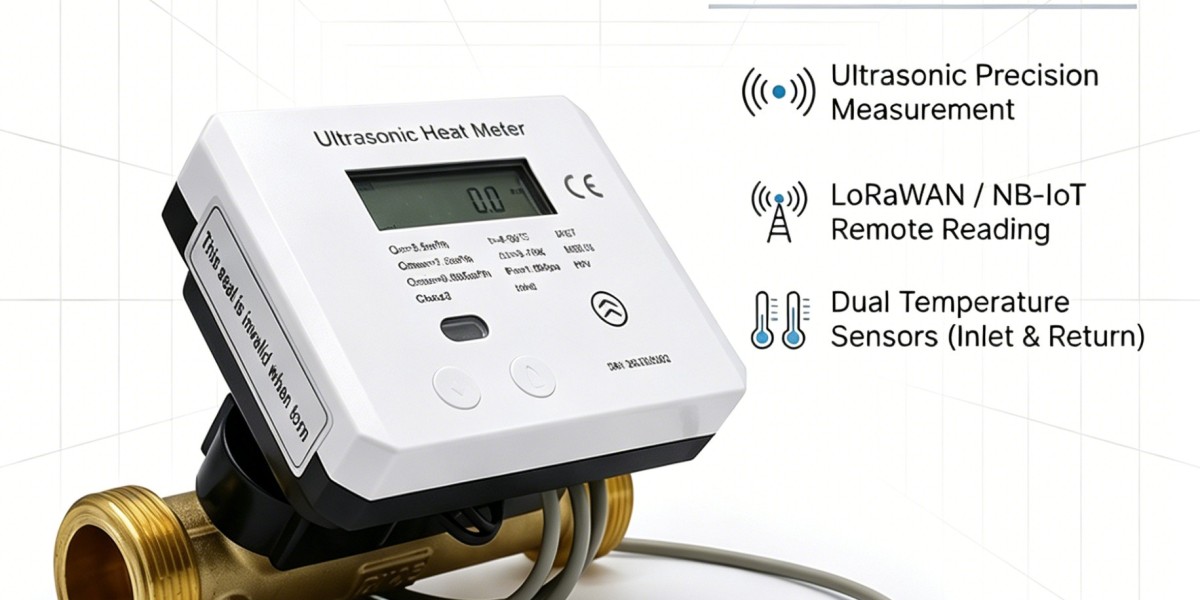
The flow measuring core of thermal energy meter adopts identical transit time ultrasonic sensor structure as standalone ultrasonic flow meter, installing dual transducers on measuring pipeline to calculate circulating water volume without internal mechanical obstruction parts. Continuous hot water circulation inside heating pipelines carries mineral scale particles that quickly wear mechanical flow measuring impellers, while ultrasonic flow detection module of thermal energy meter maintains stable flow reading without contact abrasion for multiple heating seasons. Small caliber thermal energy meter for single household heating adopts integrated pipe body sensor design for convenient wall mounting indoor installation, and large split ultrasonic flow modules match industrial heat exchange station thick circulation main pipelines. Real time instantaneous flow data transmits to built in computing chip every second as one core variable for thermal energy accumulation calculation, with wide measuring ratio adapting both tiny night low flow and daytime peak heating water circulation volume changes. All flow sensor components adopt high temperature resistant brass material to operate stably under 4 to 95 Celsius heating medium temperature range.
A pair of matched PT1000 precision platinum resistance temperature probes forms the second core component of thermal energy meter, separately fixed on heating supply water pipeline and return water pipeline to capture real time temperature values of inflow and outflow medium. The computing chip automatically subtracts two temperature readings to acquire temperature difference variable, which directly determines heat exchange quantity between heating water and building terminal radiators or air conditioning coils. Unmatched temperature probes generate large temperature measurement deviation leading to total thermal energy calculation error and resident heating billing disputes, so all thermal energy meter factory assembly uses calibrated paired probe sets with unified temperature response curve data stored in chip memory. Probe metal sleeves adopt anti corrosion coating to resist long term hot water oxidation inside circulation pipelines, avoiding slow temperature sensing failure after years of heating season continuous operation. For dual purpose heating and cooling HVAC systems, thermal energy meter temperature module automatically identifies positive and negative temperature difference to distinguish heat consumption in winter and cold energy consumption in summer.
Internal microprocessor chip of thermal energy meter integrates flow value temperature difference and water specific heat constant to perform continuous integral calculation of total consumed thermal energy, displaying cumulative kilowatt hour or BTU values on front LCD screen according to regional metering standards. Built in data storage memory records over one hundred eighty days hourly energy consumption records for heating management team monthly statistical audit and resident billing inquiry use. Multiple optional communication interfaces including M BUS RS485 LoRaWAN transmit real time energy data to building central control or heating operation cloud platforms remotely, realizing unattended heating energy monitoring without manual monthly meter reading. Small household thermal energy meter supports low power lithium battery power supply with six year service life, while large industrial thermal energy meter adopts external alternating current power supply for 24 hour continuous heat station monitoring. Heating and HVAC project designers select integrated or split thermal energy meter according to pipeline caliber and indoor outdoor installation environment to complete long term accurate thermal energy measurement.
Conclusion
Thermal energy meter completes energy calculation through three coordinated modules: ultrasonic flow detection dual PT1000 temperature sensing and digital energy accumulation chip. Integrated small models suit single household central heating while split large caliber versions adapt industrial heat exchange stations, and communication optional configurations support remote automatic energy data collection. Heating and HVAC system procurement teams can submit pipeline diameter medium temperature and billing unit standards to obtain matched thermal energy meter or ultrasonic BTU meter customized measurement solutions.







