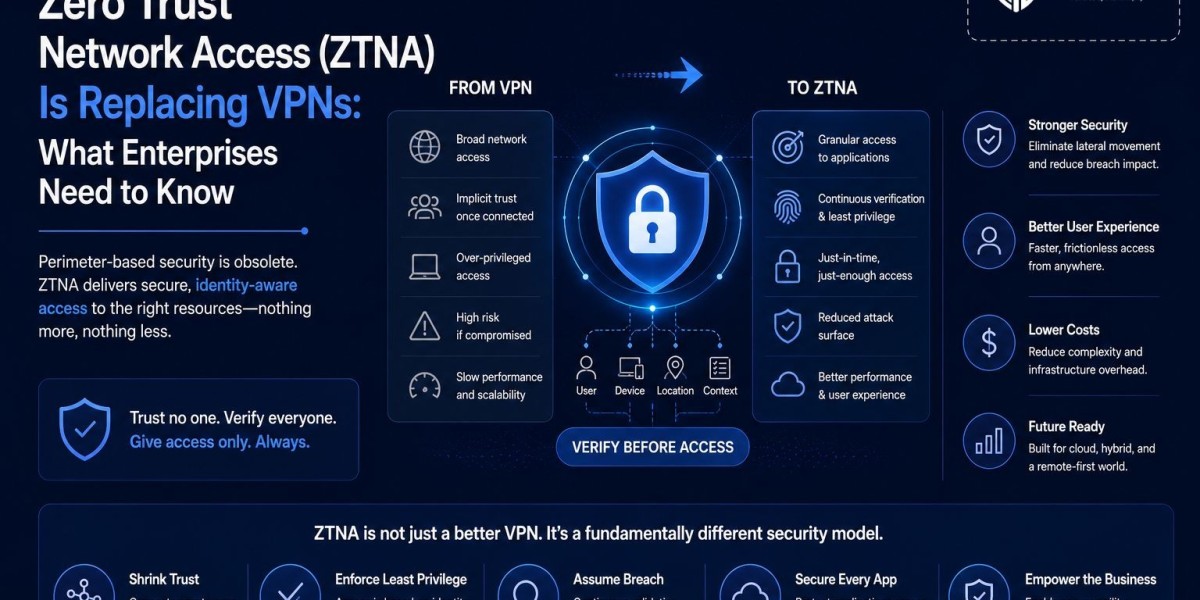

The shift to hybrid work, cloud applications, and distributed IT environments has fundamentally changed how employees access enterprise resources. For years, Virtual Private Networks (VPNs) served as the standard solution for secure remote connectivity. However, VPNs were designed for a time when users primarily accessed applications hosted within corporate data centers.
Today's enterprises operate across multiple clouds, SaaS platforms, remote offices, and unmanaged devices. Once authenticated, traditional VPNs often grant users broad network access, increasing the risk of lateral movement if an account is compromised. As identity-based attacks and credential theft continue to rise, organizations are rethinking how remote access should be secured.
Zero Trust Network Access (ZTNA) is emerging as the preferred alternative. By verifying every access request and limiting users to only the applications they are authorized to use, ZTNA delivers stronger security without sacrificing user experience.
Why Traditional VPNs Are No Longer Enough
VPNs create encrypted connections between users and corporate networks, but they generally assume that authenticated users can be trusted. This model can expose organizations to unnecessary risk if attackers obtain valid credentials.
Common challenges with VPNs include:
- Broad network access after authentication
- Increased lateral movement opportunities
- Limited visibility into user behavior
- Performance bottlenecks during peak usage
- Complex infrastructure management
These limitations make VPNs less effective in cloud-first, identity-driven environments.
How ZTNA Strengthens Enterprise Security
Zero Trust Network Access follows the principle of "never trust, always verify." Instead of connecting users to an entire network, ZTNA grants access only to specific applications or services after continuously validating identity, device posture, and contextual risk.
Key capabilities include:
- Identity-based authentication
- Least privilege access
- Continuous verification
- Device health assessment
- Application-level access control
- Real-time policy enforcement
This approach significantly reduces the attack surface while improving visibility into user activity.
Benefits Beyond Security
ZTNA provides operational advantages that extend beyond stronger cyber defense. Because users connect directly to authorized applications rather than the corporate network, organizations can simplify remote access while improving scalability.
Key benefits include:
- Improved remote user experience
- Reduced infrastructure complexity
- Better support for hybrid work
- Simplified third-party access
- Consistent security across cloud and on-premises applications
These advantages make ZTNA an important component of modern Zero Trust architectures.
Best Practices for ZTNA Adoption
Organizations should maximize the value of ZTNA by:
- Replacing network-level trust with identity-based access.
- Applying least privilege policies for every user and device.
- Continuously verifying identities throughout each session.
- Integrating ZTNA with Identity Threat Detection and Response (ITDR).
- Monitoring access activity through SIEM and XDR platforms.
- Regularly reviewing access policies as business needs evolve.
Combining ZTNA with identity security, endpoint protection, and continuous monitoring creates a stronger and more adaptive security posture.
Conclusion
The modern enterprise no longer operates within a clearly defined network perimeter, making traditional VPN-centric security increasingly difficult to justify. As organizations embrace cloud computing, hybrid work, and AI-powered applications, access decisions must be based on identity, device trust, and real-time risk rather than network location.
Zero Trust Network Access provides a more secure and flexible approach by limiting access to only the resources users need while continuously verifying every connection. This reduces the likelihood of credential-based attacks, minimizes lateral movement, and strengthens overall cyber resilience.
As Zero Trust strategies continue to mature, ZTNA is becoming more than a VPN replacement. It is a foundational technology that enables organizations to secure modern workforces, protect critical applications, and confidently support digital transformation in an increasingly distributed enterprise.
About Cyber Tech Intelligence
Cyber Tech Intelligence is a leading cybersecurity intelligence platform dedicated to delivering research-driven insights, threat intelligence, and strategic analysis across the evolving cybersecurity landscape. We help enterprises, CISOs, technology leaders, and cybersecurity vendors navigate emerging threats, security technologies, and business risks with confidence. Our expertise spans AI Security, Threat Intelligence, Cloud Security, Identity Security, Zero Trust, SIEM, XDR, DevSecOps, Application Security, and Enterprise Cyber Resilience. Through independent research, executive engagement, and market intelligence, we provide actionable insights that support informed decision-making and stronger security outcomes.
At Cyber Tech Intelligence, we believe effective cybersecurity strategies are built on trusted intelligence, transparency, and strategic relevance. Our services include cybersecurity research reports, threat trend analysis, executive briefings, vendor intelligence, CISO engagement programs, webinars, and advisory services designed to help organizations stay resilient in a rapidly changing threat environment. Whether you are looking for strategic cybersecurity insights, partnership opportunities, or expert guidance, our team is ready to help. Contact Us to connect with our cybersecurity experts and learn how we can support your organization’s security goals.