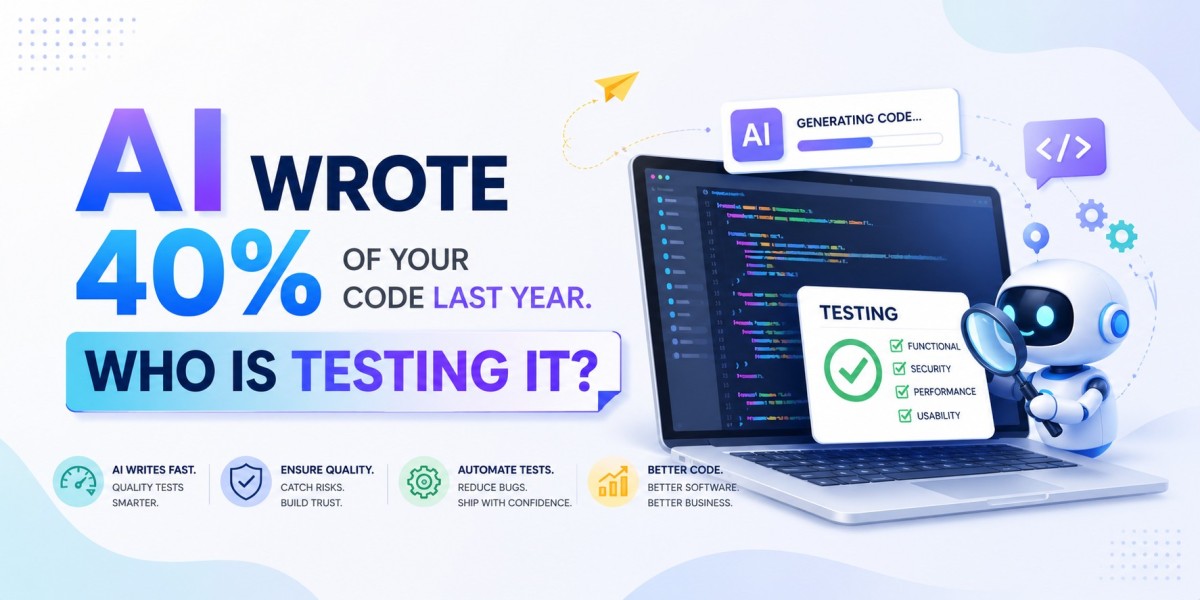

At the Transform 2025 quality engineering conference, Tricentis CEO Kevin Thompson highlighted that over 40% of code written in 2025 was generated by AI, not assisted by AI, not reviewed by AI, but generated by it.
The implications for software quality are profound and largely underappreciated. AI-generated code is fast. It is often elegant. And according to research from Tricentis, at least 60% of it contains issues that require intervention before it is safe to ship. The tools generating the code are not the same tools validating it. And in most organizations, the testing infrastructure has not kept pace with the velocity at which AI is now producing software.
This is the defining quality challenge of 2026. And it is the context in which every business making decisions about software testing services needs to be operating, because the tools generating the code are evolving faster than the processes validating it.
The Speed Problem That Testing Actually Solves
There is a persistent and damaging misconception about software testing that holds many businesses back: the belief that thorough testing slows down delivery. It does not. Poor testing does because the bugs it misses surface in production, where fixing them costs more time, money, and reputation than catching them earlier would have.
The global software testing industry is estimated at $57.73 billion in 2026, growing at a 14.29% CAGR, a market size that does not exist because businesses are choosing to slow themselves down. It exists because businesses have learned, often through painful experience, that software testing services embedded properly into the development process are what make speed sustainable. You cannot ship fast reliably without a testing infrastructure that can keep pace.
The shift that changes everything is where testing happens in the development lifecycle. The old model (build the software, then test it) creates a bottleneck at the end of every release cycle. The modern model embeds software testing services directly into continuous integration and continuous deployment pipelines, running quality gates on every code commit, every branch merge, and every deployment. By 2026, 70% of DevOps organizations will adopt hybrid quality models combining shift-left prevention with shift-right validation, testing earlier to catch defects before they compound, and monitoring in production to catch what slips through. That combination is what eliminates the end-of-cycle bottleneck entirely.
Automation Testing Services: The Foundation of Modern QA
The growth of automation in software quality is not a trend; it is a structural shift that has already happened. Automation testing is growing from USD 28.1 billion in 2023 to USD 55.2 billion by 2028 at a 14.5% CAGR, driven by the same forces reshaping software development itself: faster release cycles, more complex systems, and the need to validate AI-generated code at a scale and speed no manual process can match.
Automation testing services deliver the foundation that modern delivery requires, and they are the fastest-growing component of the broader software testing services market for good reason. Automated regression suites validate that every new code change has not broken existing functionality, running thousands of test cases in the time a human tester could work through hundreds. API testing catches integration failures between microservices before they propagate through systems. Security scanning identifies vulnerabilities at the code level, continuously, rather than in a single pre-release audit that misses the changes made in the final sprint.
The most significant evolution in automation testing in 2026 is the move from scripted automation to intelligent automation. Traditional automated tests break when the application interface changes, a button moves, a field is renamed, or a workflow is restructured. AI-powered self-healing test scripts detect these changes and update automatically, reducing maintenance overhead by approximately 40% and keeping test coverage intact even as the application evolves rapidly. For businesses shipping AI-generated code at high velocity, this resilience is a requirement.
The maturity model for automation is worth understanding because it defines where most organizations have meaningful room to improve. Level two is scripted automation; regression is automated but maintenance-heavy. Level three is CI-integrated testing, automated pipelines with quality gates on every commit. Level four is intelligent automation, AI-assisted optimization, and predictive failure detection. Most organizations are operating somewhere between levels two and three. The competitive advantage sits at level four and above.
Manual Software Testing: The Strategic Layer AI Cannot Replace
The fastest-growing misconception in quality assurance in 2026 is that automation has made human testing redundant. The data tells a different story. Manual testing remains the largest segment of the global software testing market, holding approximately 47% of the market in 2025, not because organizations have not discovered automation but because experienced human testers deliver something no automated tool can replicate.
Manual software testing is where the quality questions that matter most to users get answered. Does this feature make sense to a real person encountering it for the first time? Is this user journey intuitive, or does it create friction that will drive abandonment? Does this interface work in the conditions real users experience, on older devices, in poor network conditions, with screen readers, with the unexpected inputs that real users generate because they do not read the documentation? Automated tools validate what they are programmed to validate. They do not experience software.
The role of human testing has evolved significantly as automation has matured. Human testers in 2026 are not working through predetermined test scripts; that work is increasingly handled by automation. They are doing exploratory testing: approaching the software with curiosity and creativity, thinking the way a user thinks, deliberately seeking the edge cases and usability failures that no script anticipated. This is higher-value work, harder to replicate, and increasingly recognized as a distinct professional discipline rather than a junior QA function.
The interaction between manual and automated testing is also where some of the highest-leverage QA improvements happen. Defects discovered through manual exploratory testing inform new automated test cases, expanding coverage permanently. Patterns identified in automated test results direct human testers toward the highest-risk areas for deeper investigation. The two disciplines are not alternatives; they are a system, and they are most powerful when treated as one.
Load Testing Services: Where AI-Generated Code Meets Reality
Here is a quality risk that is growing faster than most organizations are tracking: AI-generated code that works correctly in testing environments and fails under real-world traffic conditions. The performance characteristics of AI-generated code are less predictable than those of code written by experienced engineers who understand the system's architecture, its dependencies, and its behavior under load. Validating that code at scale requires dedicated load testing services, and most development pipelines do not yet have them.
These services simulate real-world traffic volumes against applications before they go live, identifying the performance thresholds, memory leaks, and architectural bottlenecks that only become visible when hundreds or thousands of concurrent users are interacting with the system simultaneously. The failures they prevent are among the most commercially damaging in software: a product launch that collapses under traffic, an e-commerce checkout that fails during a sale event, and a financial services platform that times out during peak trading hours.
The case for this kind of performance validation is strengthened by the context of AI-generated code. Where an experienced engineer writing a database query has intuitions about its performance characteristics under load, an AI generating the same query optimizes for correctness and does not model production traffic patterns. The result is code that passes functional testing and fails under real conditions, exactly the category of failure that load testing is designed to catch. As AI code generation continues to accelerate, performance validation before launch becomes not just a best practice but a fundamental quality gate.
Building a Testing Strategy for the AI Code Era
The businesses getting software quality right in 2026 share a strategic clarity that distinguishes them from those still treating testing as a checklist. They understand that the testing infrastructure has to evolve at the same pace as the development infrastructure and that, as AI accelerates code production, the testing response has to be equally intelligent and equally fast.
That means embedding software testing services into the development process from the earliest stages, not as a gate at the end, but as a continuous quality signal throughout. It means investing in automation that can keep pace with AI-generated code velocity while preserving the human testing layer that catches what automation misses. It means treating load testing as a standard pre-release requirement rather than an optional performance check. And it means tracking quality metrics (defect escape rate, test coverage, and mean time to detect) with the same rigor applied to delivery metrics like deployment frequency and lead time.
The organizations that have built this infrastructure are not just shipping better software. They are shipping faster, with more confidence, and with fewer of the production incidents that erode customer trust and consume engineering capacity that should be building the next feature. Investing in proper software testing services is not a drag on velocity; it is what makes velocity sustainable in 2026 and beyond.
The question is not whether your business needs serious software testing services. The AI is already writing the code. The question is who (or what) is checking it.