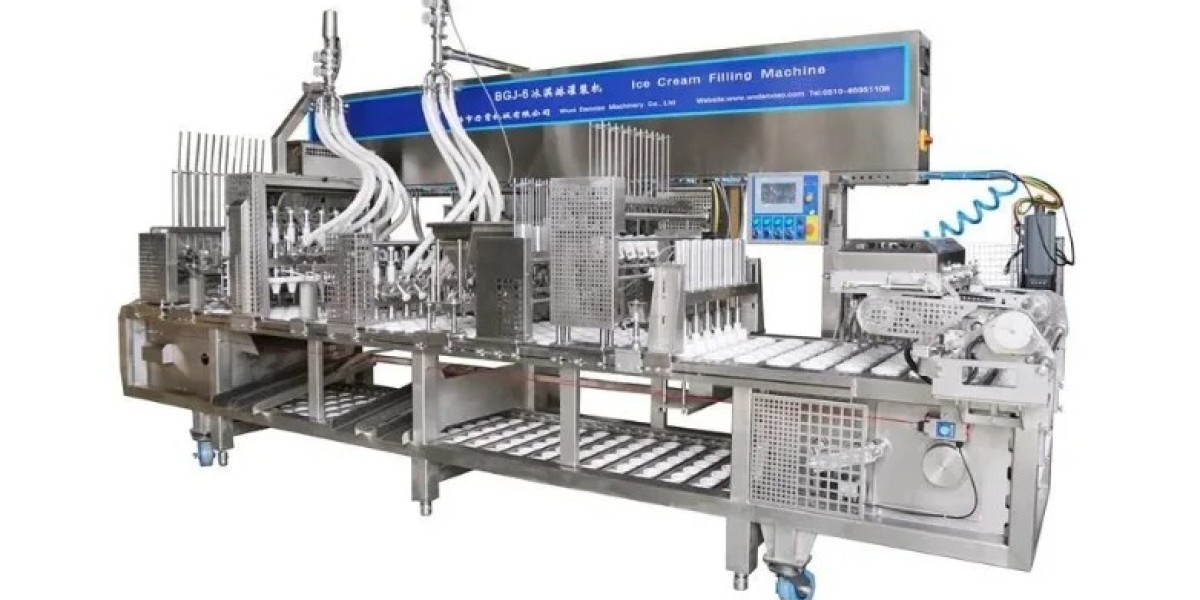

The commercial ice cream industry has evolved dramatically over the past decade. Consumers no longer expect only traditional vanilla or chocolate products. Today's retail shelves are filled with premium frozen desserts featuring multi-layer structures, dual-color swirls, chocolate inclusions, fruit ripples, decorative toppings, and customized packaging formats.
For manufacturers, producing these increasingly sophisticated products at scale presents significant engineering challenges. Consistency, efficiency, hygiene, and flexibility have become just as important as production capacity. As a result, selecting the right industrial ice cream filling machine is no longer simply about throughput—it is about building a production system capable of adapting to future market demands.
This article explores several key technical considerations that modern ice cream producers should evaluate when investing in filling equipment.
1. Maintaining Filling Accuracy in Complex Ice Cream Applications
One of the most common challenges in ice cream production is achieving consistent fill weights throughout long production runs.
Unlike water or other simple liquids, ice cream behaves as a non-Newtonian product. Its viscosity changes depending on formulation, temperature, overrun levels, and ingredient composition. Small fluctuations in pressure can affect filling accuracy, leading to product giveaway or underweight packages.
Modern ice cream filling machines address this issue through servo-driven volumetric dosing technology. Instead of relying solely on pneumatic control, servo systems provide highly precise piston movement and real-time adjustment capabilities.
This technology offers several advantages:
- Improved weight consistency
- Reduced product waste
- Better control across multiple filling lanes
- Greater adaptability to different ice cream formulations
For manufacturers running high-volume production lines, even small improvements in dosing accuracy can generate substantial annual savings in raw material costs.
2. Flexibility Is Becoming a Competitive Requirement
Consumer preferences continue to change rapidly, forcing manufacturers to introduce new products more frequently than ever before.
A production line that only supports one package format or one product type can quickly become a limitation.
Today's leading ice cream filling systems are designed around modular architecture, allowing operators to switch between various product configurations with minimal downtime.
Common production formats include:
- Family-size tubs
- Single-serve cups
- Waffle cones
- Stick ice cream
- Layered desserts
- Multi-flavor frozen snacks
Advanced systems simplify format changes through quick-change components and recipe-based automation settings. Operators can often switch products through touchscreen controls rather than extensive mechanical adjustments.
This flexibility allows manufacturers to respond faster to seasonal promotions, private-label projects, and emerging market trends.
3. Hygiene and Cleaning Efficiency Directly Impact Productivity
Food safety requirements continue to become more demanding worldwide. At the same time, manufacturers are under constant pressure to maximize production uptime.
One area where these objectives intersect is equipment sanitation.
Daily cleaning procedures can consume a significant portion of available production time if machinery is not designed with hygiene in mind.
Modern ice cream filling equipment increasingly incorporates sanitary design principles such as:
- SUS304 and SUS316L stainless steel construction
- Smooth weld-free product-contact surfaces
- Hygienic piping systems
- Easy-access maintenance points
- Automated Clean-in-Place (CIP) functionality
CIP technology allows cleaning solutions to circulate throughout the product-contact system without extensive disassembly. This approach helps reduce labor requirements, improve cleaning consistency, and shorten sanitation cycles.
For many production facilities, improved cleaning efficiency translates directly into higher Overall Equipment Effectiveness (OEE).
4. Automation Is Reshaping Frozen Dessert Manufacturing
Labor shortages and rising operating costs are encouraging manufacturers to automate more production processes.
Modern filling systems are increasingly integrated with advanced control platforms capable of collecting and analyzing production data in real time.
Features commonly found in next-generation ice cream filling equipment include:
- PLC-based process control
- Recipe management systems
- Real-time diagnostics
- Predictive maintenance monitoring
- Production reporting functions
- Integration with MES and ERP systems
These technologies help manufacturers improve process visibility while reducing the likelihood of unexpected downtime.
Instead of reacting to equipment failures after they occur, maintenance teams can identify potential issues before they impact production.
The result is a more reliable and efficient manufacturing operation.
5. Evaluating Long-Term Value Rather Than Initial Cost
When purchasing filling equipment, focusing solely on acquisition cost can be misleading.
The true value of a production system is determined by its long-term performance, including:
- Product consistency
- Downtime reduction
- Energy efficiency
- Maintenance requirements
- Production flexibility
- Future scalability
A machine with advanced automation, hygienic design, and precision dosing capabilities often delivers significantly greater return on investment over its operating life.
Manufacturers that take a long-term perspective are generally better positioned to support product innovation while maintaining competitive production costs.
Final Thoughts
As the frozen dessert market becomes more diverse and competitive, the demands placed on production equipment continue to increase.
Accuracy, flexibility, sanitation, and intelligent automation are now fundamental requirements rather than optional features.
Whether producing premium gelato, layered desserts, chocolate-coated novelties, or traditional ice cream products, manufacturers should evaluate filling equipment based on its ability to support both current production needs and future growth opportunities.
Companies such as Wuxi Danxiao Machinery Co., Ltd. continue to invest in advanced filling technologies that help manufacturers improve efficiency, reduce waste, and adapt to evolving market demands. For businesses seeking sustainable growth in the ice cream sector, choosing the right filling solution remains one of the most important strategic decisions in the production process.