
Carbon fiber reinforced polymers (CFRP) have become indispensable in industries where strength-to-weight ratio, fatigue resistance, and structural efficiency are critical. Aerospace manufacturers, automotive engineers, renewable energy developers, and advanced industrial equipment producers increasingly rely on composite materials to achieve performance targets that traditional metals cannot easily deliver.
However, despite their exceptional mechanical properties, carbon fiber composites are not immune to damage. Impact events, cyclic loading, environmental exposure, and operational wear can all compromise structural integrity over time. In many cases, replacing an entire composite component is neither cost-effective nor practical, particularly when dealing with large aerospace structures, wind turbine blades, or high-value industrial equipment.
As a result, carbon fiber composite repair has evolved into a specialized engineering field focused on restoring structural performance while minimizing downtime and replacement costs.
Understanding How Composite Structures Fail
Before selecting an appropriate repair strategy, it is important to understand the most common failure mechanisms found in composite materials.
Impact Damage
One of the most challenging aspects of composite maintenance is that damage is often hidden beneath the surface.
A dropped tool, flying debris, or accidental collision may leave only a small visible mark while causing extensive internal damage within the laminate structure. This hidden damage can significantly reduce load-carrying capacity if left undetected.
Delamination
Delamination occurs when individual composite layers separate from one another.
Because composite materials rely on load transfer between multiple bonded layers, delamination can dramatically weaken the structure and accelerate further deterioration under repeated loading conditions.
Matrix Cracking
The polymer matrix surrounding carbon fibers can develop cracks due to fatigue loading, thermal cycling, or environmental stress.
Although these cracks may initially appear minor, they can create pathways for moisture intrusion and contribute to progressive structural degradation.
Fiber Fracture
Carbon fibers provide the majority of a composite's strength and stiffness.
When fibers are severed or damaged, localized mechanical performance decreases significantly, often requiring structural repair to restore the original design specifications.
Modern Repair Methods Used in Composite Engineering
Advances in materials science and repair technologies have made it possible to restore many damaged composite structures to near-original performance levels.
Scarf Repair
Scarf repair remains one of the most widely accepted structural repair techniques, particularly in aerospace applications.
The damaged region is gradually tapered, allowing new composite plies to be bonded into the structure while maintaining smooth load transfer between the repaired and original material.
Benefits include:
- Excellent strength recovery
- Minimal aerodynamic disruption
- Reduced stress concentrations
- High compatibility with aerospace-grade structures
Because of its complexity, scarf repair requires precise machining and strict process control.
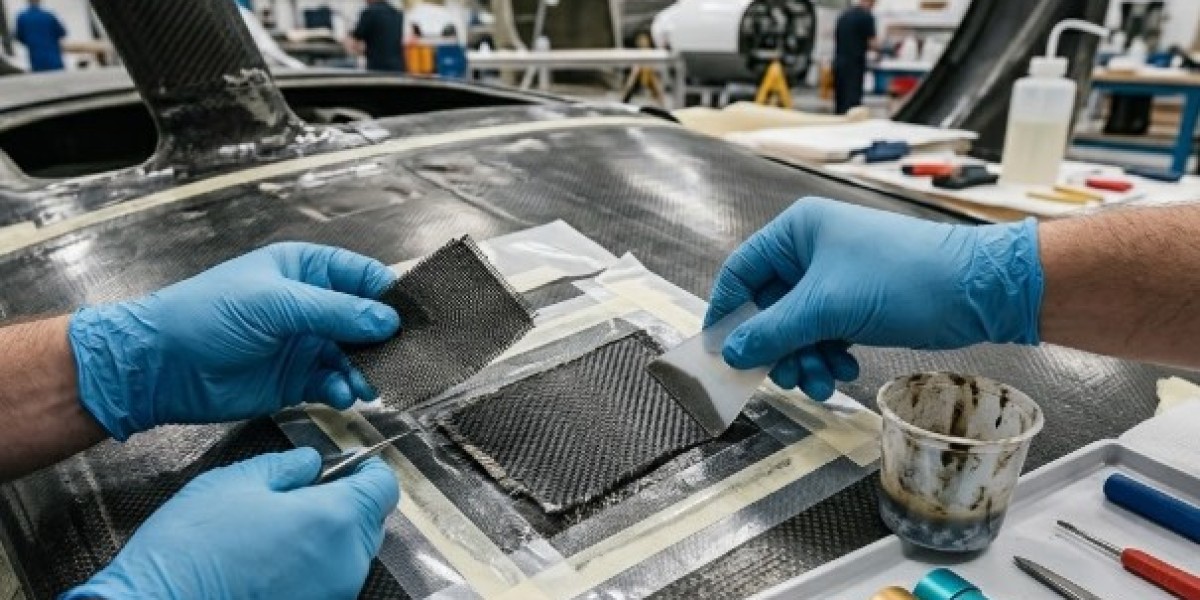
Bonded Composite Patches
For many industrial applications, bonded patch repairs provide an efficient solution.
This technique involves attaching a composite reinforcement patch over the damaged area using high-performance structural adhesives.
Patch repairs are frequently used when minimizing downtime is a priority.
Hot Bonding Processes
Hot bonding systems use carefully controlled heat and pressure to cure repair materials.
By replicating the original curing conditions as closely as possible, engineers can improve bonding quality and mechanical performance within the repaired area.
Vacuum Bagging Techniques
Vacuum-assisted repairs have become standard practice across many industries.
By applying uniform pressure during curing, vacuum bagging helps:
- Reduce void content
- Improve laminate consolidation
- Enhance adhesive bonding
- Increase structural reliability
The result is a more consistent and durable repair outcome.
Material Compatibility Is Essential
Successful carbon fiber composite repair depends not only on technique but also on material selection.
Modern repair systems typically incorporate:
- Carbon fiber prepreg materials
- Structural epoxy resin systems
- Surface preparation primers
- Adhesive films
- Peel plies and breather fabrics
- Vacuum processing consumables
A critical consideration is ensuring compatibility between repair materials and the original composite structure.
Differences in stiffness, thermal expansion characteristics, or curing behavior can introduce new stress concentrations and reduce long-term durability.
This is one area where engineering expertise becomes particularly valuable.
Companies such as Northen emphasize material compatibility analysis to ensure repaired structures maintain mechanical behavior that closely matches the original design.
Industries Driving Demand for Composite Repair
As composite materials continue to replace metals across multiple sectors, demand for advanced repair solutions is growing rapidly.
Aerospace
Aircraft manufacturers and maintenance providers routinely perform composite repairs on:
- Fuselage panels
- Wing skins
- Control surfaces
- Fairings
- Interior structural components
Strict certification requirements make repair quality especially important in aviation.
Automotive Engineering
Performance vehicles increasingly utilize carbon fiber body panels, structural reinforcements, and aerodynamic components.
Repair solutions help preserve weight advantages while reducing replacement costs.
Wind Energy
Modern wind turbine blades often exceed 80 meters in length and are constructed primarily from composite materials.
Repair technologies play a crucial role in extending operational life and reducing maintenance expenses.
Marine Applications
Composite materials are widely used in boat hulls, offshore platforms, and marine structures because of their excellent corrosion resistance.
Specialized repair systems help maintain structural integrity in harsh environments.
Industrial Equipment
Robotic systems, pressure vessels, and lightweight structural assemblies increasingly depend on composite restoration techniques to maximize service life.
Key Engineering Considerations During Repair
Not all repairs deliver the same level of structural recovery.
Engineers must carefully evaluate several critical factors:
Load Path Restoration
The repaired area must effectively transfer loads through the structure in the same manner as the original design.
Thermal Compatibility
Repair materials should exhibit similar thermal expansion behavior to prevent fatigue-related failures.
Surface Preparation
Surface cleanliness and preparation quality have a direct impact on adhesive performance and bonding strength.
Cure Process Control
Temperature, pressure, and cure duration must be precisely controlled to achieve optimal material properties.
Non-Destructive Testing
Modern inspection methods such as ultrasonic testing and thermographic analysis help verify repair quality before components return to service.
Emerging Trends in Composite Repair Technology
Several technological developments are expected to shape the future of composite repair.
These include:
- AI-assisted damage assessment
- Automated robotic repair systems
- Faster-curing structural adhesives
- Embedded structural health monitoring sensors
- Digital repair documentation and traceability systems
At the same time, sustainability initiatives are encouraging industries to adopt repair-over-replacement strategies whenever possible, further increasing demand for advanced composite restoration solutions.
Conclusion
Carbon fiber composite repair has become a fundamental part of modern engineering maintenance strategies. As industries continue to invest in lightweight, high-performance structures, the ability to restore damaged composites safely and efficiently is becoming increasingly important.
Through techniques such as scarf repairs, bonded patches, hot bonding, and vacuum-assisted curing, engineers can recover structural performance while avoiding the significant costs associated with component replacement.
Organizations such as Northen continue to support this growing field through advanced repair materials, engineering expertise, and practical restoration solutions. As composite usage expands across aerospace, renewable energy, automotive, and industrial sectors, repair technologies will play an even greater role in extending asset life, improving sustainability, and maximizing operational efficiency.
https://www.northenpipe.com/the-engineer-s-guide-to-precision-carbon-fiber-composite-patching.html