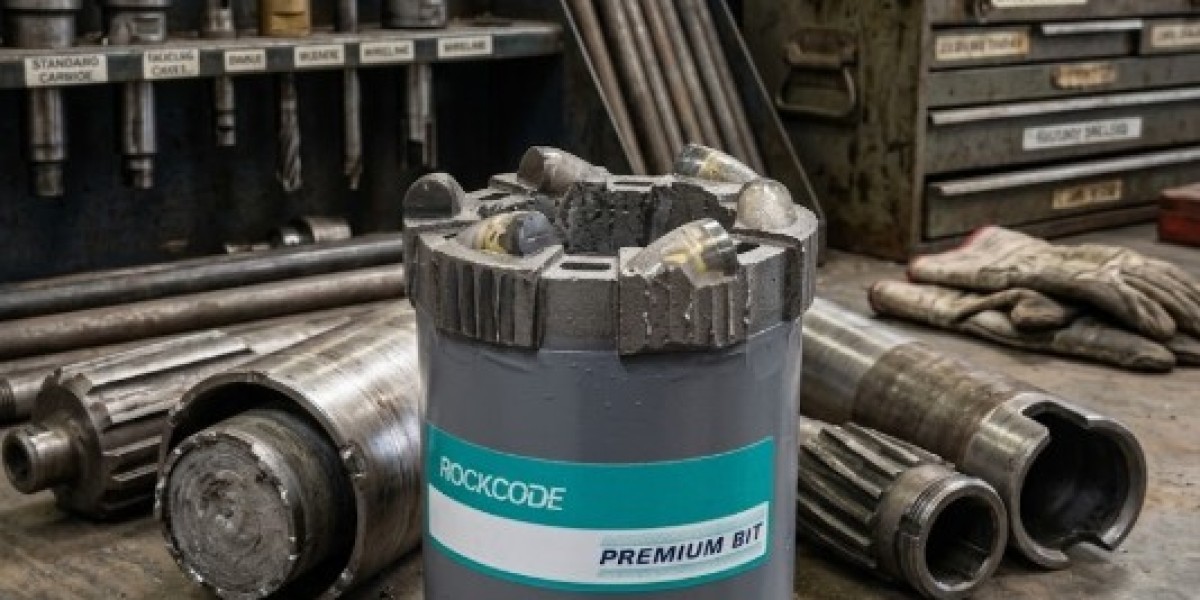

In greenfield mineral exploration and deep-hole deep-development mining programs, the structural integrity of geological samples is paramount. Geological resource models rely entirely on the quality, continuity, and representativeness of the extracted rock core. However, deep drilling operations frequently encounter challenging conditions, such as fractured strata, variable quartz abrasive bands, and alternating hard-soft formations. Under these intense structural dynamics, downhole tool failure or low core recovery rates directly increase the total cost-per-meter, leading to costly project delays.
Understanding Core Drilling Methods in Mining
Diamond Core Drilling: The Industry Standard
Diamond core drilling is the standard method for hard-rock mineral exploration and geotechnical investigation. The technique uses a hollow bit impregnated with industrial diamonds to cut an annular groove in the rock, leaving a cylindrical core sample that passes through the bit into a core barrel. This method produces high-quality core suitable for detailed geological logging, structural interpretation, and laboratory analysis.
The performance of a diamond core bit depends on several interacting factors: the matrix material that holds the diamonds, the size and grade of the diamonds themselves, the geometry of the waterways that flush cuttings and cool the bit, and the drilling parameters applied at the rig. A study on deep-sea hard rock drilling found that diamond bits with optimized matrix compositions containing 5% tungsten carbide and 0.8% nano-rare earth achieved an average rate of penetration (ROP) of 4.4 m/h with a bit life of 137.75 m in granite formations with drilling ability grades of 7-10.[1]
Wireline Core Drilling Systems
For deep exploration programs, wireline core drilling systems have become the preferred configuration. Unlike conventional coring, where the entire drill string must be pulled to retrieve each core run, wireline systems allow the inner tube containing the core to be retrieved via an overshot device lowered on a wireline cable. This dramatically reduces non-productive time, improves safety by minimizing rod handling, and enables longer single-run lengths. The trade-off is a slightly smaller core diameter for a given hole size and higher initial tooling investment.
In our own manufacturing practice at ROCKCODE, we have observed that the shift toward wireline systems has been the most consistent trend among our international customers over the past several years. Contractors running deep exploration programs in Australia, Canada, and Africa have standardized on wireline configurations because the time savings on multi-hundred-meter holes directly translate to lower per-meter drilling costs. Our product line covers the full range of DCDMA/ISO standard sizes - AQ, BQ, NQ, HQ, and PQ - with both wireline-compatible and conventional configurations available.
Alternative Methods and When to Use Them
While diamond core drilling dominates hard-rock exploration, other methods serve specific purposes. Reverse circulation (RC) drilling offers faster penetration and is commonly used for resource definition in near-surface deposits where core quality is less critical than sample volume. Auger drilling works well in soft, unconsolidated overburden. The selection of drilling method should always be driven by project objectives, geological conditions, and the decisions the drilling data must support.
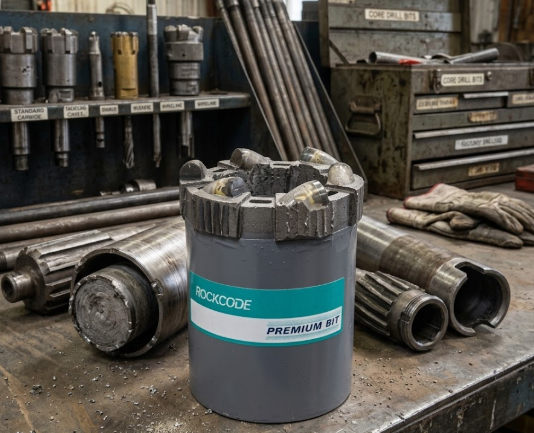
Diamond Core Bit Technology: What Matters
Matrix Composition and Manufacturing
The matrix of an impregnated diamond bit is a metal powder composite, typically based on cobalt, iron, or copper alloys, into which synthetic diamond grit is uniformly distributed. During drilling, the matrix wears away at a controlled rate, continuously exposing fresh diamond cutting edges. This self-sharpening characteristic is what gives impregnated bits their extended life in hard, abrasive formations.
Powder metallurgy techniques, including hot pressing and hot isostatic pressing (HIP), are used to consolidate the matrix-diamond mixture to near-full density. Research in diamond tool fabrication indicates that incomplete densification results in low toughness, poor wear resistance, and inadequate diamond retention. Quality control typically involves hardness testing (commonly Rockwell B) and density verification to ensure the matrix has been properly consolidated.
Diamond Grade and Distribution
Not all industrial diamonds perform equally in drilling applications. Synthetic diamonds produced under high-pressure, high-temperature (HPHT) conditions offer consistent quality and can be engineered for specific hardness and thermal stability requirements. The concentration and size distribution of diamonds within the matrix must be matched to the formation being drilled. Too few diamonds leads to rapid matrix wear and poor penetration; too many diamonds can cause glazing, where the bit polishes rather than cuts the rock surface.
Thermal Management
Temperature in the contact zone between the bit and rock is a critical but often underestimated factor. Research on thermal operational regimes for diamond core drills found that under normal wear conditions, the contact zone temperature ranges between 327°C and 660°C. When drilling parameters are poorly controlled, temperatures can exceed 800°C, leading to diamond degradation, matrix softening, and accelerated bit failure. Proper flushing with drilling fluid is essential not only for cuttings removal but also for thermal management.[2]
PDC Bits and Hybrid Designs
Polycrystalline diamond compact (PDC) bits represent an alternative to impregnated diamond bits for certain applications. PDC cutters consist of a layer of synthetic diamond bonded to a tungsten carbide substrate. They offer high penetration rates in competent formations but can be vulnerable to impact damage in fractured ground. Recent research on lunar rock drilling evaluated PDC bits against diamond-impregnated and carbide-tipped alternatives, finding that PDC bits demonstrated superior wear resistance and versatility across various rock types, though drilling temperature and core integrity remained important considerations.
In our product range, ROCKCODE manufactures both impregnated diamond core bits and PDC core bits, along with surface-set diamond bits, reaming shells, core lifters, and drilling accessories compatible with standard DCDMA/ISO wireline and conventional systems. The choice between impregnated and PDC depends on the specific formation characteristics and project priorities. We work with customers to review their drilling logs and formation descriptions to recommend the most suitable bit type for their conditions.
Selecting Core Drilling Tools for Your Project
Matching Bit to Formation
The first step in tool selection is understanding the ground conditions. Rock hardness, abrasiveness, degree of fracturing, and expected changes in lithology with depth all influence bit selection. Hard, competent rock generally allows standard impregnated diamond bits with appropriate matrix hardness. Highly fractured or weak formations may require double-tube or triple-tube core barrels to protect the core and maintain acceptable recovery rates.
Matrix hardness must be matched to formation abrasiveness. A matrix that is too hard for the formation will not wear sufficiently to expose new diamonds, resulting in glazing and reduced penetration. A matrix that is too soft will wear too quickly, leading to premature diamond loss and short bit life. Most manufacturers provide classification charts that guide bit selection based on formation characteristics.
Core Barrel Configuration
Single-tube, double-tube, and triple-tube core barrels each serve different purposes. Single-tube barrels are the simplest and most economical but offer minimal core protection. Double-tube barrels isolate the core from drilling fluid circulation, improving recovery in broken ground. Triple-tube systems add a split inner tube or liner that captures the core without disturbance, which is particularly valuable when drilling soft, friable, or clay-bearing formations.
Drill Rod and Casing Selection
Drill rods transmit torque and feed force from the rig to the bit. Rod straightness, thread integrity, and fatigue resistance are critical, especially in deep holes where connection failures or rod breakage can result in costly fishing operations. Flush-jointed rods are standard for wireline systems, allowing the inner tube to pass through the drill string. Casing programs must be designed to stabilize the upper hole sections and prevent fluid loss or formation collapse.
Conclusion
Selecting the right core drilling tools for mining is essential for achieving high core recovery, reliable geological data, and cost-effective drilling operations. From diamond core bits and wireline systems to core barrels and drill rods, each tool plays a critical role in drilling performance and sample quality.
As exploration projects move deeper and encounter more complex ground conditions, matching drilling tools to formation characteristics becomes increasingly important. The right combination of bit design, matrix hardness, and coring system can improve penetration rates, extend tool life, and reduce overall drilling costs.
→ For more information about ROCKCODE’s Products, please visit: https://www.rockcodebit.com/drill-bits-products
→ Email us at: info@rockcodebit.com
→ Information in this article is for general reference only. For specific drilling projects and drilling bits, please consult qualified professionals. Thank you.
Source:
1.Design and Experimental Study of Core Bit for Hard Rock Drilling in Deep-Sea
2.Investigation of Thermal Operational Regimes for Diamond Core Drills