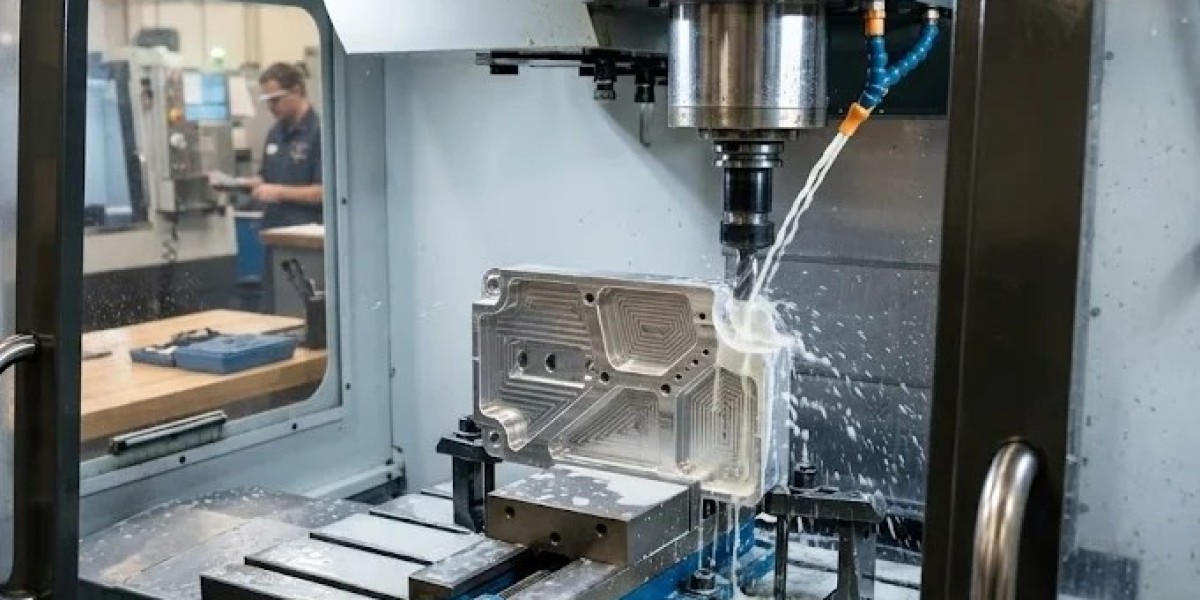

As industries such as aerospace, medical devices, semiconductors, and electric vehicles continue to push engineering limits, manufacturing precision is no longer simply a competitive advantage—it has become a fundamental requirement.
Today's advanced products often contain components with extremely tight dimensional tolerances, intricate geometries, and demanding surface quality requirements. In many applications, even a micron-level deviation can affect assembly accuracy, operational performance, or long-term reliability.
This is where CNC milling machining for precision parts plays a critical role. Modern CNC technologies enable manufacturers to consistently produce complex components with exceptional accuracy, repeatability, and surface integrity, supporting the increasingly stringent standards of advanced industries.
Understanding the Challenges of Precision CNC Milling
At first glance, CNC milling appears straightforward: remove material until the desired shape is achieved. However, producing truly high-precision parts requires far more than basic machining capability.
Materials commonly used in high-performance industries—including Titanium Grade 5, Inconel 718, hardened tool steels, and 316L stainless steel—present significant machining challenges. These materials generate substantial cutting forces and heat during processing, which can introduce:
- Tool deflection
- Thermal distortion
- Vibration and chatter
- Surface inconsistencies
- Dimensional variation
To overcome these challenges, manufacturers increasingly rely on rigid machine platforms, optimized cutting strategies, and advanced process control.
For example, heavy-duty cast structures combined with direct-drive spindle systems help minimize vibration and maintain stability throughout high-speed machining operations. Stable machine architecture is often the first step toward achieving consistent micron-level tolerances.
The Importance of Toolpath Optimization
Precision is not determined solely by machine capability. The way cutting tools move through the material has a direct impact on final part quality.
Modern CAM software enables engineers to optimize:
- Radial depth of cut (RDOC)
- Axial depth of cut (ADOC)
- Feed rates
- Tool engagement angles
- Material removal strategies
One increasingly popular approach is trochoidal milling.
Rather than maintaining constant full-width engagement, trochoidal toolpaths use controlled circular motions to reduce cutting forces and heat generation. This offers several benefits:
- Improved tool life
- Reduced thermal stress
- Better chip evacuation
- Enhanced dimensional stability
For high-value materials and complex components, these advantages can significantly improve both productivity and quality.
Why Multi-Axis CNC Milling Is Transforming Precision Manufacturing
Traditional 3-axis machining remains highly effective for many applications. However, as component complexity increases, manufacturers often encounter limitations related to accessibility and setup requirements.
Every time a workpiece must be removed, repositioned, and re-clamped, additional opportunities for error are introduced.
This is one reason why 5-axis CNC milling has become increasingly important in precision manufacturing.
Reduced Setup Errors
A major advantage of simultaneous 5-axis machining is the ability to machine multiple surfaces in a single setup.
Benefits include:
- Improved datum consistency
- Better hole alignment
- Reduced cumulative tolerance stack-up
- Higher overall accuracy
Better Tool Orientation
Five-axis machines allow the cutting tool to maintain an optimal angle relative to the workpiece surface.
This helps improve:
- Surface finish quality
- Cutting efficiency
- Tool life
- Geometric accuracy
Increased Rigidity
Instead of relying on long tooling extensions to reach deep features, shorter and more rigid tools can often be used.
Reduced tool overhang means:
- Less vibration
- Lower deflection
- Improved dimensional consistency
For industries that require extreme precision, these advantages are often essential.
Surface Integrity: More Than Just Appearance
Many people associate machining quality with visible surface finish. In reality, surface integrity extends far beyond aesthetics.
In industries such as medical manufacturing and semiconductor equipment production, surface characteristics can directly influence component performance.
Important factors include:
- Residual stress levels
- Surface roughness
- Burr formation
- Micro-cracking
- Friction characteristics
Advanced manufacturers use optimized spindle speeds, feed rates, and tool coatings to minimize these issues.
Modern CAD/CAM systems also enable the creation of constant-scallop finishing strategies that maintain uniform cutter engagement and produce highly consistent surface textures.
Combined with high-pressure through-spindle coolant systems, these techniques help eliminate chip recutting, one of the most common causes of microscopic surface damage.
Thermal Stability: The Hidden Factor Behind Precision
One of the least discussed yet most important aspects of precision manufacturing is thermal control.
Even minor temperature fluctuations can affect:
- Machine structures
- Ball screws
- Cutting tools
- Workpiece dimensions
A small change in ambient temperature may be enough to push a critical feature outside specification.
To address this issue, advanced machining facilities increasingly implement:
- Climate-controlled production environments
- Refrigerated coolant systems
- Thermal compensation software
- Real-time machine monitoring
These systems help maintain stable manufacturing conditions throughout the production process.
Metrology and Quality Verification
Precision machining does not end when cutting operations are complete.
Comprehensive quality assurance is equally important.
Leading manufacturers typically combine:
In-Process Inspection
Machine-mounted probing systems can verify critical dimensions before machining operations are completed.
This allows immediate correction if deviations are detected.
Coordinate Measuring Machines (CMM)
CMM inspection provides highly accurate dimensional verification against CAD models and engineering drawings.
Optical Measurement Technologies
Advanced optical systems can evaluate:
- Surface profiles
- Geometric tolerances
- Complex freeform features
The combination of machining and metrology ensures that final components match design intent as closely as possible.
Why Manufacturing Partners Matter
Selecting a machining supplier is not simply about equipment capacity.
Successful precision manufacturing requires expertise in:
- Material behavior
- Toolpath development
- Thermal management
- Fixture design
- Quality control
Companies such as AICHI TECHNOLOGY focus on integrating these disciplines into a comprehensive manufacturing approach, helping customers transform complex digital designs into high-performance physical components.
Whether producing aerospace assemblies, semiconductor equipment parts, medical device components, or precision industrial hardware, the ability to consistently maintain tight tolerances remains one of the most important indicators of manufacturing excellence.
Final Thoughts
As manufacturing standards continue to evolve, precision CNC milling is becoming increasingly critical across virtually every advanced industry.
The combination of multi-axis machining, intelligent toolpath strategies, thermal stability management, and rigorous metrology enables manufacturers to achieve levels of accuracy that were once considered unattainable.
For organizations seeking reliable, repeatable, and high-performance components, understanding these technologies—and partnering with experienced precision machining specialists such as AICHI TECHNOLOGY—can play a significant role in achieving long-term production success.
The future of manufacturing will not simply be defined by automation or speed. It will be defined by precision, consistency, and the ability to deliver flawless components at scale.
https://www.wxaichi.com/how-cnc-milling-drives-modern-precision-manufacturing.html