
In modern high-tech manufacturing environments, contamination control has become just as important as production efficiency. Whether producing semiconductor wafers, OLED panels, pharmaceutical products, or advanced photovoltaic cells, manufacturers face an increasingly difficult challenge: maintaining strict cleanliness standards while moving heavy and sensitive materials throughout the facility.
While advanced HVAC and HEPA filtration systems effectively control airborne particles, one often-overlooked source of contamination comes from material handling equipment itself. Conventional overhead cranes can generate particles through mechanical wear, friction, lubricant leakage, and coating degradation, introducing risks that are unacceptable in controlled environments.
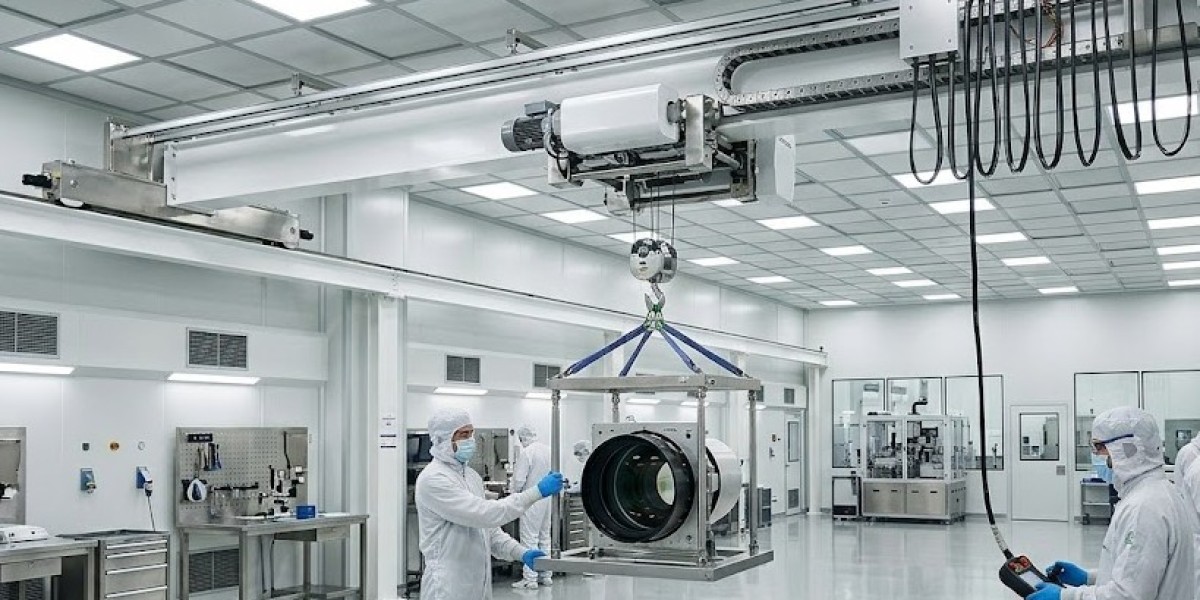
As a result, many manufacturers are adopting specialized cleanroom EOT (Electric Overhead Traveling) cranes designed specifically for contamination-sensitive applications. Unlike standard overhead cranes, these systems are engineered to operate within cleanroom environments while minimizing particulate generation and maintaining precise load handling performance.
Why Standard Cranes Are Unsuitable for Cleanroom Environments
Traditional industrial cranes are built primarily for durability and lifting capacity. In most manufacturing environments, small amounts of wear debris or lubricant emissions are considered normal.
However, in cleanrooms operating under ISO Class 3, ISO Class 4, or similar standards, even microscopic contamination can lead to significant production losses.
Potential contamination sources from conventional crane systems include:
- Metallic particles generated by wire rope wear
- Dust produced by wheel-to-rail friction
- Paint flaking from structural components
- Lubricant leakage from gearboxes and bearings
- Cable insulation wear from repeated movement
For industries where product features are measured in nanometers or sterile conditions are mandatory, these contamination sources can directly affect product quality and yield.
This challenge has driven the development of specialized cleanroom crane technology.
Key Design Features of Modern Cleanroom EOT Cranes
Low-Particle Hoisting Systems
One of the most critical areas of a cleanroom crane is the lifting mechanism.
Traditional steel wire ropes can generate microscopic metal particles during operation. To reduce this risk, many advanced cleanroom cranes utilize alternative lifting technologies such as:
- High-strength synthetic fiber belts
- Specialized low-shedding ropes
- Advanced polymer-based lifting components
These materials significantly reduce friction-related particle generation while maintaining excellent load capacity and operational reliability.
Manufacturers such as Goldcrane incorporate cleanroom-oriented lifting solutions that prioritize both mechanical performance and environmental cleanliness.
Cleanroom-Compatible Structural Materials
Material selection plays a major role in contamination control.
Modern cleanroom cranes frequently utilize:
- SUS304 stainless steel
- SUS316 stainless steel
- Low-particle industrial coatings
- Non-flaking epoxy finishes
These materials help prevent:
- Corrosion
- Surface degradation
- Particle shedding
- Coating failures
In addition, smooth polished surfaces simplify cleaning and sanitation procedures.
Sealed Drive Systems and Leak Prevention
Fluid leakage is another major concern in contamination-sensitive production environments.
To address this issue, cleanroom crane manufacturers employ:
- Multi-stage sealing systems
- Enclosed gearboxes
- Leak containment structures
- Low-volatility lubricants
These solutions reduce the possibility of oil or grease contamination reaching critical production areas.
For pharmaceutical and semiconductor facilities, such safeguards are often considered essential rather than optional.
Precision Motion Control for Sensitive Loads
Cleanliness is only one requirement.
Many products handled within cleanrooms are also highly fragile and expensive.
Examples include:
- Semiconductor wafer carriers
- LCD glass substrates
- OLED display panels
- Pharmaceutical processing vessels
- Precision optical components
Abrupt acceleration, sudden braking, or load sway can damage these materials.
Modern cleanroom cranes therefore integrate advanced motion control technologies such as:
Variable Frequency Drives (VFD)
VFD systems provide smooth acceleration and deceleration profiles, reducing shock loads and improving positioning accuracy.
Absolute Encoder Feedback
High-resolution encoder systems continuously monitor load position, allowing for precise and repeatable movement.
Anti-Sway Control
Sophisticated control algorithms actively minimize pendulum effects during transport, helping protect delicate products from impact damage.
These technologies allow operators to achieve highly accurate positioning while maintaining process stability.
Industry Applications Driving Demand
Semiconductor Manufacturing
Semiconductor fabrication facilities maintain some of the strictest cleanliness standards in the world.
Cleanroom cranes are commonly used for:
- Wafer carrier transport
- Equipment installation
- Process tool maintenance
- Material movement between production zones
Minimizing particle generation is critical to maintaining wafer yields and process consistency.
LCD and OLED Display Production
Large glass substrates used in display manufacturing are highly sensitive to contamination and mechanical stress.
Cleanroom crane systems help ensure:
- Safe transportation
- Reduced vibration
- Controlled positioning
- Minimal particulate exposure
Pharmaceutical and Biotechnology Facilities
Sterile manufacturing environments require strict control over both biological and particulate contamination.
Cleanroom cranes used in pharmaceutical applications are often designed to withstand:
- Vaporized hydrogen peroxide (VHP) sterilization
- Alcohol-based cleaning agents
- Frequent sanitation cycles
This ensures reliable operation within regulated production environments.
Photovoltaic Manufacturing
Solar panel production frequently involves moving large silicon components through chemically aggressive processing areas.
Cleanroom cranes used in these environments must combine:
- Corrosion resistance
- Contamination control
- High reliability
- Precise load handling
Advanced Travel Systems for Reduced Particle Generation
Beyond the hoist itself, crane travel systems can also contribute to contamination.
Traditional steel wheels operating on steel rails generate microscopic wear particles over time.
To reduce this effect, many modern cleanroom crane designs utilize:
Polyurethane Wheel Systems
Compared with metal wheels, polyurethane wheels offer:
- Lower vibration levels
- Reduced wear debris
- Quieter operation
- Improved environmental cleanliness
Enclosed Energy Chain Systems
Instead of conventional cable festoons, enclosed drag chain systems help protect cables while minimizing particle generation caused by cable movement.
Localized Particle Extraction
Some ultra-clean applications incorporate dedicated vacuum extraction systems near moving components.
These systems capture any particles generated during operation and direct them into localized HEPA filtration units before they can enter the surrounding environment.
Why Cleanroom Cranes Are an Investment in Manufacturing Yield
For many advanced manufacturers, cleanroom infrastructure directly influences profitability.
Reducing contamination risks can lead to:
- Higher product yields
- Lower scrap rates
- Reduced maintenance requirements
- Improved process consistency
- Greater regulatory compliance
Because material handling equipment operates throughout the production cycle, upgrading to specialized cleanroom crane systems can provide long-term operational benefits that extend well beyond lifting performance alone.
Final Thoughts
As manufacturing technologies continue to advance, contamination control requirements will become even more stringent. Cleanroom EOT cranes have evolved from niche lifting equipment into critical infrastructure for semiconductor, pharmaceutical, electronics, and renewable energy production facilities.
Through specialized materials, low-particle motion systems, sealed mechanical components, and precision control technologies, manufacturers such as Goldcrane are helping bridge the gap between heavy-duty material handling and ultra-clean production environments.
For facilities focused on maximizing yield, protecting sensitive products, and maintaining strict cleanliness standards, investing in advanced cleanroom crane technology is increasingly becoming a strategic necessity rather than simply an equipment upgrade.
https://www.goldcraneglobal.com/inside-high-quality-cleanroom-eot-crane-systems.html