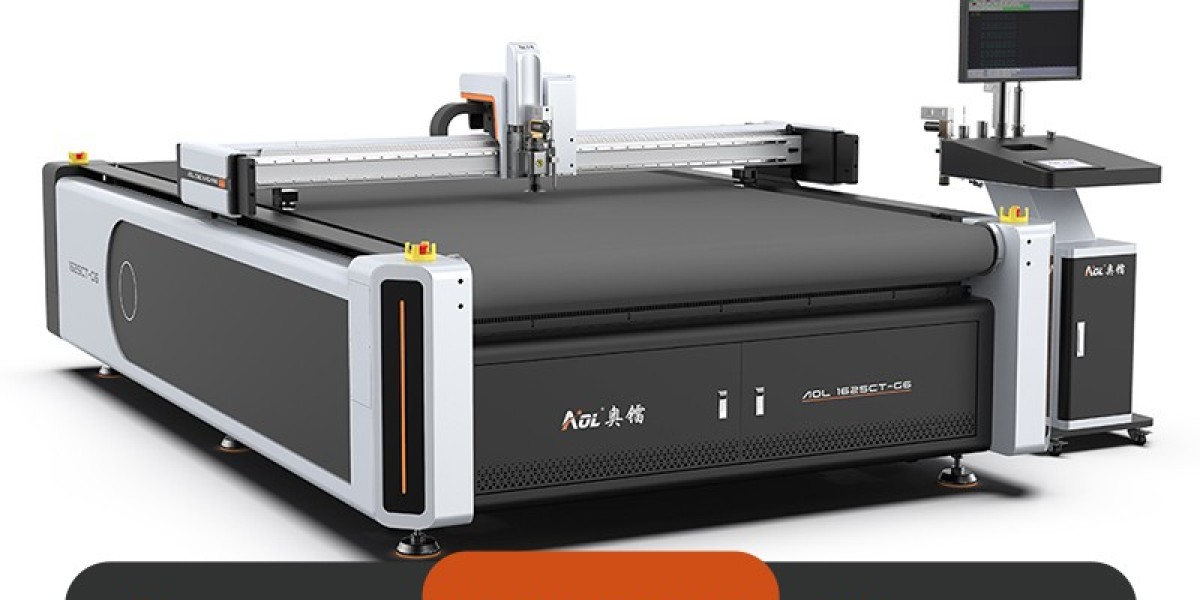

Textile factory owners in Asia and Europe often face customer complaints about uneven fabric cutting edges and inconsistent component sizes, especially for elastic fabrics, knitted fabrics and composite garment materials. Minor dimensional errors of fabric accessories will lead to finished clothing deformation, triggering batch product returns and damaging brand reputation. Many manufacturers try to improve cutting accuracy by hiring senior skilled workers, yet labor instability and human operation errors cannot be completely eliminated. Oscillating cutting machine relying on high-frequency servo vibration cutting technology has become the mainstream solution to fabric precision processing problems, but most textile enterprise buyers cannot fully understand the internal structural logic that supports high precision. This article combines years of service experience with Korean textile distributors, disassembles the precision guarantee structure of oscillating cutting machine, analyzes the specific ways to optimize fabric cutting accuracy, and provides practical reference standards for textile factory equipment upgrading.

Traditional manual fabric cutting and old die cutting equipment have inherent precision defects that cannot be avoided in mass production. Manual cutting relies on workers’ hand stability, and the cutting edge of elastic cloth will tilt under material tension, with dimensional error exceeding 0.5mm for each fabric piece; long-time continuous operation will cause worker fatigue, and the error range will further expand to 1mm to 1.5mm. Fixed mold cutting machines can only process single fabric specifications, and the mold will wear after long-term use, gradually reducing cutting flatness. For multi-layer composite textile raw materials, the pressure of die cutting will squeeze the fabric and cause interlayer displacement, resulting in inconsistent sizes of upper and lower fabric layers. A Korean garment manufacturer cooperating with AOL once adopted manual cutting before equipment upgrade, and the monthly return rate of finished clothes caused by cutting dimensional deviation reached 7%. After switching to oscillating cutting machine, the return rate dropped to less than 0.8%, which directly saved millions of won in after-sales compensation costs every year. This obvious data contrast fully reflects the precision defect bottleneck of traditional cutting modes in textile batch production.
The core component that determines the high precision of oscillating cutting machine is the servo-driven oscillating knife module, which adopts independent dual-sensor cutting precision calibration technology patented by AOL. The servo motor drives the cutting blade to produce vertical high-frequency vibration at adjustable frequency, and the vibration amplitude can be finely adjusted according to fabric thickness and softness to avoid fabric extrusion deformation during cutting. Dual precision sensors installed on the cutting head conduct real-time coordinate correction every 0.02 seconds, automatically offset the tiny displacement generated by material stretching, and control the overall cutting error within 0.1mm. The floating kiss-cut tool matching oscillating cutting machine can set hierarchical cutting depth, only cut the surface fabric without damaging the backing paper, which solves the precision processing demand of printed clothing transfer fabrics. The whole cutting head adopts modular quick replacement structure, and different cutting tools can be switched within one minute without repeated precision calibration, greatly improving the processing efficiency of mixed fabric orders. Unlike ordinary low-power oscillating cutting equipment on the market, the high-power servo oscillating module of AOL equipment can maintain stable vibration frequency for 72 hours of continuous operation without precision attenuation.
Besides the oscillating cutting head, multiple intelligent auxiliary systems of oscillating cutting machine jointly guarantee fabric cutting flatness and dimensional consistency. The energy-saving vacuum adsorption system generates uniform negative pressure to fix loose textiles on the processing platform, eliminate fabric wrinkles and tension displacement during cutting, which is especially suitable for ultra-thin silk fabrics and stretch spandex materials. The built-in high-definition CCD camera realizes automatic contour recognition of printed fabric patterns, and the system automatically modifies cutting coordinates according to pattern deviation to avoid finished product pattern dislocation. The adaptive material thickness sensing system automatically identifies fabric thickness changes, adjusts vibration frequency and cutting speed synchronously, and prevents excessive blade pressure from compressing thin fabrics to produce size shrinkage. The cloud-connected production monitoring module records real-time cutting precision data, and the intelligent fault early warning system will remind operators to calibrate the cutting head in advance when precision deviation has an upward trend, avoiding batch defective fabrics. All auxiliary precision control systems are integrated into the unified cutting control software, and buyers can receive free lifetime software upgrades after purchasing oscillating cutting machine to continuously optimize precision processing performance.
Stable high precision cutting of oscillating cutting machine brings multi-layer economic benefits to textile processing factories. First of all, the batch defective rate of fabric accessories is greatly reduced, eliminating the raw material waste and labor loss caused by reworking defective fabrics. For mid-to-high-end garment brands with strict dimensional standards, qualified fabric cutting can reduce finished product return losses and maintain stable cooperative relationships with clothing retailers. Secondly, high-precision nested cutting controlled by the system improves fabric utilization rate, and the textile material waste of oscillating cutting machine is reduced by 16% compared with manual cutting every month. From the perspective of labor management, high-precision oscillating cutting machine does not rely on experienced cutting workers, and ordinary staff can operate proficiently after one day of training, cutting the enterprise’s long-term skilled labor training cost. The Korean textile distributor cooperating with AOL has promoted dozens of oscillating cutting machines to local garment factories within two years, and all clients feedback that the comprehensive production cost per piece of clothing has decreased by about 12% after equipment deployment, and the factory’s order bearing capacity has increased significantly.
All oscillating cutting machine models produced by AOL pass strict precision testing before delivery, and the precision performance meets the international processing standard of flexible textile materials formulated by FESPA global printing and textile exhibition. The whole machine has CE electrical safety certification and ISO9001 quality management certification, and the servo oscillating knife core technology is protected by multiple independent invention patents. The enterprise’s standardized production base is equipped with independent precision processing workshops for cutting head components, and all metal parts of oscillating modules are processed by CNC precision lathes to ensure consistent assembly tolerance of each machine. The annual output of standard oscillating cutting equipment exceeds 300 sets, and customized oscillating cutting machines with special processing width and multi-tool combination can be delivered within 20 to 30 days. Professional engineers provide on-site precision debugging services for overseas clients in more than 20 countries, and carry out systematic precision operation training for factory operators to ensure the equipment maintains stable cutting accuracy in long-term mass production.
Conclusion
Oscillating cutting machine fundamentally solves the precision instability problem of fabric processing through servo high-frequency vibration cutting structure and multi-dimensional intelligent auxiliary calibration system, effectively reducing defective rate and raw material loss of textile factories. Factories producing elastic cloth, knitted fabric, composite garment materials and silk fabrics can significantly improve product qualification rate by deploying oscillating cutting machine. Professional equipment manufacturers with independent precision calibration patents, complete international certification and global on-site debugging service capacity can provide long-term stable high-precision processing support for global textile enterprises. Actual mass production cases of Asian textile factories fully prove that oscillating cutting machine is the core intelligent equipment for textile industry precision upgrading.