
Introduction
SAP ABAP developers are responsible for building applications that make business processes faster, more efficient, and user-friendly. While learning the basics of ABAP programming is important, becoming a professional SAP developer requires mastering advanced concepts such as ALV Reports, Smart Forms, and Module Pool Programming. These are among the most commonly used components in enterprise SAP projects and are expected skills for every SAP ABAP professional.
Organizations use ALV Reports to display business data in an interactive and organized manner. Smart Forms are used to generate business documents like invoices, purchase orders, salary slips, and delivery notes. Module Pool Programming helps developers create interactive SAP screens that allow users to enter, edit, and manage business data efficiently.
Understanding these technologies not only improves your technical expertise but also prepares you to work on real-world SAP implementation and support projects. Whether you want to become an SAP ABAP Developer, Technical Consultant, or SAP S/4HANA Developer, these skills form an important part of your professional journey.
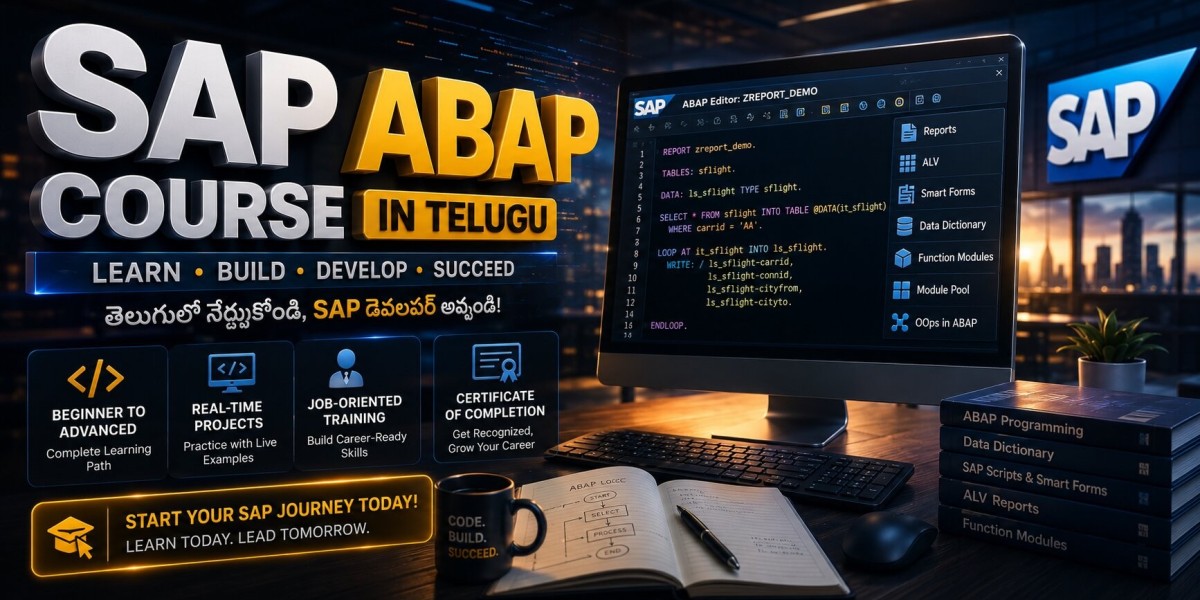
A SAP ABAP Course in Telugu helps learners understand these advanced concepts through practical examples, real-time projects, and hands-on exercises that closely match industry requirements.
Why Should You Learn These SAP ABAP Concepts?
Every SAP implementation requires developers who can create reports, forms, and custom screens.
Learning these technologies helps you:
Build interactive SAP applications
Generate professional business documents
Display business data effectively
Improve user experience
Work confidently on enterprise projects
These skills are commonly tested during SAP ABAP interviews and are used extensively in production environments.
Understanding ALV Reports
ALV stands for ABAP List Viewer. It is one of the most popular reporting tools in SAP ABAP.
Unlike classical reports that display plain text, ALV reports provide an interactive interface where users can:
Sort records
Filter data
Search information
Export reports to Excel
Hide or display columns
Create customized layouts
Calculate totals and subtotals
For example, an HR department may generate an employee salary report containing thousands of records. Instead of manually searching through the data, users can filter by department, salary range, or employee designation within seconds.
Because of these features, ALV Reports are widely used in Finance, Sales, Human Resources, Procurement, and Inventory Management modules.
Types of ALV Reports
SAP provides multiple ways to create ALV reports.
Some common types include:
Simple ALV
Displays data in a tabular format with basic functionalities.
Grid ALV
Provides advanced interactive features such as sorting, filtering, and layout customization.
OO ALV (Object-Oriented ALV)
Uses Object-Oriented Programming concepts and is commonly used in modern SAP development.
Understanding all three approaches helps developers build efficient reporting solutions.
Understanding Smart Forms
Businesses generate thousands of documents every day.
These include:
Customer invoices
Purchase orders
Delivery notes
Employee salary slips
Quotation documents
Shipping labels
Instead of designing these documents manually, SAP uses Smart Forms.
Smart Forms allow developers to design dynamic documents using graphical tools without writing large amounts of formatting code.
Smart Forms automatically retrieve data from SAP tables and generate well-formatted business documents.
For example:
A sales order entered into SAP can automatically generate an invoice with customer details, product information, tax calculations, and payment information using Smart Forms.
Benefits of Smart Forms
Smart Forms offer several advantages.
They provide:
Dynamic document generation
Professional layouts
Barcode support
Logo integration
Multiple language support
Automatic page formatting
Because of these features, Smart Forms have become one of the most widely used SAP document technologies.
Understanding Module Pool Programming
While reports display information, businesses also need applications where users can enter or modify data.
This is where Module Pool Programming becomes important.
Module Pool Programming is used to create interactive SAP transaction screens.
These applications contain:
Input fields
Buttons
Menus
Table controls
Validation logic
Navigation screens
Users interact directly with these applications to perform business operations.
Real-Time Examples of Module Pool Applications
Organizations use Module Pool Programming for applications such as:
Employee Information Management
Customer Registration
Material Master Maintenance
Inventory Updates
Purchase Order Entry
Vendor Management
Almost every custom SAP transaction screen is built using Module Pool Programming.
Hands-On Projects You Will Build
Practical experience is essential for mastering these concepts.
Typical projects include:
Employee ALV Report
Develop a searchable employee database with sorting and filtering options.
Sales Dashboard
Create an interactive report displaying customer orders and sales performance.
Invoice Generation System
Design Smart Forms for generating invoices automatically.
Inventory Transaction Screen
Build a Module Pool application that allows warehouse staff to update stock information.
These projects help learners understand how SAP development works in real business environments.
Common Challenges Beginners Face
New learners often struggle with:
Understanding ALV field catalogs
Designing Smart Form layouts
Screen navigation in Module Pool Programming
Data validation
Event handling
A structured learning approach helps overcome these challenges through guided practice and debugging sessions.
Career Opportunities
Professionals with expertise in ALV Reports, Smart Forms, and Module Pool Programming can pursue roles such as:
SAP ABAP Developer
SAP Technical Consultant
SAP S/4HANA Developer
SAP Support Consultant
SAP Application Developer
ERP Technical Consultant
These skills are valuable for both implementation and support projects.
Conclusion
ALV Reports, Smart Forms, and Module Pool Programming are among the most important skills every SAP ABAP developer should master. They allow developers to create professional reports, automate business document generation, and build interactive SAP applications that improve organizational efficiency.
Learning these concepts through practical projects helps learners gain confidence and prepares them for real-world SAP development roles.
A SAP ABAP Course in Telugu provides comprehensive training on these advanced SAP technologies through structured lessons, hands-on projects, and industry-oriented exercises, helping learners become confident SAP professionals.