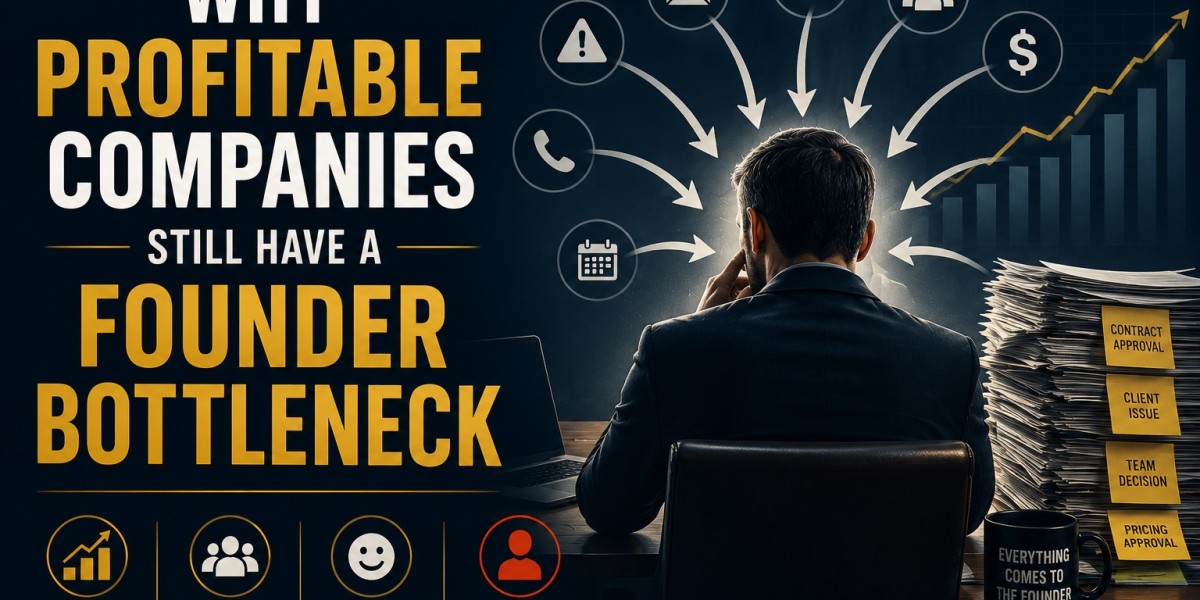

Why Profitable Companies Still Have a Founder Bottleneck Problems
Revenue is good. The team is growing. Clients are happy. By every number that matters on paper, the business is working. And the founder is still the one fielding the 9 pm message about a contract clause, still the one who gets pulled into a call that should never have reached them, still the only person who can say yes fast enough to keep a deal moving.
This is one of the things that surprises founders most when we start working together. They assume profitability is proof that the business is healthy. What I see most often is the opposite. Profit does not remove the bottleneck. It just makes it easier to ignore, because the numbers are telling a story that the operating reality does not back up.
A founder bottleneck has nothing to do with whether the company makes money. It has to do with whether the company can move without the founder in the room. Plenty of founders only discover how dependent the business is on them once they slow down long enough to check, rather than waiting for the business to force the question on them.
Why Profit Hides the Bottleneck Instead of Fixing It
Founders use revenue as the scoreboard, and it is a reasonable instinct. Revenue is visible. It is comparable year over year. It is the number investors ask about first. None of that makes it a good measure of whether the operating system underneath the business actually works.
A company can be profitable for reasons that have nothing to do with operational health. Strong market timing. A few large clients who are easy to retain. Pricing power that covers up inefficiency. None of these things requires the business to function well without the founder. They just require the founder to keep showing up.
Profit measures whether the business is making money. It says nothing about whether the business can run without you.
During interventions, we often discover that the founder has been reading strong revenue as a sign that the company has matured operationally, when in practice the two have been moving in opposite directions. Revenue went up. Founder centrality went up with it, not down.