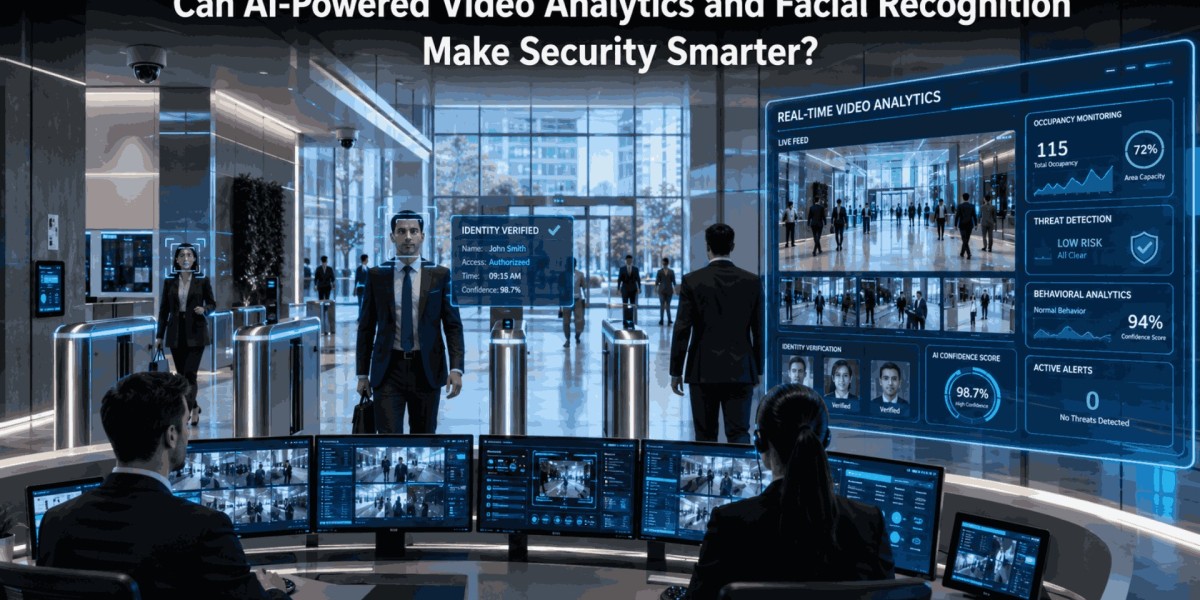
Have you ever wondered how modern security systems can identify individuals, detect unusual behavior, and respond to incidents in real time? The answer lies in AI-powered analytics, a powerful combination of artificial intelligence and computer vision that transforms ordinary video footage into actionable insights.
Rather than simply recording events, these technologies analyze visual data automatically, helping organizations improve security, streamline operations, and make faster decisions. From airports and retail stores to corporate offices and smart cities, AI-powered video intelligence is reshaping how surveillance systems operate.
What Is Video Analytics and Facial Recognition?
Video analytics uses artificial intelligence to examine video streams and identify patterns, movements, and events without constant human monitoring. Video analytics and facial recognition adds another layer by comparing facial features against stored databases to verify or identify individuals.
Together, these technologies enable organizations to:
- Detect people entering restricted areas
- Verify identities quickly
- Monitor crowd activity
- Improve operational efficiency
- Support faster incident response
Instead of reviewing hours of recorded footage, security teams receive meaningful alerts when important events occur.
How Does Technology Work?
The system follows a structured process that converts video into useful intelligence.
Video Capture
High-definition cameras continuously capture footage from designated locations.
AI Analysis
Machine learning algorithms examine movement, facial features, object behavior, and environmental changes.
Facial Matching
When authorized, facial recognition software compares captured facial characteristics with enrolled databases.
Real-Time Alerts
If predefined conditions are met, the system immediately notifies operators for further action.
Key Benefits of AI Video Intelligence
Faster Threat Detection
AI continuously monitors multiple video feeds, allowing suspicious activities to be identified within seconds instead of relying solely on manual observation.
Improved Access Control
Organizations can automate identity verification, reducing reliance on traditional access cards or manual check-ins.
Better Operational Insights
Video analytics provides valuable information about occupancy, visitor flow, and facility usage, helping businesses optimize resources.
Reduced Human Error
Automated monitoring minimizes missed incidents while allowing security personnel to focus on higher-priority situations.
Scalable Monitoring
Whether protecting a single building or multiple facilities, AI systems can analyze thousands of camera feeds simultaneously.
A modern smart security camera enhances these capabilities by combining high-resolution imaging with onboard AI processing for faster and more accurate event detection.
Common Applications Across Industries
Retail
Retailers use AI to reduce losses, understand customer movement, and improve store operations.
Healthcare
Hospitals monitor restricted zones while helping maintain patient and staff safety.
Transportation
Airports, railway stations, and transit hubs improve passenger screening and crowd management.
Corporate Offices
Businesses automate employee access while strengthening workplace security.
Smart Cities
Municipal authorities monitor traffic, public spaces, and emergency situations more efficiently.
Privacy and Ethical Considerations
As facial recognition becomes more common, organizations must balance innovation with responsible data use.
Important best practices include:
- Following local privacy regulations.
- Informing individuals where monitoring occurs.
- Securing stored biometric information.
- Limiting access to authorized personnel.
- Using facial recognition only for legitimate business purposes.
Transparent policies help build public trust while ensuring responsible technology deployment.
Future Trends in Intelligent Surveillance
Artificial intelligence continues to evolve rapidly. Future developments may include:
- Predictive security analytics
- Improved behavioral analysis
- Faster biometric authentication
- Enhanced edge computing
- Smarter automation
- Greater integration with Internet of Things devices
As these technologies mature, smart surveillance systems will become increasingly proactive, providing organizations with deeper operational intelligence while supporting safer environments.
Choosing the Right AI Video Solution
When evaluating an AI-powered surveillance platform, consider:
- AI detection accuracy
- Facial recognition performance
- Integration capabilities
- Real-time notifications
- Data encryption
- Cloud or local deployment
- Scalability
- Compliance with privacy laws
Selecting a solution that matches organizational goals ensures better long-term performance and return on investment.
You can also watch: Stop Just Recording: AI-Powered Face Recognition with VideoraIQ
Summary
AI-powered video analytics and facial recognition transform traditional surveillance into intelligent monitoring systems. By automating detection, identity verification, and operational analysis, organizations improve security, efficiency, and decision-making while supporting responsible privacy practices and scalable future growth.
Frequently Asked Questions
What is video analytics?
Video analytics uses artificial intelligence to analyze live or recorded video, automatically detecting patterns, movement, and events without continuous manual monitoring.
How does facial recognition improve security?
It verifies or identifies individuals by comparing facial features with authorized databases, improving access control and accelerating incident response.
Is facial recognition accurate?
Modern AI systems offer high accuracy when supported by quality cameras, proper lighting, and regularly updated recognition models.
Which industries benefit the most?
Retail, healthcare, transportation, education, manufacturing, corporate offices, and smart city projects commonly use AI-powered video intelligence.
Is facial recognition privacy compliant?
Yes, when organizations follow applicable regulations, secure biometric data, provide transparency, and implement appropriate access controls.