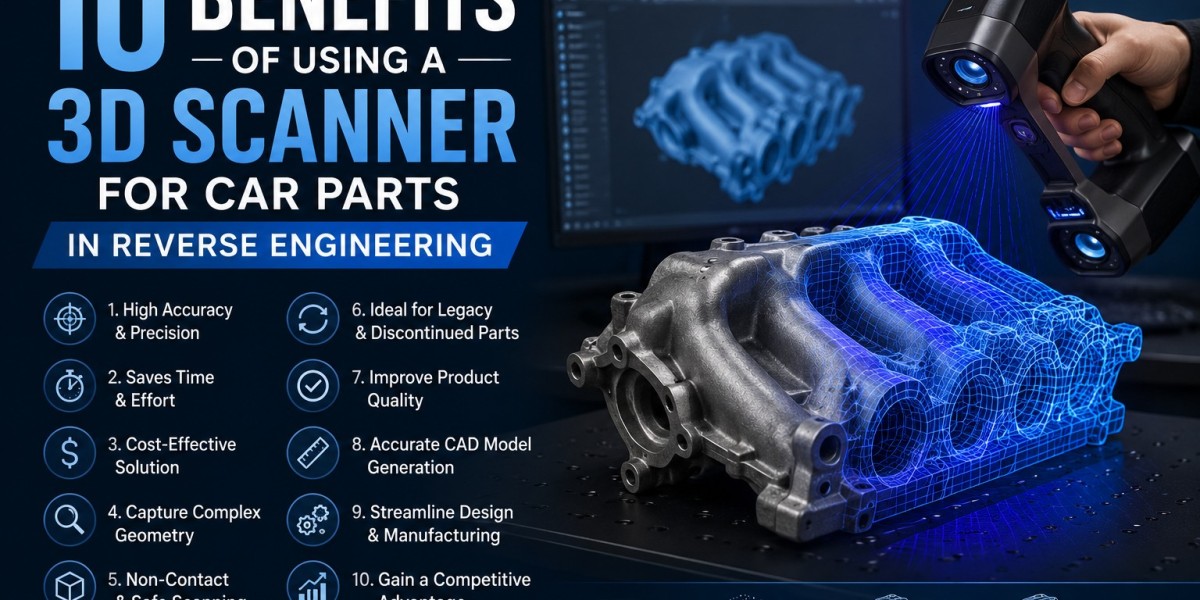

Reverse engineering has become an essential process in the automotive industry, helping manufacturers, repair shops, aftermarket suppliers, and product designers recreate, improve, or replace vehicle components with exceptional accuracy. Traditional measurement methods often require significant time and manual effort while increasing the risk of errors. Today, advanced 3D scanning technology has transformed the way automotive professionals capture complex part geometries and convert them into precise digital models.
Whether you're reproducing discontinued components, improving aftermarket products, or designing custom performance parts, using a 3D scanner for car parts offers significant advantages. Here are the top 10 benefits of incorporating 3D scanning into your reverse engineering workflow.
1. Capture Highly Accurate Measurements
One of the biggest advantages of 3D scanning is its ability to capture extremely precise measurements. Automotive components often feature complex curves, hidden surfaces, and intricate details that are difficult to measure manually.
A high-quality 3D scanner creates millions of measurement points within minutes, producing a detailed digital representation of the part. This accuracy minimizes dimensional errors and ensures that the recreated component closely matches the original.
2. Reduce Design Time
Traditional reverse engineering requires manual measurements, CAD modeling, and repeated verification, which can take days or even weeks depending on the complexity of the component.
With a 3D scanner, engineers can quickly capture the entire geometry of a part and generate a digital model that serves as the foundation for CAD design. This streamlined process significantly reduces development time and accelerates product delivery.
Faster design cycles allow businesses to respond more quickly to customer demands and market opportunities.
3. Easily Recreate Discontinued Parts
Many older vehicles have replacement parts that are no longer manufactured. This creates challenges for restoration shops and vehicle owners searching for compatible components.
Reverse engineering with a 3D scanner makes it possible to digitize existing parts—even worn or damaged ones—and recreate them with remarkable precision. Manufacturers can then produce replacement components using CNC machining, casting, or additive manufacturing techniques.
This capability helps preserve classic vehicles while extending the lifespan of aging equipment.
4. Improve Product Quality
Accurate digital models provide engineers with better insights into component geometry and manufacturing tolerances. By analyzing scanned data, designers can identify imperfections, optimize designs, and improve overall product quality.
Reverse engineering also enables companies to benchmark competitor products and develop enhanced versions with improved strength, durability, and performance.
The result is a higher-quality product that meets customer expectations while maintaining manufacturing consistency.
5. Handle Complex Automotive Components
Modern vehicles contain highly sophisticated components featuring organic shapes, intricate curves, and detailed surface textures.
Manual measuring tools often struggle to capture these complex geometries accurately.
A 3d scan service allows engineers to digitize even the most challenging automotive parts, including:
Engine components
Transmission housings
Intake manifolds
Turbocharger assemblies
Suspension parts
Interior trim pieces
Dashboard components
Plastic body panels
Even highly detailed surfaces can be scanned without compromising accuracy.
6. Minimize Human Error
Manual measurements depend heavily on operator skill and experience. Even small measurement mistakes can create costly manufacturing errors.
3D scanning automates the data collection process, dramatically reducing the possibility of human error. Automated point cloud generation ensures consistent measurements across multiple scans, leading to more reliable CAD models and production-ready designs.
Improved accuracy also reduces expensive rework during manufacturing.
7. Support Faster Prototype Development
Product development often involves multiple prototype iterations before final production.
With accurate scan data, engineers can quickly modify existing designs, generate CAD models, and produce functional prototypes using CNC machining or 3D printing.
Rapid prototyping shortens development cycles while allowing teams to evaluate fit, functionality, and performance much earlier in the design process.
This speed gives manufacturers a valuable competitive advantage.
8. Simplify Quality Inspection
Reverse engineering doesn't end after creating a CAD model. Manufacturers must verify that finished parts match original specifications.
Digital scan data can be compared directly against CAD models using advanced inspection software. This process highlights dimensional deviations, manufacturing defects, and tolerance variations with exceptional precision.
Using laser scanner metrology during inspection helps ensure every manufactured component meets strict automotive quality standards while reducing inspection time.
9. Lower Overall Development Costs
Although advanced scanning equipment represents an initial investment, it often delivers substantial long-term savings.
Companies reduce costs by:
Eliminating repeated manual measurements
Reducing engineering labor
Minimizing design revisions
Preventing manufacturing errors
Accelerating production timelines
Lowering prototype expenses
Improved efficiency leads to better resource utilization and increased profitability across the entire product development process.
10. Enable Digital Manufacturing Workflows
Modern manufacturing increasingly relies on digital processes that connect design, inspection, simulation, and production.
3D scanning fits seamlessly into these workflows by generating accurate digital models that integrate with CAD, CAM, CAE, and manufacturing software.
These digital assets support:
CNC machining
3D printing
Mold design
Toolpath generation
Finite element analysis
Product simulation
Automated inspection
The result is a more connected, efficient, and data-driven manufacturing environment that supports continuous innovation.
Choosing the Right 3D Scanner for Automotive Reverse Engineering
Not every scanner is suitable for automotive applications. Before selecting a scanning solution, consider factors such as:
Measurement accuracy
Scanning speed
Resolution
Portability
Compatibility with CAD software
Ability to scan reflective or dark surfaces
Ease of operation
Inspection software integration
Choosing the right scanner depends on the size, complexity, and precision requirements of the components you work with.
Industries That Benefit from Automotive Reverse Engineering
Many industries use automotive 3D scanning beyond vehicle manufacturing, including:
Automotive OEMs
Aftermarket parts manufacturers
Motorsport engineering
Vehicle restoration companies
Tool and die manufacturers
Aerospace suppliers
Heavy equipment manufacturers
Research and development organizations
Each industry benefits from faster product development, improved accuracy, and enhanced manufacturing efficiency.
Final Thoughts
Reverse engineering has become a critical capability for modern automotive manufacturing, and 3D scanning is at the center of this transformation. From capturing highly accurate measurements to reducing development time and improving product quality, the benefits of using a 3D scanner for car parts are substantial.
As vehicles become increasingly sophisticated, manufacturers need reliable digital tools that simplify complex workflows while maintaining exceptional precision. Investing in advanced scanning technology enables businesses to recreate components faster, improve engineering accuracy, and accelerate innovation throughout the product lifecycle.
Whether you're developing aftermarket products, restoring classic vehicles, or optimizing production processes, integrating 3D scanning into your reverse engineering workflow is a smart investment that delivers long-term value, greater efficiency, and higher-quality results.