
Plenty of businesses sign up for Salesforce expecting it to transform how they sell, serve, and grow. Then, a few months in, the excitement fades — teams quietly slip back into spreadsheets, reports don't tell the full story, and the platform starts to feel more like a chore than a tool.
In almost every case, the issue isn't Salesforce itself. It's that the platform was switched on, not properly implemented.
This guide walks through what Salesforce implementation really means, why getting it right matters more than ever in 2026, and the process that separates businesses that thrive on Salesforce from those that abandon it.
Salesforce Implementation, Defined
At its core, Salesforce implementation is the work of shaping the platform around your business — rather than expecting your business to bend around the platform.
That work generally covers:
- Translating your existing sales, service, or marketing processes into Salesforce's structure
- Moving your current customer and operational data into the new system
- Building out the specific fields, objects, and automated workflows your business needs
- Connecting Salesforce to the other software your teams already rely on
- Preparing your people to actually use the system once it's live
Put simply: implementation is the bridge between purchasing Salesforce and running your business on Salesforce.
Why Getting This Right Matters Even More Today
Salesforce has only grown more capable — more automation, more AI-driven insight, more ways to connect systems together. That's a genuine advantage, but it also means a poor implementation costs you more than it used to.
When the foundation is weak, none of the advanced capability built on top of it works the way it should. Teams build workarounds. Leadership makes calls based on patchy data. Automation that should be saving hours never gets switched on.
Get the foundation right, though, and everything else — integrations, reporting, AI features — has something solid to stand on.
Implementation Looks Different Depending on What You're Solving For
There's no single implementation blueprint, because the goal changes depending on which part of the business you're focused on:
- Sales Cloud implementations centre on lead management, tracking customer interactions, and giving sales teams accurate forecasting and pipeline visibility.
- Service Cloud implementations bring every customer touchpoint into a single workspace, so support teams aren't piecing together history from five different places.
- Marketing Cloud implementations are built to run coordinated, data-driven campaigns across email, social, mobile, and web.
- Commerce Cloud implementations focus on connecting buying experiences across both online and offline channels.
It's common for businesses to start with one cloud and expand their implementation as needs evolve — there's no requirement to tackle everything at once.
How a Salesforce Implementation Actually Unfolds
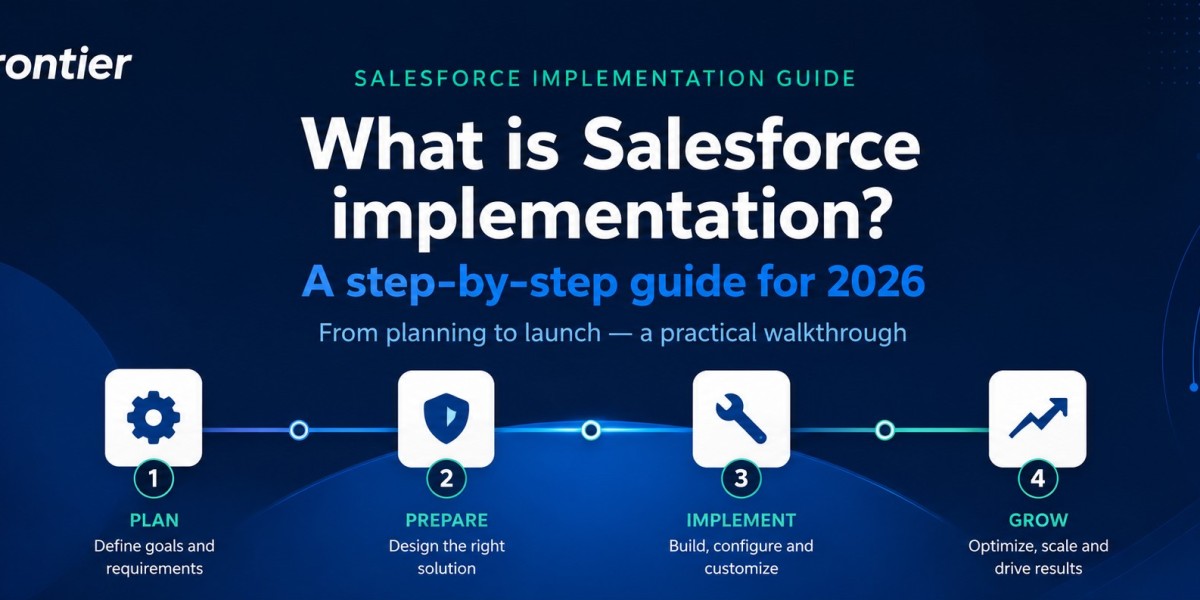
While every project has its own nuances, most successful implementations move through the same six phases:
Discovery / Consultation Everything starts with understanding the business — current processes, pain points, and what success actually looks like. Get this wrong and everything downstream suffers.
Planning With discovery complete, a concrete plan takes shape: scope, timeline, data requirements, and the specific configuration work ahead.
Build / Development This is the hands-on stage — configuring fields, objects, automations, and integrations according to the plan that's been agreed.
Go-Live / Deployment The system moves from being "built" to being "live." Data gets migrated, configurations are tested, and the business starts operating inside the new environment.
Training A system is only as good as its adoption. Teams need proper training to actually use what's been built — this is often where projects quietly succeed or fail.
Ongoing Support Implementation doesn't end at launch. Continued support means issues get resolved quickly and the system keeps evolving alongside the business.
The most common failure point isn't any single phase — it's rushing planning and training in the name of moving fast, then dealing with the fallout months later.
What Separates a Strong Implementation From a Risky One
A few things consistently show up in implementations that go well:
- A genuinely tailored build — generic, templated setups rarely hold up; the platform needs to be shaped around your specific goals.
- A repeatable, proven methodology — a structured process reduces guesswork and keeps everyone aligned from kickoff to launch.
- Certified, experienced specialists — implementation involves real technical trade-offs, and expertise here prevents expensive mistakes later.
- Support that extends well past go-live — the highest-value work often happens after launch, refining the system as real usage reveals what needs adjusting.
- A focus on measurable outcomes — better visibility, stronger adoption, and a clear return on the investment, not just "it's technically working."
Mistakes Worth Avoiding
- Treating implementation as a finished project rather than an evolving system
- Skimping on training and assuming the platform will "explain itself"
- Rushing past planning to hit an arbitrary deadline
- Under-customizing the platform, leaving teams to compensate with manual workarounds
Frequently Asked Questions
What does Salesforce implementation actually mean? It's the process of configuring Salesforce so it reflects how your business genuinely operates — well beyond simply activating the software.
How long does it typically take? It depends heavily on scope. A focused, single-cloud setup for a small business might take a few weeks; a multi-cloud enterprise rollout can stretch across several months.
What determines the cost of an implementation? Pricing varies based on how many clouds are involved, the depth of customization required, data migration complexity, and any integrations needed. A consultation is usually the quickest way to get a realistic estimate.
Is it possible to implement Salesforce without outside help? Technically, yes — but most businesses without a dedicated Salesforce admin find that an experienced implementation partner significantly lowers risk and avoids costly rebuilds later.
How is implementation different from customization? Implementation is the full process of setting Salesforce up and deploying it. Customization is one piece of that — specifically, tailoring fields, objects, and workflows to your needs.
Is this only relevant for large companies? Not at all. Implementation scales to fit the business — many smaller companies start with a lean, single-cloud setup and expand it as they grow.
What comes after the implementation is finished? Launch is the starting point, not the finish line. Ongoing support, refresher training, and periodic optimization are what keep the system delivering value long-term.
The Bottom Line
A Salesforce implementation isn't really a one-time technical task — it's the deciding factor in whether your team embraces the platform or quietly drifts back to spreadsheets. Treating it as a genuine process — discovery, planning, building, launch, training, and continued support — is what makes the difference.
If you're weighing up a Salesforce implementation and want a setup built around how your business actually works, rather than a generic template, CRM Frontier's certified team can talk you through what that would look like. Get in touch for a free consultation to start the conversation.