
Appraiser Independence Requirements AIR sits at the center of why appraisal management companies exist in the first place. The Dodd-Frank Wall Street Reform and Consumer Protection Act established strict AIR rules to prevent conflicts of interest in the appraisal process, mandating a firewall between loan production staff and appraiser selection to ensure unbiased property valuations.
For years, AMCs have managed this requirement through procedures: written policies, manual checklists, training, and trust. The problem is that procedures rely on people following them correctly, every time, without exception and “most of the time” is not a standard that survives a regulatory examination.
In 2026, the AMCs that are pulling ahead are the ones treating AIR compliance not as a procedure to follow, but as a system to enforce. This post explains the difference, and why it matters more than ever.
Why Procedural AIR Compliance Has a Structural Weakness
A procedure-based compliance model says: “Coordinators are trained not to let lenders select appraisers, and we have a policy against it.” That model has an inherent gap; it depends entirely on individual adherence, and it produces no reliable evidence of that adherence beyond the policy of the document itself.
This creates specific exposure points.
No structural prevention. A written policy does not stop a coordinator from accidentally or under pressure accommodating a lender’s preference for a specific appraiser. The only thing preventing the violation is human judgment now.
Inconsistent documentation. When a regulator asks for evidence that loan production staff had no role in appraiser selection on a specific file, a procedure-based system can usually only point to the general policy, not file-specific proof.
Rotation tracking gaps. Avoiding the appearance of favoritism requires tracking assignment patterns across the entire panel over time. Doing this manually, across hundreds or thousands of monthly orders, is functionally impossible to do with full accuracy.
Conflict screening delays. Identifying potential conflicts of interest in an appraiser with a prior relationship to a property, a borrower, or a loan officer requires a screening step. When that step is manual, it is easy to skip under time pressure, especially on rush orders.
What System-Level AIR Enforcement Looks Like
The distinction that matters are between enforcing compliance through system architecture versus requesting compliance through policy. Leading AMC platforms enforce AIR compliance at the database level, not just through user interface restrictions.
In practice, this means several specific mechanisms working together:
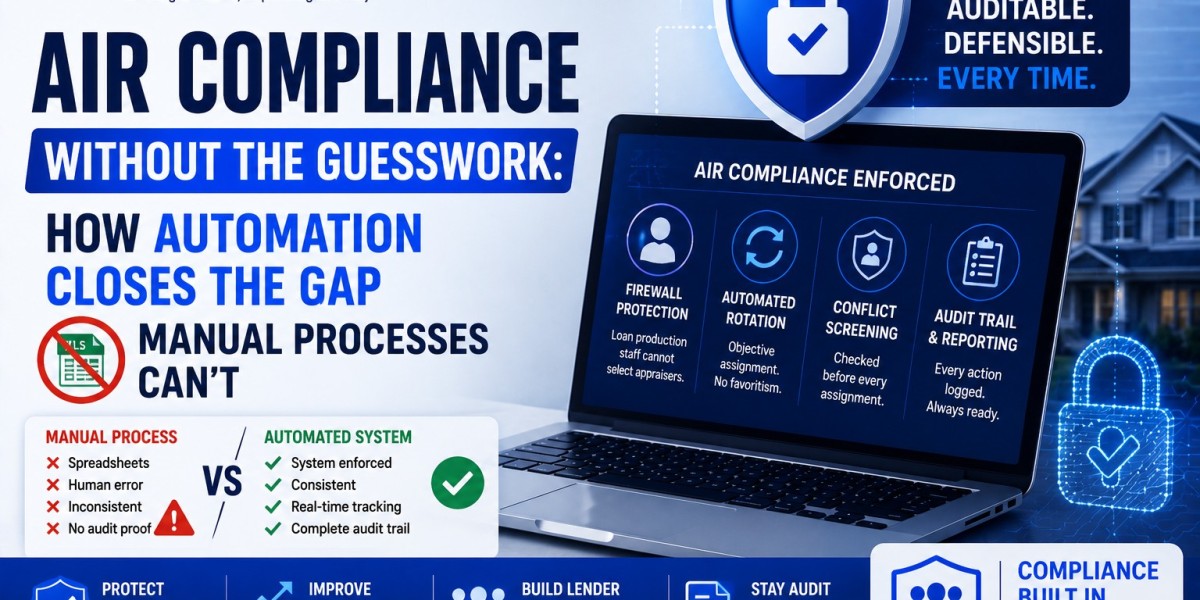
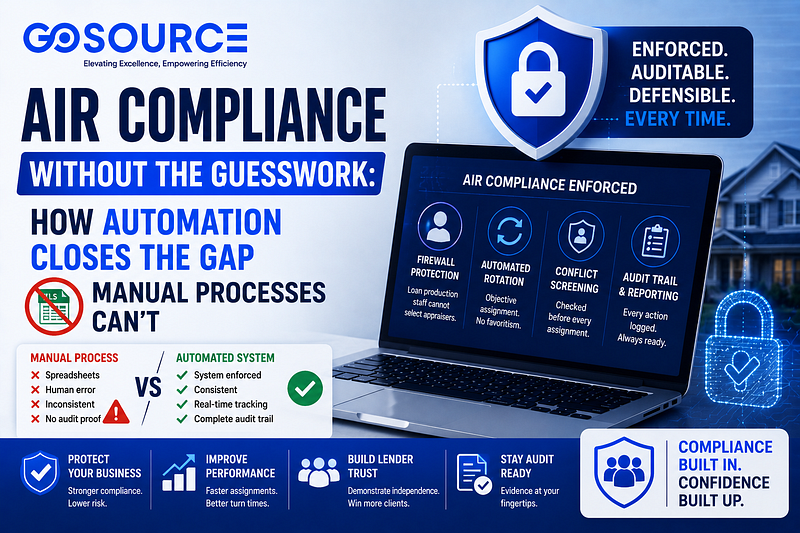
Hard role-based access controls. Lender users can place orders and view status, but they structurally cannot select specific appraisers or influence valuations the system does not present that option, regardless of what a lender user requests. This removes the human judgment’s call entirely; the violation becomes architecturally impossible rather than merely discouraged.
Production data firewalls. AMC coordinators manage appraiser assignment but have no access to loan production data meaning the people making assignment decisions structurally cannot see the information that would let them, even unintentionally, factor in loan officer preferences or production pressure.
Automated rotation tracking. The system tracks assignment patterns to ensure objective distribution across the panel, surfacing any drift toward repeated use of specific appraisers that could suggest favoritism a pattern that is nearly invisible in manual tracking but immediately visible in system-level reporting.
Pre-assignment conflict screening. The system screens for conflicts before assignment automatically, checking for prior relationships or disqualifying connections as a built-in step in the routing process rather than a manual task someone must remember to perform
Comprehensive audit logging. Every action is logged with user ID, timestamp, and IP address for regulatory audits, producing the kind of granular, file-specific evidence that procedure-based systems simply cannot generate after the fact.
Why This Matters for Lenders, Not Just AMCs
AIR compliance failures do not stay contained to the AMC. Before sending a single order, a lender’s compliance team will evaluate the AMC’s AIR compliance documentation and audit-readiness meaning a lender’s own regulatory exposure is directly tied to the strength of their AMC partner’s compliance infrastructure.
When an examiner asks a lender to demonstrate that appraiser independence was maintained across their loan portfolio, “our AMC has a policy” is a materially weaker answer than “our AMC’s platform enforces independence at the system level and can produce a complete audit trail for every file.” Lenders carry vendor management responsibility for their AMC relationships, which means AIR compliance gaps at the AMC level become AIR compliance gaps on the lender’s own examination record.
AIR in the Context of 2026’s Broader Compliance Landscape
AIR compliance does not exist in isolation anymore. Modern compliance frameworks increasingly integrate PAVE-aligned bias prevention alongside AIR and Dodd-Frank requirements, recognizing that independence and equity are connected to dimensions of the same underlying appraisal integrity question.
This convergence matters operationally. An automated system that enforces AIR firewalls is also positioned to layer in bias screening, ROV transparency, and UAD 3.6 data validation within the same compliance infrastructure rather than treating each regulatory requirement as a separate manual process bolted onto the workflow. Building compliance directly into the workflow allows lenders to stay protected without adding steps or delays, which is the practical advantage of system-level enforcement over procedural checklists.
What AMCs Should Be Doing Right Now
For AMC leadership assessing their own AIR compliance posture, the honest evaluation comes down to a few direct questions:
Is AIR enforced at the system level, or only through written policy? If a lender user technically could select an appraiser by working around a policy, the compliance model has a structural gap.
Can you produce a file-specific audit trail on demand? Not a general policy document — a timestamped record of exactly who took what action on a specific file, ready for an examiner within minutes.
Is rotation tracked systematically across the entire panel? Or does “we avoid favoritism” rely on coordinators’ general sense of fairness?
Does conflict screening happen automatically before every assignment? Or only when someone remembers to check?
If any of these answers reveal a gap, that gap is a liability sitting in every lender relationship the AMC holds.
What Lenders Should Ask Their AMC Partners
Lenders evaluating or renewing AMC relationships should treat AIR infrastructure as a primary due diligence item, not an afterthought:
- Does your platform enforce AIR through system architecture or through staff training and policy?
- Can you provide a sample audit trail for a recent file?
- How is appraiser rotation tracked and reported?
- What is your conflict screening process, and is it automated or manual?
An AMC that cannot answer these with specifics is asking the lender to take their independence on faith, which is precisely the gap AIR was designed to eliminate in the first place.
How Go Source Valuation Supports AIR-Compliant AMC Operations
At Go Source Valuation, we help AMC clients build compliance infrastructure that holds up under scrutiny, not just policies, but enforceable, auditable systems covering AIR, bias screening, and UAD 3.6 readiness together. Our back-office support is designed to help AMCs operate with the kind of structural compliance that protects both their own operation and every lender relationship they serve.
To learn more about how Go Source Valuation supports AMC compliance and operational excellence, visit our AMC Management Solutions page.
Frequently Asked Questions
What is AIR, and why does it matter to AMCs?
AIR stands for Appraiser Independence Requirements, established under the Dodd-Frank Wall Street Reform and Consumer Protection Act. AIR mandates a firewall between loan production staff and appraiser selection to prevent conflicts of interest and ensure unbiased property valuations. AMCs exist in large part to serve as the independent intermediary that maintains this firewall.
What is the difference between procedural and system-level AIR compliance?
Procedural compliance relies on written policies and staff training, depending on individual adherence without structural prevention. System-level compliance enforces independence through technical architecture, role-based access controls, production-data firewalls, and automated conflict screening, making violations structurally difficult or impossible rather than simply discouraged by policy.
Can a lender be held responsible for their AMC’s AIR compliance failures?
Yes, indirectly. Lenders carry vendor management responsibility for the AMC partners they use, and regulatory examiners routinely evaluate whether lenders performed adequate due diligence on their AMC’s compliance infrastructure. An AIR failure at the AMC level can surface as a finding on the lender’s own examination.
What does an AIR audit trail need to include?
A credible audit trail should document every action taken on a file related to appraiser selection and assignment, including user identification, timestamps, and the specific basis for the assignment decision with sufficient detail to demonstrate to an examiner that loan production staff had no influence over appraiser selection on that specific file.
How does automated rotation tracking prevent favoritism?
Automated systems monitor assignment patterns across the entire panel over time, surfacing any drift toward disproportionate use of specific appraisers that could suggest favoritism or improper influence, a pattern that is extremely difficult to detect through manual tracking but becomes visible immediately in system-level reporting.
Is AIR compliance connected to bias and fair lending requirements?
Increasingly, yes. Modern compliance frameworks are integrating AIR and Dodd-Frank requirements alongside PAVE-aligned bias prevention measures, treating appraiser independence and valuation equity as related dimensions of overall appraisal integrity rather than entirely separate compliance tracks.
What should I ask an AMC partner to evaluate their AIR compliance?
Ask whether AIR is enforced through system architecture or only through policy, request a sample audit trail, ask how appraiser rotation is tracked, and confirm whether conflict screening happens automatically before every assignment. Vague or policy-only answers indicate a compliance gap.