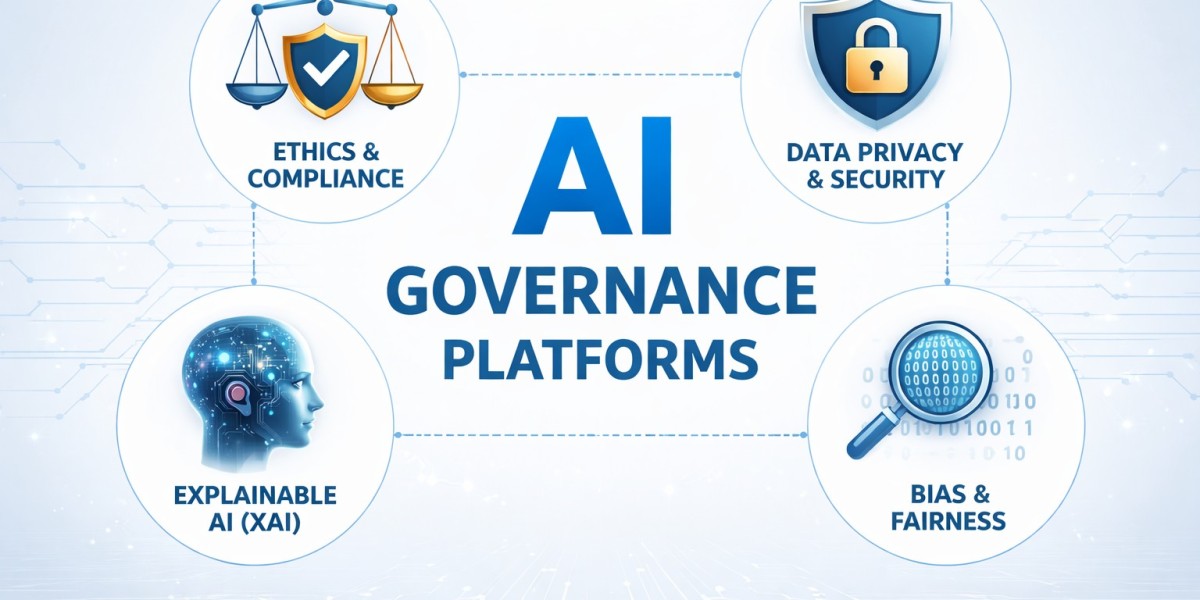

The global AI Governance market is poised for significant growth through 2028, fueled by the rapid adoption of Artificial Intelligence (AI) across industries and the increasing need to ensure responsible, transparent, and ethical AI implementation. As enterprises continue integrating AI into mission-critical operations, the demand for comprehensive AI governance frameworks has become a strategic priority.
What is AI Governance?
AI Governance refers to the policies, frameworks, technologies, and processes that ensure AI systems are developed, deployed, monitored, and managed responsibly throughout their lifecycle. Effective AI governance helps organizations maintain transparency, fairness, accountability, privacy, security, and regulatory compliance while minimizing operational and reputational risks.
Modern AI governance encompasses:
- AI policy management
- Model risk management
- Data governance
- AI explainability
- Bias detection and mitigation
As AI becomes central to enterprise transformation, governance is evolving from a compliance requirement into a strategic business capability.
Key Factors Driving AI Governance Market Growth
Rising Regulatory Requirements
Governments worldwide are introducing regulations to govern AI usage. Regulations surrounding data privacy, algorithmic transparency, automated decision-making, and consumer protection are compelling organizations to establish formal AI governance programs.
Increasing Enterprise AI Adoption
Organizations across healthcare, banking, manufacturing, retail, telecommunications, and government sectors are rapidly deploying AI-driven applications. As AI adoption expands, so do concerns related to explainability, fairness, and accountability.
AI governance solutions provide organizations with standardized controls that ensure AI systems remain reliable, secure, and compliant throughout their lifecycle.
Growing Focus on Responsible AI
Responsible AI has become a board-level priority. Enterprises recognize that ethical AI practices improve customer trust, protect brand reputation, and reduce business risk.
AI governance platforms enable organizations to establish ethical guidelines while ensuring AI systems make fair and transparent decisions.
Emerging Trends in the AI Governance Market
AI Ethics Frameworks Becoming Standard
Organizations are increasingly adopting formal AI ethics principles that guide AI development and deployment. These frameworks emphasize fairness, transparency, inclusiveness, accountability, and human oversight.
Integration with Enterprise Risk Management
AI governance is becoming closely integrated with enterprise risk management, cybersecurity, compliance, and internal audit functions. This integration enables organizations to manage AI risks alongside traditional business risks.
Automated Governance Platforms
Next-generation AI governance platforms leverage automation to monitor AI models continuously, detect anomalies, generate compliance reports, and trigger corrective actions without extensive manual intervention.
Explainable AI (XAI)
Businesses increasingly demand AI models that provide understandable explanations for automated decisions. Explainable AI technologies are becoming an essential component of governance platforms, particularly in regulated industries.
Industry Applications
AI governance is becoming critical across numerous industries.
Banking and Financial Services rely on governance solutions to manage credit scoring models, fraud detection systems, and regulatory compliance.
Healthcare organizations use AI governance to ensure patient privacy, clinical transparency, and ethical diagnostic support.
Retail companies implement governance to improve personalization while protecting customer data and ensuring fairness in recommendation engines.
Manufacturing organizations monitor AI-driven automation systems to improve operational reliability and minimize production risks.
Challenges Facing the Market
Despite strong market momentum, organizations face several implementation challenges.
Many enterprises struggle with fragmented AI environments consisting of multiple vendors, cloud platforms, and business units. Establishing consistent governance across diverse AI ecosystems remains complex.
Future Outlook Through 2028
The future of the AI Governance market remains exceptionally promising. As AI regulations mature and enterprise AI deployments become increasingly sophisticated, governance will transition from a compliance function to a core business enabler.
Organizations will increasingly invest in comprehensive AI governance platforms capable of managing every stage of the AI lifecycle—from data collection and model development to deployment, monitoring, auditing, and retirement.
Conclusion
The global AI Governance market is entering a period of accelerated expansion driven by regulatory mandates, enterprise AI adoption, and the growing emphasis on responsible AI. Organizations across industries recognize that effective governance is essential for ensuring transparency, fairness, accountability, and compliance while unlocking the full potential of artificial intelligence. As the AI ecosystem continues to evolve through 2028, AI governance will become a foundational pillar of digital transformation, enabling enterprises to innovate confidently, mitigate risks proactively, and deliver trustworthy AI solutions that create sustainable business value.