
Introduction
Modern software applications are far more complex than traditional desktop programs. A single application may serve millions of users across different countries, process thousands of requests every second, and integrate with multiple third-party services. To manage this complexity, software companies use architectural approaches such as microservices, APIs, and distributed systems. These technologies improve scalability, flexibility, and reliability while making applications easier to maintain.
Many of today's popular platforms, including e-commerce websites, streaming services, banking applications, and social media platforms, rely on microservices rather than a single monolithic application. APIs enable these services to communicate efficiently, while distributed systems ensure workloads are shared across multiple servers to improve performance and availability.
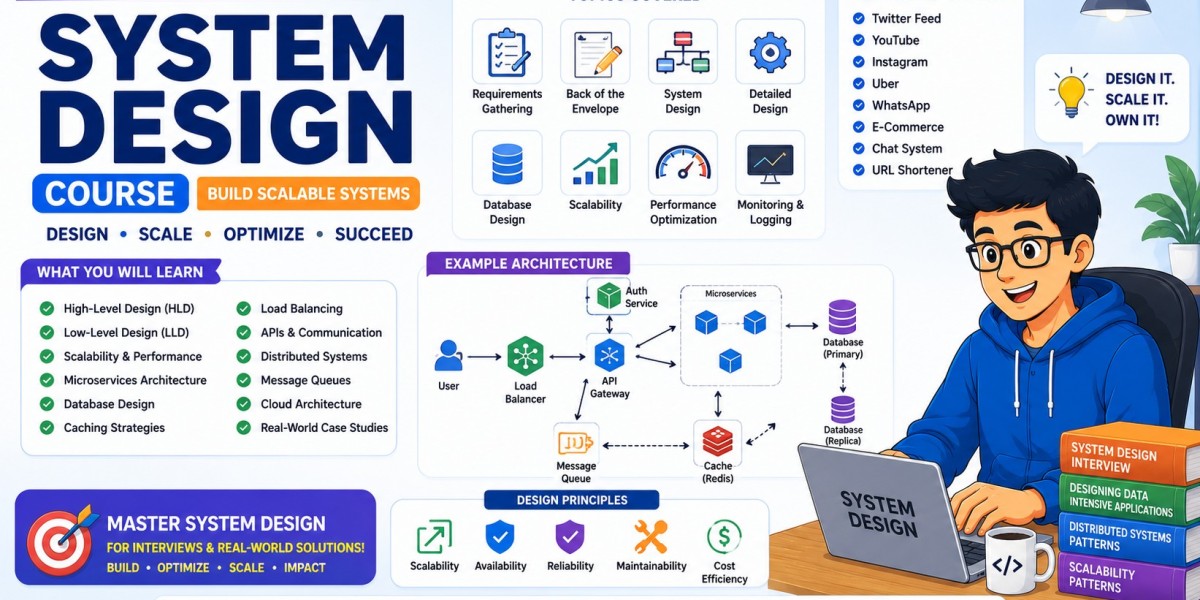
Understanding these concepts is essential for software developers who want to build modern applications or prepare for System Design interviews. A System Design Course explains microservices, APIs, and distributed systems through practical examples, real-world case studies, and hands-on exercises, helping learners understand how enterprise applications are designed.
What are Microservices?
Microservices are an architectural style where an application is divided into multiple small, independent services.
Each service is responsible for a specific business function.
For example, an online shopping application may have separate services for:
User management
Product catalog
Shopping cart
Payment processing
Order management
Notifications
Each service can be developed, deployed, and updated independently.
Benefits of Microservices
Microservices provide several advantages over monolithic applications.
These include:
Better scalability
Independent deployment
Easier maintenance
Improved fault isolation
Faster development
Organizations adopt microservices because they support continuous development and frequent software updates.
Understanding APIs
An API (Application Programming Interface) allows different software components to communicate with one another.
APIs enable applications to:
Exchange data
Request services
Authenticate users
Integrate third-party systems
Support mobile and web applications
REST APIs are among the most commonly used API styles in modern software development.
API Design Best Practices
Well-designed APIs improve software reliability and usability.
Students learn practices such as:
Using meaningful resource names
Maintaining consistent responses
Implementing authentication
Handling errors effectively
Versioning APIs
These techniques improve maintainability and simplify integration.
What are Distributed Systems?
A distributed system consists of multiple computers working together as a single system.
Instead of relying on one server, workloads are shared across several machines.
Distributed systems improve:
Performance
Availability
Fault tolerance
Scalability
Resource utilization
Most large-scale cloud applications use distributed architectures.
Challenges in Distributed Systems
Designing distributed systems introduces new challenges.
Students explore topics including:
Network failures
Data consistency
Latency
Synchronization
Service discovery
Understanding these challenges helps developers design more reliable systems.
Practical Examples
Learners apply these concepts by designing applications such as:
Food delivery platforms
Online banking systems
Ride-sharing applications
Video streaming services
Social networking websites
These examples demonstrate how microservices and APIs support enterprise-scale software.
Career Benefits
Knowledge of microservices, APIs, and distributed systems prepares learners for positions such as:
Backend Developer
Software Engineer
Full Stack Developer
Cloud Engineer
Software Architect
These skills are frequently evaluated during technical interviews at product-based companies.
Conclusion
Microservices, APIs, and distributed systems have become the foundation of modern software architecture. By understanding how independent services communicate and scale across multiple servers, developers can build applications that are reliable, flexible, and capable of supporting millions of users.
A System Design Course provides practical training in these concepts through real-world examples and architecture discussions, helping learners build modern software systems while preparing for successful software engineering careers.