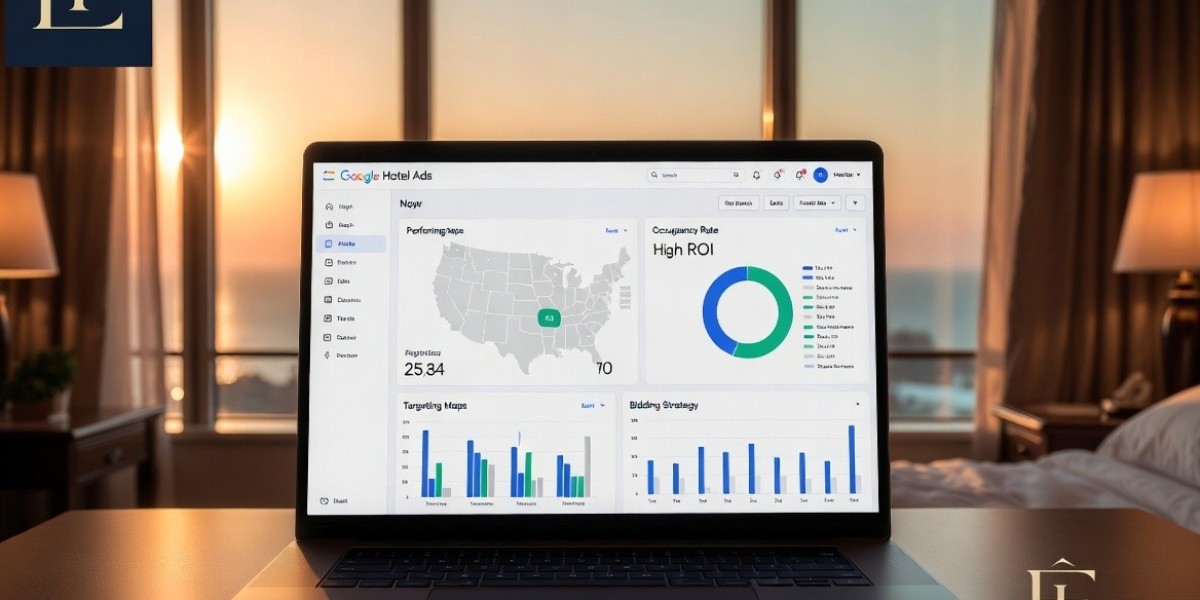

The global hospitality sector is more competitive than ever. For hoteliers aiming to maximize revenue, relying solely on traditional booking channels is no longer a viable long-term strategy. While Online Travel Agencies (OTAs) provide visibility, their steep commissions eat directly into your bottom line.
If you want to reclaim control over your inventory, driving direct bookings must be your top priority.
The most powerful tool at your disposal to achieve this is Google Hotel Ads. By placing your property directly in front of travelers who are actively ready to book, this platform bridges the gap between intent and conversion. However, running a profitable campaign requires more than just launching an ad; it demands a deep understanding of audience targeting and precise bidding configurations.
In this comprehensive guide, curated by the hospitality experts at Ease My Hotel, we will break down how to optimize your Google Hotel Ads campaigns, master advanced bidding strategies, and implement hyper-targeted parameters to unlock a significantly higher return on ad spend (ROAS).
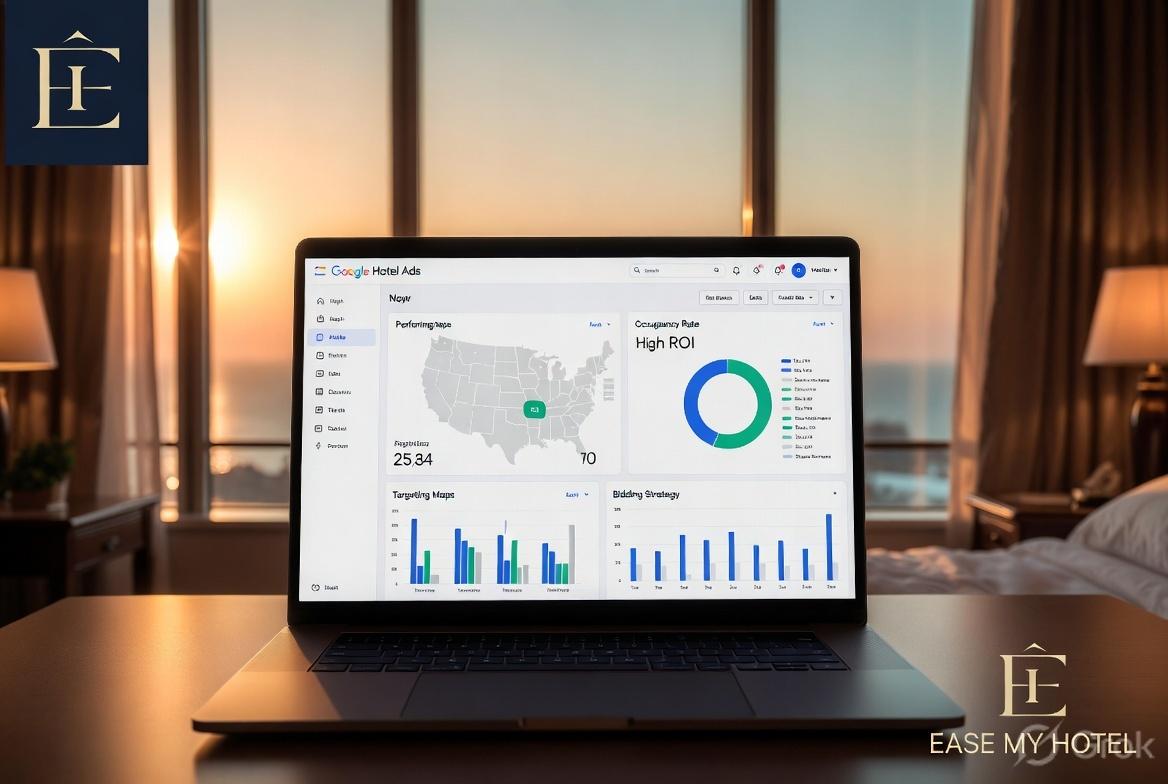
What is Google Hotel Ads and Why Does It Matter?
Google Hotel Ads is a specialized advertising platform that displays your hotel’s real-time rates, availability, and amenities across Google Search, Google Maps, and Google Travel.
When a traveler searches for "hotels in Miami" or looks up your specific property by name, Google displays a dedicated immersive module. This module features a structured list of booking options, comparing OTAs against your official website.
For modern hoteliers, integrating this tool into your digital marketing mix offers massive benefits:
Skyrocket Direct Bookings: By placing your official website link right next to major OTAs, you provide a frictionless path for users to book directly with you.
Lower Distribution Costs: Shifting bookings away from OTAs to your direct booking engine significantly reduces commission payouts, increasing your overall net revenue.
Capture High-Intent Traffic: Unlike standard display ads, these ads only appear when a traveler is actively looking for accommodation, resulting in an exceptionally high conversion rate.
Own Your Guest Data: Direct bookings allow you to capture guest emails and preferences right from the start, enabling personalized pre-stay marketing and building long-term loyalty.
At Ease My Hotel, we consistently see properties transform their profitability simply by switching from a passive distribution model to an active, optimized metasearch strategy.
Navigating the Bidding Ecosystem: Finding Your Profitable Mix
Succeeding with Google Hotel Ads requires a clear, data-driven approach to bidding. Unlike standard text ads that rely purely on a flat Cost-Per-Click (CPC), hotel campaigns offer distinct, industry-specific bidding models tailored to different risk tolerances and financial goals.
1. Manual CPC (Cost-Per-Click)
Under the manual CPC model, you pay a fixed amount whenever a traveler clicks on your hotel listing. This strategy gives you absolute control over your maximum bid limits. It is highly effective for established brands that have a precise understanding of their conversion funnel metrics and want to carefully manage their daily ad spend.
2. CPC% (Percent CPC)
With CPC% bidding, your bid is calculated as a percentage of your total room price per night (including taxes and fees). For example, if you set a 2% bid and your room rate is $200, your base bid for that auction will be $4.00. This model naturally scales your ad spend based on the value of the booking, ensuring you don’t overpay for low-cost dates while remaining aggressive on high-revenue premium nights.
3. Enhanced CPC (eCPC)
Enhanced CPC bridges the gap between manual control and machine learning. You set your foundational base bids, but Google’s algorithms automatically adjust them in real-time. If a user exhibits strong signals of being highly likely to convert, Google will automatically raise your bid; conversely, it will lower your bid for lower-intent queries to save budget.
4. Target ROAS (Return on Ad Spend)
As part of Google's advanced Smart Bidding ecosystem, Target ROAS uses deep historical data and machine learning to maximize total conversion value. You define your goal—such as a 500% ROAS—and the algorithm dynamically adjusts your bids in every single auction based on immediate user signals like device type, time of day, and traveler location.
Important Bidding Architecture Update: Google's automated systems have evolved to ensure high predictability. When a campaign is constrained by budget but utilizes a target-based bid strategy (like Target ROAS), the system adjusts performance to deliver much closer to your exact stated target. It is vital to audit your targets within your dashboard to ensure they align precisely with your real-world margins.
Mastering Targeting Parameters for Maximum ROI
To achieve a higher return on ad spend, you cannot treat all traffic equally. A user looking for a 7-night summer vacation has a profoundly different value profile than a local user looking for a 1-night stay tonight.
Google Hotel Ads allows you to fine-tune your targeting by applying precise bid adjustments across several critical dimensions:
Geographic Location & Device Type
Analyze your historical data to identify where your most profitable guests originate. If your data reveals that international travelers from the UK spend 40% more on incidentals than domestic travelers, you can apply a positive bid adjustment (e.g., +25%) for users located in the UK.
Similarly, optimize for device type. While mobile traffic accounts for the vast majority of initial travel research, desktop traffic often maintains a higher average booking value. Adjust your bids to capture users across this multi-device journey.
Length of Stay (LOS) & Check-In Day
Maximize your operational efficiency by syncing your bidding strategies with your property's occupancy needs. If your property struggles to fill rooms on Sunday and Monday nights, you can increase your bids for itineraries that include a Sunday check-in. Furthermore, you can aggressively bid on a longer length of stay (e.g., 4+ nights) to secure highly profitable, extended bookings.
Advanced Booking Window
The time gap between when a traveler books and their actual arrival date is an invaluable data point.
Early Birds: Travelers booking 60 days in advance are often planning major, high-value vacations.
Last-Minute Bookers: Users searching for a room for tonight or tomorrow are highly motivated to convert immediately.
By adjusting your bidding intensity based on these windows, you can strategically fill empty rooms at the last minute or secure a stable baseline of future bookings months in advance.
Crucial Optimization Strategies for Peak Performance
Launching a campaign is only the baseline; continuous optimization determines your long-term profitability. To truly outcompete the major OTAs, focus your efforts on these foundational pillars:
1. Maintain Strict Price Parity
The single most common reason for a poor conversion rate is a broken price match. If a traveler clicks your ad expecting a $150 rate, but arrives at your booking engine only to see the price jump to $175 due to delayed syncing, they will immediately bounce.
Google closely monitors this behavior. Frequent discrepancies degrade your quality score, driving up your costs. To prevent this, ensure your channel manager or distribution platform maintains a real-time connection with your feed, achieving a price match rate above 95%.
2. Transition to Direct Price Feeds
Critical Technical Alert: Google is officially sunsetting the legacy third-party rates feature for hotel ads. Campaigns relying on these external third-party rates will stop serving entirely. To avoid catastrophic disruptions to your ad visibility, you must establish a direct price feed. This is accomplished by working directly with a certified integration partner or setting up a dedicated Hotel Center account linked straight to your Google Ads interface.
3. Build Detailed Audience Remarketing Lists
Don't let qualified traffic slip away. By using audience lists, you can create tailored remarketing campaigns targeting users who visited your website or abandoned your booking engine without finishing their reservation. Offering a small incentive—such as a complimentary breakfast or a flexible cancellation policy—via a targeted remarketing ad is an incredibly cost-effective way to win back direct bookings.
Conclusion: Take Control of Your Distribution with Ease My Hotel
Driving a higher return on ad spend through Google Hotel Ads is not about outspending the competition; it is about out-smarting them. By aligning your property with the right bidding model, optimizing your real-time data feeds, and applying hyper-targeted bid adjustments based on traveler behavior, you can significantly shift your share of bookings away from high-commission OTAs and straight to your official website.
Navigating the complexities of direct price feeds, algorithmic bidding updates, and continuous rate synchronization can feel overwhelming for busy hoteliers. That is exactly where we come in.
At Ease My Hotel, we specialize in managing cutting-edge metasearch and digital marketing campaigns designed exclusively for the hospitality industry. We handle the technical complexities—from feed management to real-time bid optimization—so you can focus on delivering an exceptional guest experience.
Ready to maximize your direct bookings and transform your digital ROI? Contact the team at Ease My Hotel today, and let’s build a high-performing advertising strategy customized for your property!