
As businesses continue to adopt cloud technologies, managing complex IT environments has become one of the biggest challenges for modern enterprises. Organizations often rely on multiple cloud providers, hybrid infrastructures, hundreds of applications, and distributed teams. While the cloud delivers flexibility and scalability, it also introduces operational complexity that can slow innovation, increase costs, and create security risks.
Many IT leaders struggle with fragmented cloud environments where monitoring, security, compliance, cost management, and performance optimization are handled through separate tools. This disconnected approach makes it difficult to maintain visibility, enforce governance, and respond quickly to changing business needs.
This is where a cloud services management platform becomes a strategic investment. Instead of managing multiple cloud resources manually, businesses can centralize operations, automate routine tasks, improve governance, and gain complete visibility across their cloud ecosystem.
Whether your organization uses public cloud, private cloud, hybrid cloud, or multiple cloud providers, a cloud services management platform simplifies IT management while improving operational efficiency and business resilience.
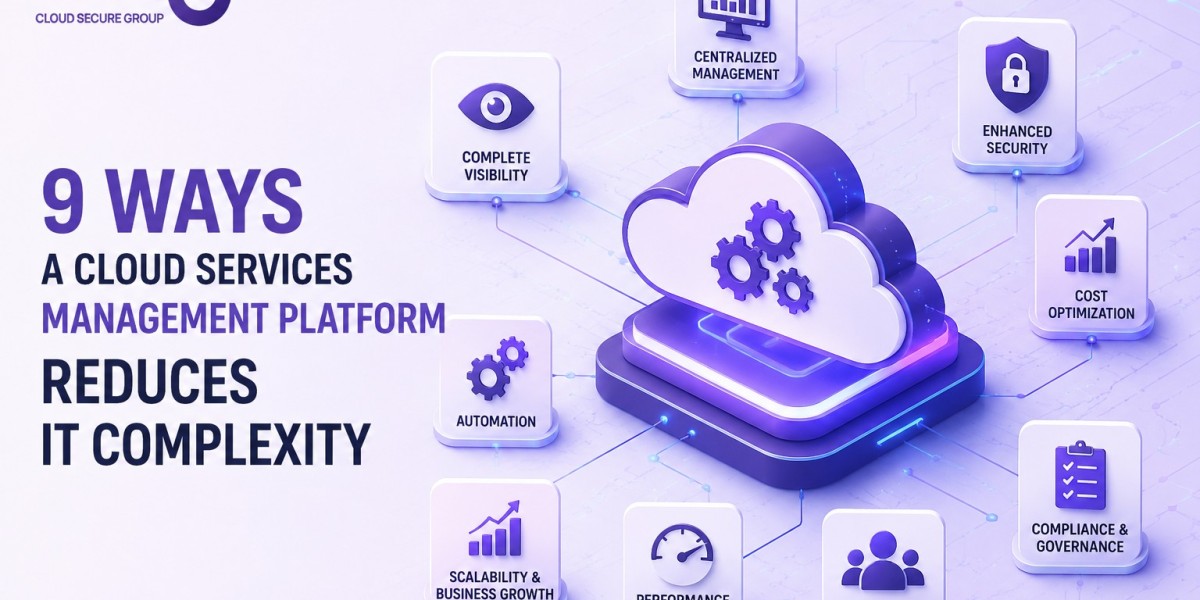
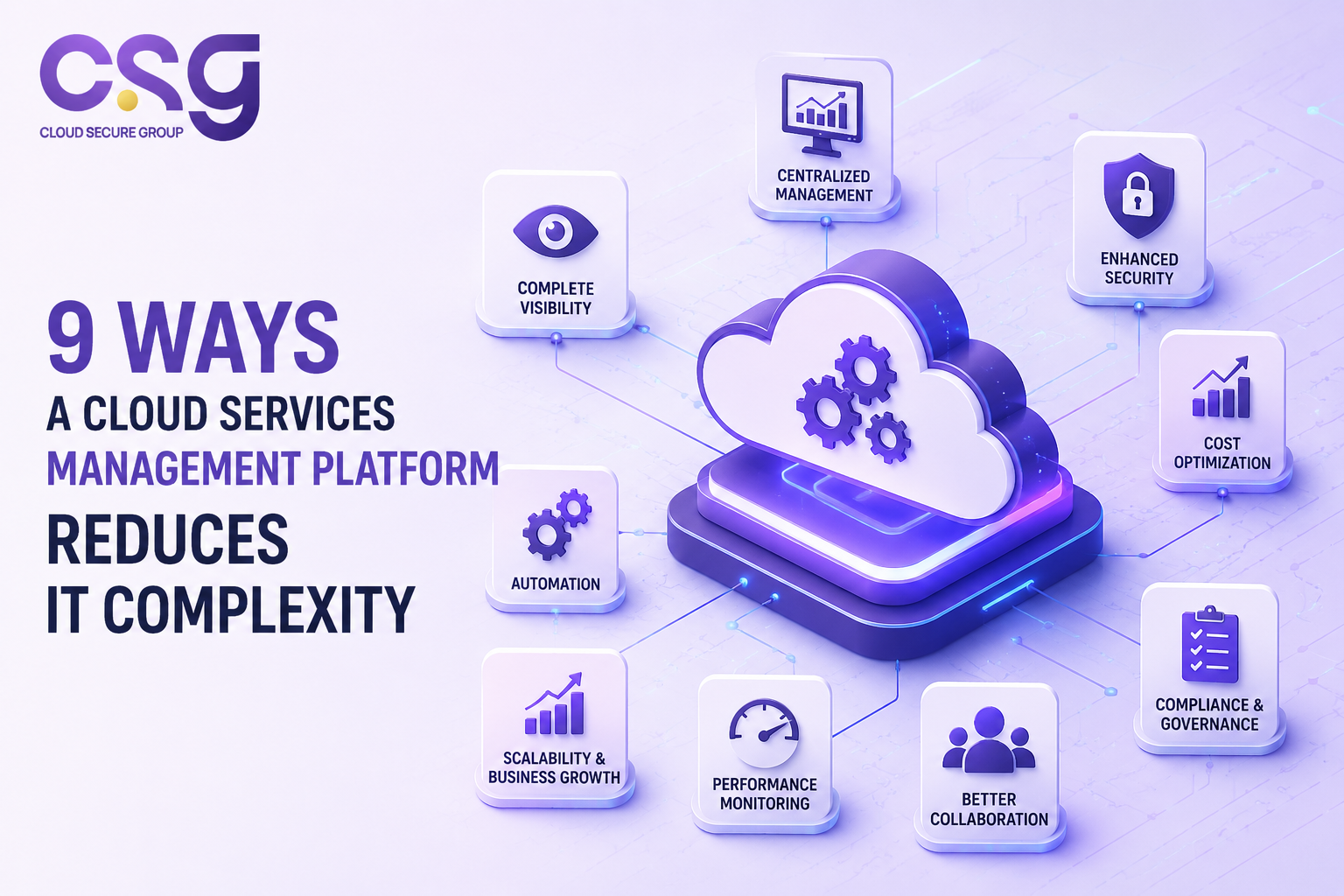
In this article, we'll explore 9 ways a cloud services management platform reduces IT complexity, helping enterprises improve productivity, strengthen security, and maximize cloud investments.
 Cloud Services Management Platform
What Is a Cloud Services Management Platform?
A cloud services management platform is a centralized solution that helps organizations monitor, manage, optimize, secure, and automate cloud infrastructure from a single interface.
Instead of switching between multiple management consoles, IT teams gain unified control over cloud resources, workloads, users, security policies, compliance requirements, and operational workflows.
Modern platforms often integrate with:
- Microsoft Azure
- Amazon Web Services
- Google Cloud Platform
- Hybrid cloud environments
- On premises infrastructure
- SaaS applications
Combined with cloud security managed services, businesses gain proactive monitoring, threat detection, governance, and ongoing optimization without increasing operational complexity.
Why IT Complexity Continues to Increase
Before exploring the benefits, it helps to understand why cloud environments become difficult to manage.
Common challenges include:
- Multiple cloud providers
- Growing number of virtual machines
- Manual resource provisioning
- Rising cloud costs
- Security misconfigurations
- Compliance requirements
- Limited visibility
- Separate monitoring tools
- Complex identity management
- Increasing cyber threats
Without centralized management, these issues quickly overwhelm internal IT teams.
1. Centralizes Cloud Management
One of the biggest advantages of a cloud services management platform is centralized visibility.
Instead of logging into different cloud consoles throughout the day, administrators manage everything from one dashboard.
This allows IT teams to:
- View infrastructure health
- Monitor applications
- Track resource utilization
- Review security alerts
- Manage user permissions
- Analyze cloud spending
A single source of truth significantly reduces administrative overhead.
Example
A company operating workloads across Azure and AWS no longer needs separate monitoring systems. Everything is accessible through one management platform.
2. Automates Routine IT Operations
Manual processes consume valuable IT resources.
Provisioning virtual machines, applying patches, backing up workloads, monitoring alerts, and generating reports often require repetitive manual effort.
A cloud services management platform automates these routine operations.
Automation capabilities include:
- Resource provisioning
- Scheduled backups
- Patch management
- Auto scaling
- Incident response
- Compliance reporting
- Infrastructure deployment
- Cost optimization
Automation reduces human error while allowing IT teams to focus on strategic initiatives.
For organizations using azure cloud managed services, automation improves deployment consistency across multiple Azure subscriptions and environments.
3. Improves Cloud Visibility Across All Environments
Many organizations lack complete visibility into their cloud infrastructure.
Different teams often manage different cloud accounts, resulting in:
- Shadow IT
- Duplicate resources
- Underutilized infrastructure
- Unidentified security risks
A cloud services management platform provides comprehensive visibility across:
- Virtual machines
- Storage
- Networks
- Databases
- Containers
- Applications
- Security events
- Performance metrics
This visibility enables faster decision making and proactive issue resolution.
4. Simplifies Cloud Security Management
Security becomes increasingly difficult as cloud environments grow.
Misconfigured storage accounts, excessive permissions, outdated software, and unsecured endpoints create unnecessary risks.
When combined with cloud security managed services, a cloud services management platform strengthens security through:
- Continuous monitoring
- Threat detection
- Vulnerability assessments
- Identity management
- Security policy enforcement
- Security automation
- Real time alerts
- Compliance monitoring
Rather than reacting to incidents, organizations can identify risks before they become major problems.
Practical Example
If an administrator accidentally exposes a storage bucket publicly, automated security monitoring immediately detects the issue and triggers remediation workflows.
5. Reduces Cloud Costs Through Better Resource Optimization
Cloud spending can quickly become unpredictable.
Organizations often pay for:
- Idle virtual machines
- Unused storage
- Oversized instances
- Duplicate services
- Forgotten development environments
A cloud services management platform continuously analyzes cloud usage and recommends optimization opportunities.
These include:
- Rightsizing resources
- Eliminating unused workloads
- Scheduling non production environments
- Storage optimization
- Reserved instance recommendations
Better resource utilization helps businesses maximize cloud ROI without compromising performance.
6. Strengthens Governance and Compliance
Regulatory compliance is no longer optional for most enterprises.
Organizations must demonstrate adherence to standards such as:
- ISO 27001
- SOC 2
- HIPAA
- GDPR
- PCI DSS
Managing compliance manually across multiple cloud providers is extremely time consuming.
A cloud services management platform simplifies governance by:
- Enforcing standardized policies
- Monitoring compliance continuously
- Automating audit reporting
- Tracking configuration changes
- Managing access controls
- Detecting policy violations
This reduces compliance risks while making audits significantly easier.
7. Enhances Performance Monitoring and Incident Management
IT teams need real time insights into infrastructure health.
Without centralized monitoring, performance issues often go unnoticed until users report them.
Modern cloud platforms provide:
- Performance dashboards
- Resource utilization metrics
- Application monitoring
- Infrastructure monitoring
- Service health tracking
- Intelligent alerting
- Root cause analysis
When integrated with azure cloud managed services, organizations gain deep monitoring capabilities for Azure resources while maintaining visibility across hybrid environments.
Business Impact
Instead of spending hours identifying the source of an outage, IT teams receive actionable alerts with recommended remediation steps.
This significantly reduces downtime.
8. Supports Business Growth Without Increasing Complexity
As organizations expand, cloud environments naturally become more complex.
Growth often involves:
- New business units
- Additional cloud accounts
- More applications
- Remote teams
- Global operations
Without scalable management practices, operational complexity grows faster than the business itself.
A cloud services management platform scales alongside organizational growth by providing:
- Standardized deployment templates
- Centralized governance
- Automated provisioning
- Unified monitoring
- Consistent security policies
This enables businesses to expand confidently without overwhelming internal IT teams.
9. Enables Better Collaboration Across IT Teams
Large enterprises often have multiple teams responsible for different aspects of cloud operations.
These include:
- Infrastructure teams
- Security teams
- DevOps engineers
- Compliance officers
- Application developers
Disconnected tools create communication gaps.
A centralized cloud services management platform improves collaboration through:
- Shared dashboards
- Role based access
- Unified reporting
- Automated workflows
- Centralized documentation
- Integrated ticketing
Everyone works from the same data, improving operational efficiency and reducing delays.
Real World Scenario
Imagine a growing SaaS company operating across multiple regions.
Initially, the company manages cloud resources manually through individual Azure and AWS portals.
As the business grows, they begin experiencing:
- Rising cloud costs
- Security alerts
- Resource sprawl
- Compliance challenges
- Longer incident response times
After implementing a cloud services management platform supported by cloud security managed services, the organization experiences:
- Centralized monitoring
- Automated infrastructure management
- Faster incident response
- Improved compliance reporting
- Lower cloud costs
- Better resource utilization
- Stronger security posture
The result is an IT environment that supports business growth rather than slowing it down.
Best Practices for Maximizing Your Cloud Services Management Platform
To achieve the greatest value, organizations should:
- Define clear governance policies
- Automate repetitive operational tasks
- Continuously monitor cloud costs
- Review security configurations regularly
- Integrate compliance monitoring
- Standardize deployment processes
- Train IT teams on platform capabilities
- Use predictive analytics for capacity planning
- Partner with experienced managed cloud providers
These practices help ensure long term operational success.
Conclusion
Managing modern cloud infrastructure does not have to be complicated.
As organizations adopt hybrid cloud, multi cloud, and distributed applications, the need for centralized management becomes increasingly important. A cloud services management platform helps businesses simplify operations, improve security, optimize costs, strengthen governance, and support sustainable growth through automation and intelligent monitoring.
When combined with cloud security managed services and expert azure cloud managed services, organizations gain the visibility, control, and operational efficiency needed to manage today's complex IT environments with confidence.
If your business is looking to reduce operational complexity while improving cloud performance and security, investing in a comprehensive cloud services management platform is a strategic decision that delivers long term business value.
Frequently Asked Questions
1. What is a cloud services management platform?
A cloud services management platform is a centralized solution that helps organizations manage, monitor, automate, secure, and optimize cloud infrastructure across multiple cloud environments from a single dashboard.
2. How does a cloud services management platform reduce IT complexity?
It simplifies cloud operations by centralizing management, automating repetitive tasks, improving visibility, strengthening governance, optimizing costs, and enhancing collaboration between IT teams.
3. How do cloud security managed services complement a cloud services management platform?
Cloud security managed services provide continuous monitoring, threat detection, vulnerability management, compliance support, and incident response, helping organizations maintain a strong security posture while reducing the burden on internal IT teams.
4. Can a cloud services management platform manage hybrid and multi cloud environments?
Yes. Most modern platforms support hybrid and multi cloud environments, allowing businesses to manage resources across providers such as Microsoft Azure, AWS, Google Cloud, and on premises infrastructure through a unified interface.
5. Why are Azure cloud managed services important for enterprises?
Azure cloud managed services help organizations optimize Microsoft Azure environments through proactive monitoring, performance optimization, security management, automated maintenance, governance, and expert support, enabling businesses to maximize the value of their Azure investments.