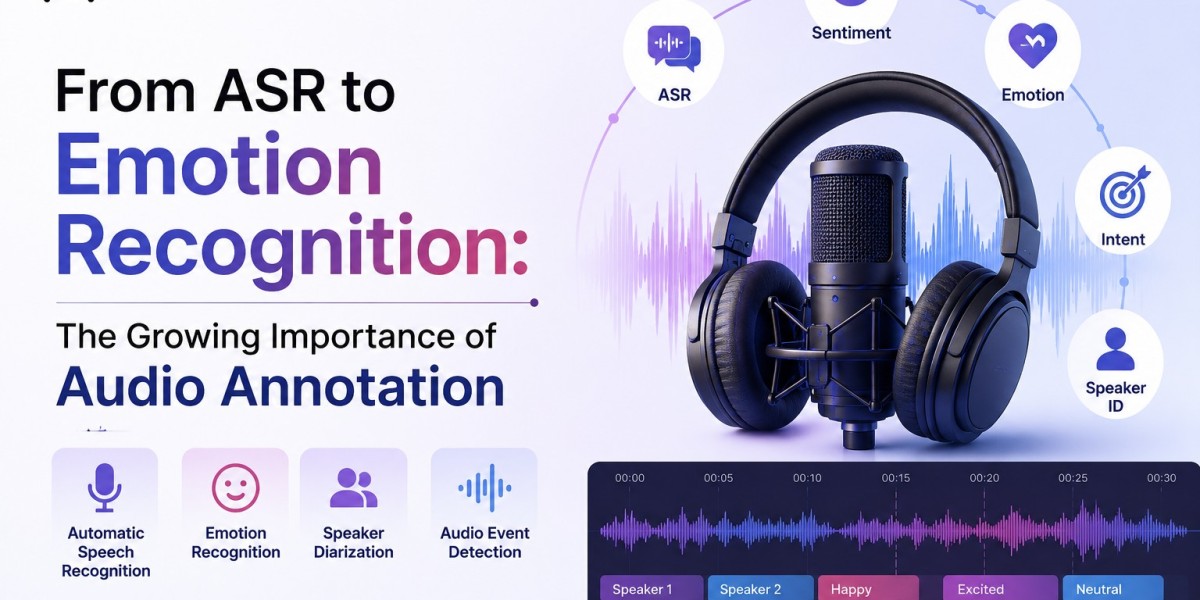

Artificial intelligence has transformed how machines understand and interact with human speech. From voice assistants and automated customer support to healthcare transcription and emotion-aware virtual agents, speech-based AI has become an essential part of modern business operations. Behind these intelligent systems lies a critical yet often overlooked component—high-quality audio annotation.
Automatic Speech Recognition (ASR) once represented the primary application of speech AI, focusing mainly on converting spoken language into text. Today, AI systems are expected to go far beyond transcription. They must recognize emotions, identify speakers, detect intent, classify sounds, understand context, and even interpret subtle vocal cues. Achieving these capabilities requires carefully labeled audio datasets that accurately reflect real-world conversations.
As organizations increasingly invest in voice AI, partnering with an experienced data annotation company has become a strategic advantage for building reliable, scalable, and production-ready AI models.
The Evolution of Speech AI
The first generation of speech AI focused primarily on ASR systems. These models were trained to recognize spoken words and convert them into written text with acceptable accuracy.
Modern speech AI, however, performs much more sophisticated tasks, including:
- Speech-to-text transcription
- Speaker diarization
- Emotion recognition
- Intent detection
- Keyword spotting
- Audio event detection
- Language identification
- Sentiment analysis
- Accent recognition
Each of these capabilities depends on annotated audio data that teaches AI models how to recognize different acoustic patterns under varying real-world conditions.
Without accurate annotation, even the most advanced AI architectures struggle to generalize beyond laboratory environments.
Why Audio Annotation Matters More Than Ever
Every audio recording contains multiple layers of information beyond spoken words.
A single customer support call may include:
- Multiple speakers
- Background noise
- Interruptions
- Emotional shifts
- Different accents
- Silence
- Non-verbal sounds such as laughter or sighs
AI models cannot automatically understand these nuances without structured training data.
Audio annotation converts raw recordings into meaningful datasets by labeling:
- Speech segments
- Speaker identities
- Emotional states
- Acoustic events
- Language
- Intent
- Time stamps
- Overlapping conversations
This structured data enables AI models to learn patterns that closely resemble real-world interactions.
Audio Annotation Powers Automatic Speech Recognition
Automatic Speech Recognition remains one of the largest applications of annotated audio.
Modern ASR systems require millions of carefully labeled audio clips paired with accurate transcripts. These datasets help models learn pronunciation differences, speaking speed, dialects, background interference, and regional accents.
Quality annotation improves:
- Word Error Rate (WER)
- Accent adaptability
- Noise robustness
- Domain-specific vocabulary recognition
- Real-time transcription accuracy
Industries such as healthcare, legal services, finance, media, and customer support all rely heavily on highly accurate ASR systems.
Professional audio annotation outsourcing enables organizations to create large-scale transcription datasets without compromising consistency or quality.
Beyond Transcription: The Rise of Emotion Recognition
Today's conversational AI is expected to understand not just what people say—but how they say it.
Emotion recognition enables AI systems to detect feelings such as:
- Happiness
- Anger
- Frustration
- Fear
- Excitement
- Sadness
- Neutral tone
These models analyze vocal features including:
- Pitch
- Tone
- Speaking rate
- Volume
- Stress patterns
- Pause duration
- Voice modulation
Creating emotion-aware AI requires carefully annotated datasets where human experts label emotional cues consistently across thousands of audio samples.
Since emotional expression varies significantly across cultures, languages, and individuals, human annotation remains indispensable for producing trustworthy training data.
Industries Benefiting from Advanced Audio Annotation
The demand for annotated audio datasets continues to expand across multiple industries.
Customer Experience
AI-powered contact centers analyze conversations to measure customer satisfaction, identify escalations, and recommend agent improvements through emotion detection and sentiment analysis.
Healthcare
Speech AI assists clinicians with medical transcription, patient monitoring, mental health analysis, and voice biomarker research.
Automotive
Voice-controlled infotainment systems require annotated multilingual speech datasets for safer hands-free interactions.
Financial Services
Banks use speech analytics to improve fraud detection, monitor compliance, and enhance customer support quality.
Media & Entertainment
Streaming platforms use audio annotation to improve subtitle generation, speaker identification, and multilingual content indexing.
Smart Devices
Virtual assistants depend on high-quality annotated speech data to recognize commands accurately across diverse accents and noisy environments.
Challenges in Audio Annotation
Although AI has made significant advances, audio annotation remains one of the most complex forms of data labeling.
Some common challenges include:
- Overlapping speakers
- Poor recording quality
- Background noise
- Regional dialects
- Code-switching between languages
- Emotional ambiguity
- Inconsistent annotation guidelines
Maintaining consistency across large annotation teams requires standardized workflows, expert quality assurance, and detailed annotation protocols.
This is one reason many organizations prefer data annotation outsourcing, allowing them to leverage experienced specialists while accelerating project timelines.
Human Expertise Remains Essential
Despite rapid advances in AI-assisted labeling, human annotators continue to play a central role in creating reliable speech datasets.
Experienced linguists and annotation specialists can accurately identify:
- Emotional nuances
- Sarcasm
- Conversational intent
- Speaker transitions
- Non-verbal vocalizations
- Acoustic events
Human reviewers also validate AI-generated annotations, ensuring higher precision before datasets are used for model training.
This human-in-the-loop approach consistently produces better-performing AI models than fully automated annotation workflows.
Why Businesses Choose Audio Annotation Outsourcing
Building an internal annotation team requires substantial investments in hiring, training, infrastructure, and quality management.
By choosing audio annotation outsourcing, organizations gain access to:
- Skilled annotation professionals
- Scalable workforce capacity
- Faster project turnaround
- Multilingual expertise
- Rigorous quality assurance
- Reduced operational costs
- Flexible project scaling
Outsourcing also enables AI teams to focus on model development while annotation specialists manage complex data preparation workflows.
Why Annotera Is Your Trusted Audio Annotation Partner
At Annotera, we understand that exceptional AI begins with exceptional training data.
As a trusted data annotation company, Annotera delivers high-quality audio annotation services tailored to enterprise AI initiatives. Our experienced annotation specialists combine domain expertise with robust quality assurance processes to produce datasets that improve speech recognition, emotion detection, speaker identification, and conversational AI performance.
Whether your project involves multilingual transcription, acoustic event labeling, speaker diarization, sentiment analysis, or emotion recognition, our scalable delivery model supports AI development across industries while maintaining exceptional accuracy and consistency.
With a human-in-the-loop approach, secure workflows, and customizable annotation guidelines, Annotera helps organizations accelerate AI deployment through reliable data annotation outsourcing and specialized audio annotation outsourcing services.
Conclusion
Speech AI is rapidly evolving beyond simple transcription. Today's intelligent systems must understand context, emotion, intent, and conversational dynamics to deliver truly human-like interactions. As these capabilities become more sophisticated, the quality of annotated audio data becomes increasingly important.
Organizations that invest in accurate audio annotation gain stronger AI performance, improved customer experiences, and faster innovation across voice-driven applications. High-quality annotation is no longer just a supporting task—it is the foundation of successful speech AI.
If you're looking to develop enterprise-grade voice intelligence, partner with Annotera. Our expert annotation teams deliver precise, scalable, and secure audio annotation solutions that empower your AI models from ASR to advanced emotion recognition.