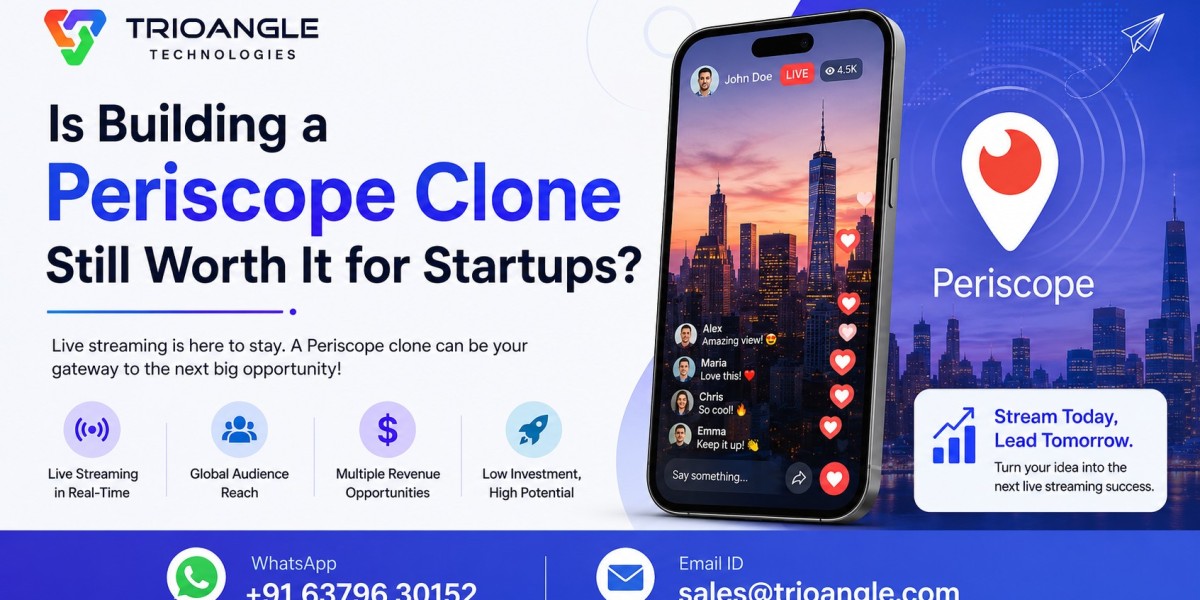

Periscope disappeared years ago. The demand for live streaming didn't.
At its peak, Periscope had millions of active users. It showed that people would tune in to strangers' lives, skills, and views as they were streamed live from a smartphone. That behavior didn't go away when the app went away. It migrated.
If you're weighing whether a Periscope clone is worth building in 2026, that hesitation makes sense. The live streaming landscape looks nothing like it did when Periscope was at its best, and the question of where a new platform fits into that isn't immediately obvious.
Which raises the question,
How the Live Streaming Market Evolved Beyond Periscope
According to Grand View Research, the global live streaming market is estimated to reach $345.1 billion by 2030. It's not a single platform that is fueling that growth. It is being fueled by the lack of one strong, unified app in these verticals that actually works well.
Gamers have Twitch. YouTube Live is a feature for creators. Instagram and TikTok are the platforms for casual broadcasters.
In between are some big gaps: niche communities, professional verticals, and regional markets where the major platforms simply don't pay much attention. Smaller creators often struggle to gain visibility, face limited monetization opportunities, and compete with algorithms that tend to reward established accounts. For many of these communities, a dedicated live streaming platform can offer a much better experience.
It's in that space that a well-placed Periscope clone app can find its audience.
Breaking Down the Investment Behind a Periscope Clone Script
A Periscope clone script is a ready-made live streaming platform solution that comes integrated with the core functionality of Periscope, which includes support for live mobile streaming, live audience interaction, live comment streams, and virtual gifting.
The difference between building this from scratch and using a Periscope clone script is that with the script, you get a fully pre-built platform that can be customized and launched as your own with minimal time and cost. In parallel, custom development is the expensive route, in both time and budget.
A Periscope clone script covers the core features: live broadcasting, real-time chat, virtual gifting, user profiles, and an admin panel.
For this, the base packages generally fall between $8,000 and $20,000 depending on the provider and what the launch needs.
For advanced features, like:
Multi-currency gifting
Subscription tiers
HD streaming
Replay storage
Analytics dashboards
White-label B2B options
You can expect to pay anywhere from $20,000 to $45,000.
Custom development from scratch for the same feature set is $80,000 to $150,000 minimum, and 6 to 12 months before the product is built and seen by a single user.
So, the realistic entry point with a Periscope clone script is $10,000 to $45,000 for a fully featured live streaming app and $1,000 to $2,000 per month in operating costs at the early stage.
Breaking Down the Real ROI of a Periscope Clone
#1. Virtual Gifting and In-App Currency
This is the most profitable revenue source on most live streaming platforms. Now, let's look at the math in action.
You charge $0.10 for each virtual coin that you sell to viewers. During a live session, a viewer gives a creator 500 coins, which is $50 on the platform before the creator's cut. You give the creator 50-70% of the value of the gift and retain the remaining 30-50%.
With a creator payout of 70%, you'll retain $15 from that single sale.
Now multiply that by a platform that has 200 active users per day, who spend an average of $5 in gifts per session.
That's $1,000 in daily gift revenue, approximately $700 in creator payouts, and $300 in net platform revenue per day, which equals about $9,000 in monthly net platform revenue.
#2. Subscription Tiers for Creators
Say, your platform has 300 active creators, 30% of which subscribe to the creator tier for more advanced tools and analytics at $19.99/month, resulting in $1,800/month of pure subscription revenue.
With 500 creators and 35% conversion, it's $3,500 per month. At 1,000 creators, it's $7,000 per month, and subscription revenue is predictable, recurring, and not reliant on any single stream.
#3. Viewer Subscriptions
With 10,000 monthly active viewers, if 5% subscribe at $4.99 for ad-free viewing and HD access, that’s around 500 paying users. Bringing in roughly $2,495 each month.
Applying the same 5% conversion rate to 50,000 monthly active viewers would bring your Periscope clone app $12,475 per month from subscriptions alone.
When Does Your Periscope Clone App Break Even?
This is a realistic estimate for a Periscope clone app, but with a specific niche, such as professional education or regional entertainment, for 18 months.
Months 1-6: Attracting Your First Creators
Just concentrate on getting 50 to 100 active creators in your niche. Revenue is very low, with the early gifting activity bringing in $500 to $2,000 per month. It's not the right time to aim for maximum revenue. The better approach is to put creators first and build around what actually helps them.
Typically, your monthly operating costs will be in the range of $3,000 to $5,000, which includes infrastructure, marketing, and user support.
Months 7–12: Building the Audience
With a sufficient creator base, you can expect an increase in returning views. You begin to receive consistent revenue from gifts and subscriptions. On average, you can make between $5,000 and $12,000 per month, while infrastructure costs typically rise to $4,000-$7,000 as traffic rises. At this point, breakeven is within reach.
Months 13-18: Revenue Optimization
By this point, your Periscope clone app should have a dedicated creator community and a growing viewership. This is when platforms add more revenue streams like premium plans, ads, pay-per-view, and sponsored streams. When combined, these can lead to monthly revenues of $15,000 to $30,000, while the operating costs are between $6,000 and $10,000.
For most live streaming platforms, month 18 is when profits can start to show, typically between $5,000 and $20,000 per month, depending on the niche and creator retention.
Say you invested $50,000 to launch the platform. Reaching $10,000 in monthly profit by month 18 would put you well on the way to earning that investment back.
As the platform grows past the initial niche, the numbers move considerably from there.
Conclusion
So, is the ROI of a Periscope clone worth it to get started in 2026?
It depends on whether you build for a specific audience or try to serve everyone.
Periscope tried to serve everyone and got absorbed by a platform that already had them. That's a positioning problem, not a product one.
A Periscope clone script gives you the infrastructure. What generates the return is deciding clearly who that infrastructure is for, how you bring them in, and what keeps them coming back.
In 2026, the live streaming market is big enough that you don't need a massive audience. You need the right one, showing up consistently, in a place that feels like it was built for them. That's where the return actually comes from.
Visit: https://www.trioangle.com/periscope-clone/
WhatsApp - +91 63796 30152
Email ID - sales@trioangle.com
Telegram- https://t.me/Trioangle_Technologies