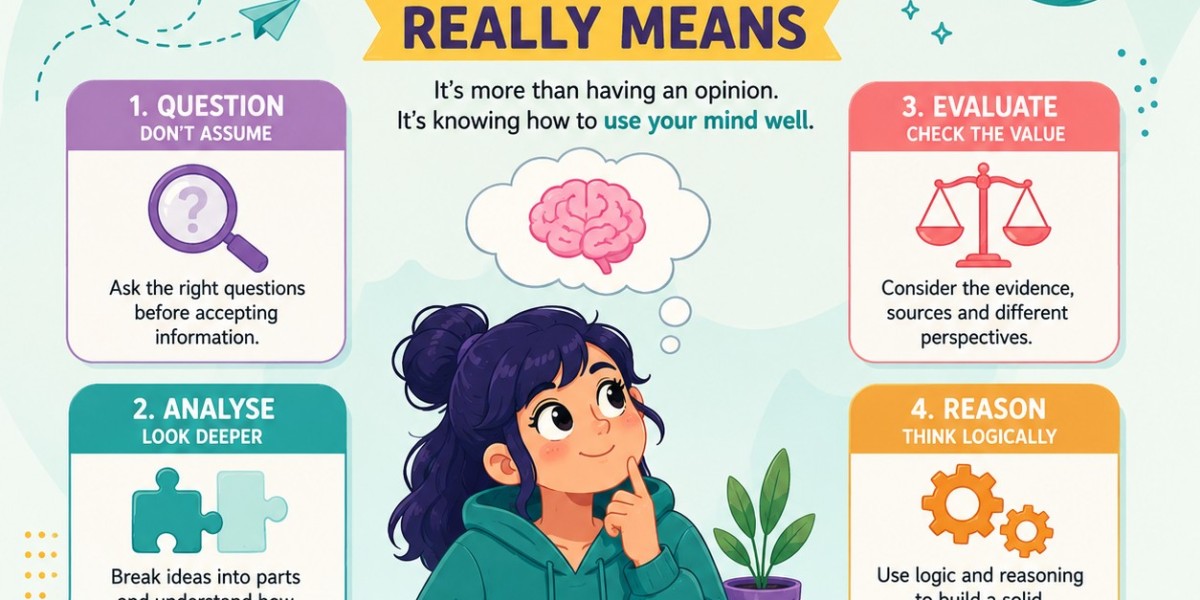

This assignment lacks critical thinking" is one of the most common pieces of feedback Sydney university students receive — and one of the least useful without further explanation. Critical thinking sounds like a personality trait rather than a writing technique, which makes it genuinely difficult for students to know what would look different on the page if they were doing it well. The practical reality is that critical thinking in academic writing is not a disposition — it is a set of specific, learnable writing moves that are visible in the text and that markers are trained to identify at every performance level. Once a student understands what those moves actually look like, implementing them becomes a technical challenge rather than a mysterious aspiration. This is something Assignment Help Sydney review services address specifically and concretely rather than in abstract terms.
What Critical Thinking Is Not
Before explaining what critical thinking in academic writing actually involves, it helps to clear up the most common misconception — that critical thinking means finding fault with things or expressing a negative opinion. This misunderstanding leads students to either avoid critical engagement because it feels presumptuous or to add superficial criticism of sources that does not actually demonstrate analytical capability.
Critical thinking in academic writing is none of the following:
- Simply disagreeing with an author or theory because their conclusions are uncomfortable
- Expressing personal opinions without grounding them in evidence and reasoning
- Finding weaknesses in sources for the sake of appearing analytical rather than because those weaknesses are relevant to the argument
- Summarising what multiple scholars have said and then choosing the one whose view you prefer without explaining the reasoning behind the preference
- Using qualifying language to appear uncertain without actually engaging with the reasons for genuine uncertainty in the evidence
What Critical Thinking Actually Looks Like on the Page
Critical thinking in academic writing is visible in specific ways that markers can identify at the sentence and paragraph level. It involves a particular relationship between claims, evidence, and reasoning — one in which the student is actively evaluating rather than passively reporting.
The specific moves that demonstrate critical thinking include the following:
- Evaluating evidence rather than describing it — not just reporting what a study found but assessing how robust the methodology was, how large the sample was, and how far the findings can be generalised
- Identifying assumptions — making explicit the underlying assumptions on which a theoretical claim or policy argument depends and asking whether those assumptions are warranted
- Considering alternative interpretations — acknowledging that the same evidence could support more than one conclusion and explaining why the interpretation being argued for is more persuasive
- Weighing competing claims — when two scholars disagree, explaining the basis for the disagreement and making a reasoned judgement about which position is better supported rather than simply acknowledging both
- Connecting evidence to claims explicitly — making the logical relationship between a piece of evidence and the claim it supports visible in the writing rather than assuming the reader will infer it
How Expert Review Makes Critical Thinking Visible
The most effective way to help students develop critical thinking is by identifying exactly where in a draft the writing is descriptive rather than evaluative. This targeted, paragraph-level feedback is what Assignment Help Sydney delivers — transforming the abstract criterion of "critical thinking" into something specific and addressable.
This kind of targeted, paragraph-level feedback transforms the abstract criterion of "critical thinking" into something specific and addressable. When a student can see the exact sentence where description ends and evaluation should begin, they can make that change in the current draft and understand what to do differently in the next one.
Conclusion
Critical thinking in academic writing is not a mysterious quality that some students naturally possess and others do not. It is a specific set of writing moves that are learnable, practisable, and visible in the text — and they are exactly what markers at Sydney universities are trained to look for and reward at higher grade levels. Assignment Help Sydney support that makes these moves explicit in the context of a student's own work provides the most direct available pathway from understanding the concept of critical thinking to demonstrating it consistently in academic writing.