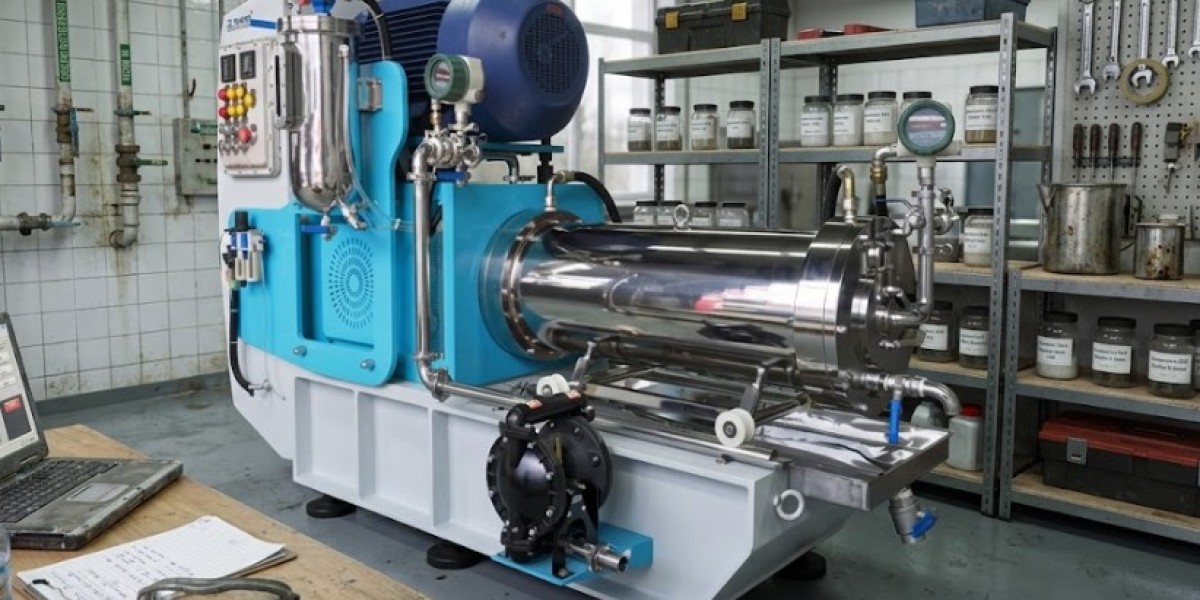

The rapid growth of electric vehicles (EVs), renewable energy storage, consumer electronics, and industrial energy systems has created an unprecedented demand for high-performance batteries. While battery chemistry often receives the most attention, the manufacturing process behind battery materials is equally important. One of the key factors influencing battery quality is the ability to achieve precise particle size reduction and uniform material dispersion.
This is where a bead mill for battery production becomes an indispensable piece of equipment. By producing finely dispersed and consistently sized particles, bead mills help manufacturers create stable battery slurries that directly contribute to better battery performance, longer service life, and improved production efficiency.
As a professional manufacturer of grinding and dispersion equipment, Rucca develops advanced bead mill solutions designed to meet the demanding requirements of modern battery material processing.
What Is a Bead Mill?
A bead mill is a high-efficiency grinding and dispersing machine that uses small grinding media to reduce particle size and create highly uniform material dispersions.
In battery manufacturing, bead mills are primarily used to process critical electrode materials, including cathode and anode powders. Through high-speed interaction between the grinding beads and the material, the mill breaks down particle agglomerates and produces a consistent particle size distribution.
This process is essential for preparing battery slurries with excellent stability and uniformity before electrode coating.
Why Particle Size Matters in Battery Production
The quality of battery materials has a direct impact on battery performance.
Smaller and more uniformly distributed particles provide several important advantages:
- Larger effective surface area for electrochemical reactions
- Improved conductivity
- Better slurry stability
- More uniform electrode coating
- Higher energy density
- Faster charging capability
- Longer cycle life
Conversely, inconsistent particle sizes can reduce battery efficiency, create coating defects, and negatively affect overall product quality.
A high-performance bead mill helps manufacturers maintain tight particle size control, ensuring consistent results from batch to batch.
Applications of Bead Mills in Battery Manufacturing
Modern battery production relies on bead milling technology throughout multiple stages of material preparation.
Lithium-Ion Battery Materials
Bead mills are widely used for grinding and dispersing cathode materials such as:
- Lithium iron phosphate (LFP)
- NCM (Nickel Cobalt Manganese)
- NCA materials
- Graphite anode materials
- Conductive additives
Uniform dispersion improves slurry quality and contributes to more stable battery performance.
Lead-Acid Battery Production
Although lead-acid batteries use different active materials, precise grinding and homogeneous mixing remain equally important.
Bead mills help produce consistent lead oxide slurries that improve electrode quality and battery reliability.
Solid-State Battery Development
As solid-state battery technology continues to advance, manufacturers require increasingly precise particle processing.
Bead mills are being adapted to process ceramic electrolytes, advanced conductive materials, and other next-generation battery components, supporting the development of safer and higher-energy-density batteries.
Advantages of Using a Bead Mill for Battery Production
Superior Grinding Efficiency
One of the primary benefits of modern bead mills is their ability to achieve ultra-fine particle sizes within relatively short processing times.
This high grinding efficiency increases production capacity while lowering manufacturing costs.
Uniform Particle Size Distribution
A narrow particle size distribution is essential for stable battery slurry preparation.
Advanced bead mills provide consistent grinding performance that minimizes oversized particles and material agglomeration, helping improve coating quality and battery consistency.
Excellent Dispersion Performance
Battery materials often contain nanoparticles and conductive additives that tend to cluster together.
A bead mill effectively disperses these materials, ensuring homogeneous slurry composition and improving electrode conductivity.
Flexible Material Processing
Modern bead mills can process a wide range of battery materials, making them suitable for both established and emerging battery technologies.
Applications include:
- Cathode materials
- Anode materials
- Conductive carbon
- Ceramic materials
- Functional additives
- Nanomaterials
This versatility makes bead mills valuable equipment for battery manufacturers with diverse production requirements.
Quality Control Through Advanced Grinding Technology
Consistent product quality is essential for large-scale battery manufacturing.
Modern bead mills incorporate intelligent monitoring systems that allow operators to precisely control key process parameters, including:
- Rotor speed
- Grinding time
- Temperature
- Material flow rate
- Energy consumption
Accurate process control helps maintain stable particle size distribution while reducing production variability.
The result is improved product consistency and more reliable battery performance.
Rucca's Advanced Bead Mill Solutions
As battery technologies continue to evolve, manufacturers require grinding equipment capable of meeting increasingly demanding production standards.
Rucca has focused on developing bead mills that combine high grinding efficiency, reliable operation, and intelligent process control.
Key advantages of Rucca bead mills include:
- High-energy grinding technology
- Excellent particle size control
- Stable continuous operation
- Efficient cooling systems
- Intelligent control and monitoring
- Low energy consumption
- Reduced maintenance requirements
These features enable battery manufacturers to achieve consistent slurry quality while improving production efficiency.
Supporting Sustainable Battery Manufacturing
Sustainability has become an important objective throughout the battery industry.
Modern bead mills contribute to greener manufacturing by:
- Reducing energy consumption
- Improving raw material utilization
- Minimizing production waste
- Supporting efficient continuous processing
- Lowering overall operating costs
Rucca designs its equipment with both productivity and environmental responsibility in mind, helping manufacturers achieve high-performance production while supporting sustainable manufacturing practices.
Choosing the Right Bead Mill for Battery Applications
Selecting the appropriate bead mill depends on several production factors, including:
- Material characteristics
- Required particle size
- Production capacity
- Slurry viscosity
- Cooling requirements
- Continuous or batch operation
- Automation level
Working with an experienced equipment manufacturer helps ensure that the selected bead mill matches the specific requirements of each battery production process.
Final Thoughts
As global demand for electric vehicles, renewable energy storage, and advanced electronics continues to grow, manufacturers face increasing pressure to produce higher-quality battery materials with greater efficiency and consistency.
A bead mill for battery production plays a vital role in achieving these objectives by delivering precise particle size reduction, excellent material dispersion, and stable slurry preparation. These capabilities directly influence battery performance, production efficiency, and long-term product reliability.
With advanced grinding technology, intelligent process control, and a commitment to continuous innovation, Rucca provides bead mill solutions that help battery manufacturers improve product quality while preparing for the future of energy storage. Whether producing lithium-ion batteries, lead-acid batteries, or next-generation solid-state batteries, investing in high-performance bead milling technology is a critical step toward building more efficient and reliable battery manufacturing processes.
https://www.ruccagroup.net/the-critical-role-of-advanced-battery-bead-mills.html